In the previous article, Why Medical Aesthetics Is Not Competitive Enough, I made this point:
From hyaluronic acid to collagen, from regenerative materials to biosynthetics — hundreds of products have launched, yet their names cluster around a handful of the same syllables: zhen, li, yan, su, ai, ti.
Chinese is a vast and profound language, with no shortage of poetry, resonance or spatial feeling, and yet a great many brands like to circle around the same few syllables — a tongue-twister peculiar to medical aesthetics.
None of those characters is wrong; several are genuinely lovely. Behind the loveliness, though, is a collective collapse of recognisability and memorability.
A successful product name is where brand equity begins. Its job is to be remembered, repeated and trusted. Sounding good and feeling upmarket are add-ons, not the core.
A good name usually has three basic qualities:
easy to read, easy to remember, and vivid.
It is encoded quickly in the mind as brand language, and it triggers feeling and association about the product automatically as it travels.
Put differently, a well-judged name is the market’s first impression of the brand.
Naming, of course, has never been a game of sudden inspiration and a brainstorm.
Producing something that dazzles the world is hard. Avoiding the awkwardness of blending into the crowd and being constantly mistaken for something else is not.
Naming does have method — logic, technique and aesthetics.
So today, let us talk about
the plain and rather scientific logic behind naming a brand.
*In this article, naming refers broadly to brand names, product-line names and product names.
Why a Chinese brand should also have an English name
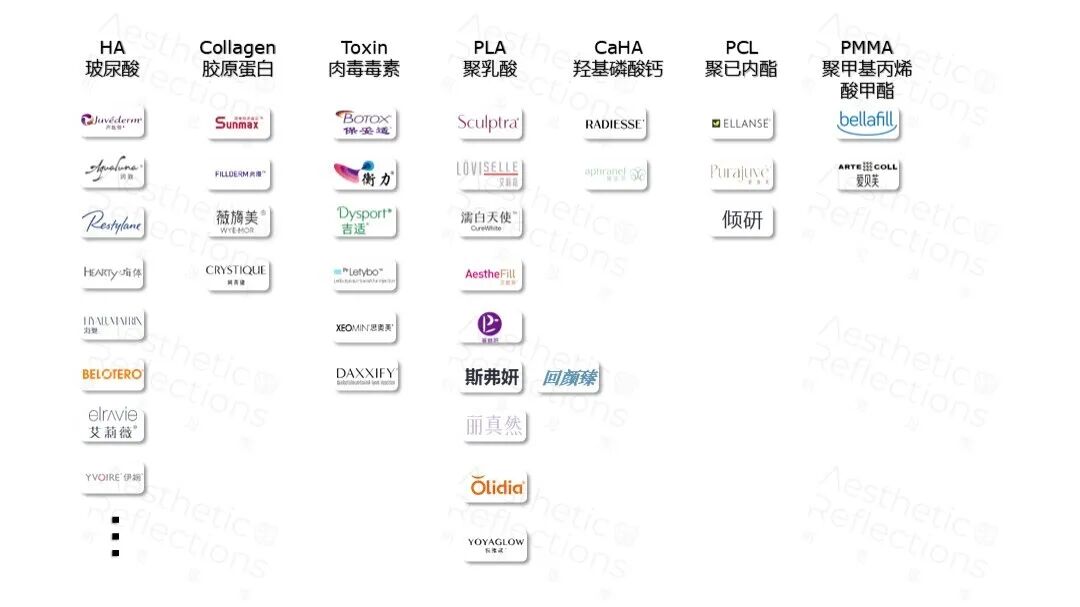
I have gathered the main product brands and logos across the upstream of medical aesthetics, and it is easy to see that the overwhelming majority use both Chinese and English versions.
A small number of domestic brands still have no matching English name.
In my view, even a brand that leads in Chinese should plan an English name alongside it. Not out of a taste for foreign polish, but for deeper reasons of brand strategy.
Internationalisation and a professional register
For most products that already hold a Class III certificate, internationalisation is becoming an irreversible trend.
Overseas sales, international congresses and published papers all require a consistent identifier for the product in English packaging, registration and communication.
And even for a product promoted only in China, a well-judged English name conveys a brand character that is professional, modern and internationally minded.
It makes the brand more trustworthy in the minds of physicians and consumers, and easier to place in an international context.
Visual beauty and design malleability
This point is often overlooked.
The lines and structure of English lend themselves naturally to visual design.
Compared with Chinese characters, Latin letters can be extended, reconstructed and fused with graphic elements freely, giving a brand more range and more recognisability across logo, packaging and advertising.
Something many people do not know: designing a Chinese typeface is far harder than designing a Latin one.
Not because one script is better than the other, but because of differences in stroke complexity and compositional rules.
An English name therefore tends to make the visual system more complete, and lets it carry more personality.
Integrated management of brand assets
A systematic English name helps a brand hold a consistent image globally, and also helps with domain registration, unified social-media handles, search optimisation and trademark protection as long-term assets.
An English name is not a decorative extra. It is infrastructure.
It gives a brand a sustainable underlying logic from design through communication, from visual identity through legal protection.
English name first, or Chinese name first?
I lean towards the English name first, on grounds of brand structure and how communication works.
On the logic of language
English is more economical in semantic structure, and its word formation — roots, affixes, compounds — is freer and leaves more room to extend.
An English name makes it easier to establish the brand’s semantic frame and the outline of its character first.
Chinese carries more cultural depth and poetry at the semantic level, and in naming it tends to play the role of expression rather than construction.
Put another way: the English name is the structural skeleton, the Chinese name is the cultural tissue.
Starting with English and then pairing a Chinese name to it makes it easier to find the resonance between meaning and culture precisely.
From the perspective of visual and brand design
Logo design usually leads with the English name.
That is because English is highly malleable visually — letters can be extended, recombined and abstracted, and combined more easily with graphic symbols and packaging design.
By comparison, in a relatively professional field like medical aesthetics, the paired Chinese typeface strengthens rapid recognition and recall, emotional identification and cultural grounding, while offering less room for design extension.
In one line
The English name determines a brand’s structure and how it travels;
the Chinese name gives the brand its emotion and its culture.
The two complement each other, but the direction is best set by English first.
Common logics of naming
When naming a brand, many people are limited from the outset by whether it sounds nice and whether the meaning is auspicious.
In fact, English naming has a mature taxonomy. Let me set out a few types common in medical aesthetics to make it concrete.
From there we can brainstorm freely and choose what suits our own brand character, material and product characteristics, and communication strategy.
Brandable names
Entirely original names that read fluently and distinctively, suited to brands seeking strong recognition and global reach.
Merz’s Xeomin® and Radiesse®, for example.
Xeomin (Merz): the construction carries a technical feel. “Xeo” suggests newness and innovation; “min” lends a sense of purity, echoing its positioning as a highly purified neurotoxin perfectly.
Radiesse (Merz): a syllabic structure soft with steel inside it. “Radi-” comes from radius, the bone base; “-esse” makes the whole sound light and feminine, matching an appeal built on structural support with a natural result.
Botox (Allergan): an entirely original word, concise and forceful. It contains “tox”, short for toxin, while the prefix “Bo” keeps it from sounding dangerous and makes it read as a brand code instead.
Compound words
Two words combined to create a new meaning — functional and recognisable at once, a common approach in technology and medicine.
Restylane (Galderma): evolved from “restore” plus “style” (line), holding science and beauty together.
Skinboosters (Galderma): “Skin” plus “Boosters”, expressing the core selling point of improving skin quality.
Juvederm (Allergan): “juvenile” plus “dermis”, strongly logical and semantically complete.
AestheFill: “Aesthetic” plus “Fill” — intuitive and professional, both scientific and easy to market.
Dysport (Ipsen): “dys-” (muscle) plus “sport” (movement, power) combined into a new meaning, both vivid and easy to spread.
Evocative names
Using imagery to suggest a product’s characteristics or its value.
Allergan’s Juvéderm® family, for instance, with Voluma®, Volbella® and Vollure® — the root “vol-” (volume) varied by prefix and suffix, conveying volume restoration, shaping and lift clearly.
Galderma’s Restylane® family: “re-” (again) plus “stylene” (style, line), evoking restored contours and a rebuilt youthful outline. Products within it — Refyne, Defyne, Contour — use English verbs and nouns directly to express redefinition and contouring.
Belotero (Merz): “belo” (beautiful, from Italian) plus the suffix “-tero”, elegant and international.
Ellansé (Sinclair): from the French élancer, to soar or spring upward, rich in European resonance and suggesting youth and lift.
Alternate spelling
Respelling a familiar word: highly individual, visually distinctive, easy to remember and pleasant to say.
Lyft (Galderma) alters the letters of “lift” slightly, expressing the full meaning of lift with more personality.
Sculptra (Galderma) comes from “sculpture” — a concise respelling that conveys shaping and regeneration directly.
Galderma’s product names really are the textbook cases of naming in this field.
What to watch out for when naming
- Cultural fit: avoid negative associations and cultural misreadings.
- Sound and rhythm: concise and easy to say, avoiding tongue-twisters and obscure characters.
- Trademark registrability: coined or suggestive names are easier to register successfully and to protect.
- Visual presentation: consider the visual balance on packaging, in the logo and on social platforms.
- The user’s view: the name is the entrance to the brand, so consider the cost of understanding it for clinic sales staff and for consumers.
- The time dimension: avoid chasing trending words, and leave the brand a full life cycle.
- Consistency across channels: check availability of the domain, the app name and social handles at the same time.
A systematic naming process
- Strategic positioning: be clear on the brand’s core message, target audience, differentiation and personality.
- Creative divergence: generate a large pool of candidates through keyword association, root combination, cultural imagery, and roots with affixes.
- Linguistic and legal screening: check for unfortunate homophones, cultural taboos and trademark conflicts.
- Consumer testing: test recall, preference and consistency of association.
- Implementation: settle the name, register the trademark, design the visual identity, secure the domain and write the communication language.
In closing: the name is the skeleton of a brand’s soul
A good name cannot simply be defined as one that sounds good. It is one that lets a brand be remembered, understood, trusted and repeated. It belongs not only to design or marketing but to strategy.
Plenty of owners in this industry have had their product names vetted by a feng-shui master.
Even so, I will say it again: naming a medical-aesthetics product is not mysticism. It is a science.
The process of naming is really the process of a brand finding its own language.
The moment the name is announced, it becomes the brand’s first sentence of self-introduction.
One last thing, a plea to the brand owners: please circulate your BI and VI widely — embed the standard files in your official social accounts, your website and your press materials, so that content co-creators can find them and work with them easily. Vector files are not confidential; they exist to make communication work. And if any brand owner sees their logo used incorrectly, please get in touch.