From hyaluronic acid to collagen to regenerative microspheres, more and more upstream manufacturers are entering the white-label business. Unlike traditional cosmetics OEM, the medical-aesthetics version behaves much more like tightly regulated medical-device manufacturing.
Upstream white-label arrangements tend to appear at a few distinct moments:
- Materials converge, sales hit a ceiling, capacity is under-used, in-house R&D is decent and new products are coming. Demand here mostly comes from large clinic chains that want their own brand presence, want to reduce the grind between older products, and want to hold or widen the price band.
- A new product launches to a cold reception well below forecast; under pressure the company cuts price or opens up white-labelling. Demand comes mostly from clinic chains looking to push cost down and clinic margin up.
- The category is already crowded with certificates and the company has not launched yet, cannot find product differentiation, has no brand advantage, lacks channel resources or team experience — so it enters via white-label from the outset. Demand here comes mainly from upstream distributors with established teams and channels.
So: does an upstream company need a white-label business at all? Is it a short-term or a long-term play? What purposes does it serve? Does a manufacturer have to build its own brand? Let me try to lay out the development logic and the commercial pros and cons of white-labelling in this industry.
Which kind of white-label logic applies in medical aesthetics?
- OEM
(Original Equipment Manufacturer) — the manufacturer produces on contract, the brand provides visual packaging design and marketing resources, and the registration certificate belongs to the manufacturer.
- CDMO
(Contract Development and Manufacturing Organization) — the brand is deeply involved in the product concept, formulation, submission packaging and labelling before registration is even applied for, and the factory helps complete registration and manufacture. The manufacturer holds not only the certificate and the capacity but also provides regulatory consulting, registration design, submission services and even joint development of some innovative formulations. Suited to strong brands that lack registration capability but want an exclusive product.
- ODM
(Original Design Manufacturer) — the brand supplies the design concept. But for medical-device products in this field, national regulation requires the holder of the registration certificate to be a certified manufacturer. And because the core ingredients, the formulation and the inner and outer packaging all sit inside the registration dossier, the brand cannot modify anything outside the registered conditions. At a stretch, all that is possible is selecting one specific presentation from among the registered variants and signing an exclusivity agreement for it.
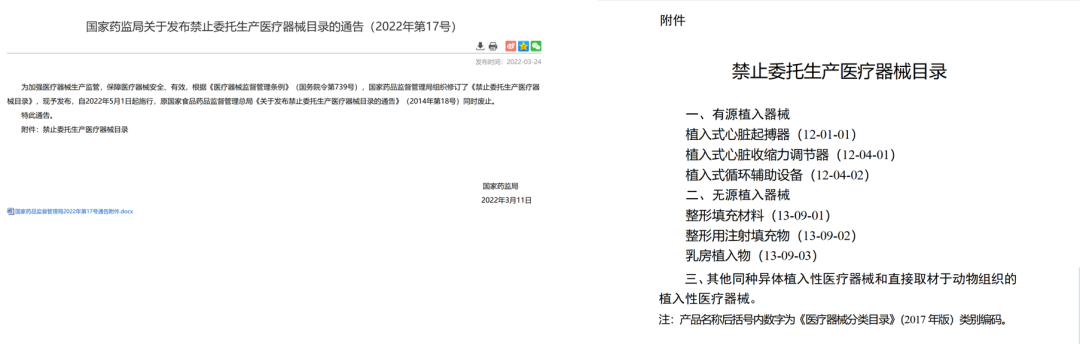
On 24 March 2022 the NMPA published its catalogue of medical devices for which contract manufacturing is prohibited. From 1 May 2022, injectable fillers for cosmetic use — including code 13-09-02 — were added to that list.
OEM versus CDMO in medical aesthetics:
| Item | OEM | CDMO |
|---|---|---|
| Ownership of the registration certificate | Held by the manufacturer | Manufacturer, or jointly developed and filed |
| Product design | Brand leads outer packaging visuals | Co-created; brand participates in formulation and registration dossier |
| Packaging changes | Must match the registration dossier | Customisable before registration, restricted after |
| Regulatory support | Usually none | Full-chain regulatory, registration and testing services |
| Degree of customisation | Low | High |
| Difficulty of the partnership | Low; can start quickly | High (heavy investment, long cycle) |
| Typical demand side | Clinic chains and channel companies with volume-price negotiating power | Strong brands with a platform for building their own brands |
| Examples | Meilai, Yestar / CMS Beauty | L’Oréal |
Whether OEM or CDMO, the brand in this field still has to carry the marketing investment, the consumer education and the brand building. The main difference between the two models is whether the manufacturer can provide regulatory support and upstream development capability.
How the main OEM manufacturers got here, and where they stand now
Since 2023, white-label hyaluronic acid brands such as Runluowei, Funiwei, Jierui, Aoxishi, Manfujia and ARSMO have come to market one after another, developed and manufactured by Bloomage Biotech, Haohai’s Shanghai Qisheng and Imeik respectively.
I tried to trace how these manufacturers’ businesses changed across 2022–2024, around the peak of hyaluronic acid contract manufacturing. None of them breaks out white-label revenue in its annual report, so what follows is inference from public data cross-checked between financials and media coverage:
Bloomage Biotech
Medical-aesthetics revenue reached RMB 555 million in 2024, up 43.6% year on year, while net profit fell 70%. Behind that sit falling prices in its established own-brand lines and rising marketing pressure — and it is also visible that OEM contributed close to nothing to net profit.
Haohai Biological
Medical-aesthetics revenue grew 95.5% in 2023 to RMB 602 million, then slowed markedly to 13% in 2024. As is well known, Haohai opened up hyaluronic acid white-labelling extensively in 2023 and growth followed. But in 2024 the pool of partner clinics was limited in scale, and several of them changed course and switched their push to another supplier’s hyaluronic acid. Clinic customers presumably want to keep their bargaining power strong, and with an undifferentiated product no stable binding relationship forms.
Imeik
Imeik’s results have been under pressure for several years. In 2023 revenue reached RMB 2.869 billion, up 47.99%; in 2024 growth was only 5.45%, with net profit attributable to shareholders up 5.33% and non-recurring-adjusted net profit up 2.2% — a marked slowdown from 47.08% in 2023.
Allgens Medical
Worth mentioning too is Allgens, the remarkable company focused on bone powder. Before compliant products existed in this niche, at its peak Allgens is said to have contract-manufactured for over a hundred bone-powder brands, with annual output in the hundreds of thousands of units — quite a moment.
But with the first CaHA approval in 2024 and tighter enforcement, this grey-area business was quickly affected. I gather the contract-manufacturing business had already been stopped earlier over some safety issues.
What the CDMO cases show
Jinbo Biological
In 2023 Jinbo’s revenue surged to RMB 780 million, roughly doubling year on year, with net profit around RMB 300 million, up nearly 175%. Its Weiyimei recombinant collagen lyophilised fibre was sold into more than 1,500 clinics and contributed over RMB 500 million of revenue on its own.
In 2024 total revenue reached RMB 1.443 billion, up 84.9%, with net profit attributable to shareholders of RMB 732 million, up 144.6%. Margins are extraordinary: 95% gross margin across the business, with the medical-device segment at RMB 1.254 billion, roughly 87% of the total.
In 2023 Jinbo provided manufacturing and registration support for L’Oréal’s SkinCeuticals brand and its injectable recombinant type III humanised collagen solution. Its own flagship Weiyimei® performs strongly and the SkinCeuticals product is a very small share of Jinbo’s business — so beyond the revenue itself, what the deal really did was lift the company’s standing and endorsement in the industry through a powerful CDMO partner’s brand.
And unlike the margin dilution typical of OEM, this contract work has not cost overall profitability. On the contrary, high-end registered products and technical exclusivity have produced a durable profit advantage.
Jinbo helped L’Oréal get a new product to market fast, successfully crossing over from supplying raw material for a cosmetics jar into medical aesthetics, and deepening the supply-chain bond between the two.
Mindray
Entered the market early by doing OEM work for overseas medical companies, gradually built its own R&D and registration capability, and now runs on both technology and brand — the model for a Chinese medical-device company going global.
Suzhou Meichuang
Focused on interventional implant materials and catheters, it plays a high-precision OEM and CDMO role in partnership with international brands, with technical barriers that create stickiness in global markets.
In closing
White-labelling is not one thing. It comes mainly in two forms: OEM and CDMO.
OEM is a stage-appropriate play given the resources you have. It is a tool, not a strategy. It can be a fulcrum for scaling volume quickly and a hidden risk of brand dilution at the same time. The barrier to entry keeps falling, partnership cycles are short, and while it dilutes margin it may not deliver the volume or channel efficiency to justify itself.
It suits companies in an exploratory, testing or resource-consolidation phase.
CDMO is usually led by companies with real strength, involves product customisation, joint registration development and regulatory alignment, and is a far more sustainable model with real brand-premium potential.
So when a company takes on white-label work, it should weigh it against its own resources and brand strategy:
is this about absorbing capacity, short-term sales and locking in channels — or about long-term product architecture and deep, exclusive integration?
More importantly, once a company has a longer-range plan, it has to ask: can the product be upgraded, and can the arrangement be converted into a brand?
Long-term competitiveness in this industry always comes back to building a brand moat of your own.