As approvals for new products accelerate, upstream medical-aesthetics companies are holding launch events in succession. Each chooses a different timetable, format and set of messages.
Some hold an event six months after receiving a registration certificate; others do so as soon as they can sell compliantly. Team readiness and strategy shape both the timing and the content.
Some brands favour one major national event in person. Others repeat regional launches across sales territories, while some begin online to reach a wider audience.
There is no universal timetable or format. Timing, location, the number of events and the choice between online and in person should reflect channel readiness, market objectives and available resources.
Is the event a declaration that sales have begun, a founder’s account of the journey, a display of policy and institutional support, or a presentation of scientific and clinical evidence? Is it the formal introduction of the product’s positioning, a setting for content production, or an occasion to bring partners together?
All of these appear at launch events. Putting them all on the same agenda without priorities does not make the event effective.
A launch event is one touchpoint in a broader go-to-market campaign. Its value depends on whether it advances commercialisation and leaves assets the company can use after the audience has gone home.
Planning should begin with business questions, not the venue, guest list, stage or running order. What problem must the event solve? Who is the target customer? What should attendees understand and do afterwards? Which brand assets can support later communication?
Only then can a company decide when to hold it, whom to invite, what to say, how to structure the programme, how many sessions to run and where to spend the budget.
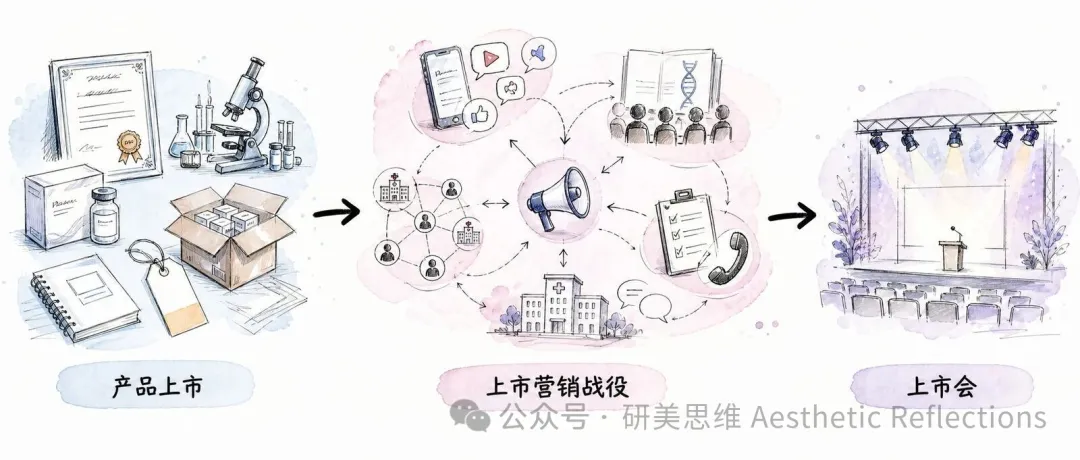
Distinguish the Product Launch, the Marketing Campaign and the Launch Event
Industry coverage calls several different milestones a ‘launch’: receiving a registration certificate, beginning distribution and sales, and holding a public event. In commercial terms, these are different steps.
A registration certificate is a major regulatory milestone. Once production, release, distribution and delivery requirements are met, the product can enter commercial sales. Legal market entry does not mean doctors understand and want to use it, clinics know how to offer it, channels can keep selling it, or consumers are ready to buy.
A product launch is a cross-functional commercialisation project. It covers market and customer insight, positioning and value proposition, compliant claims, clinical and technical evidence, pricing, channels and access, sales training, medical education and delivery, followed by adoption, repeat purchases and feedback. Go-to-market strategy requires departments to work together, track the market and revisit decisions. It cannot be reduced to a handoff from R&D and regulatory teams to Marketing and Sales, or to a public announcement.
A marketing campaign is a coordinated set of market-facing activities within that wider launch. It may include brand, social media, integrated or digital marketing, events and promotions. Each activity needs its own objective, audience, timescale, format and measure of success.
A launch event is one possible campaign activity. It can make an announcement, build a shared understanding, present evidence, convene important relationships and create a moment for communication. It is not compulsory. Weak positioning, untested clinical claims, unprepared sales teams or poor coordination can determine the outcome before the event begins; an impressive production cannot conceal or repair those gaps.
A company should time its launch event around the commercial milestone most worth amplifying.
That milestone might be certification, delivery of the first products, publication of a pivotal study, an emerging clinical consensus, initial clinic orders or a ready distribution network. The question is not how many months after certification to hold an event. It is whether the company has a mature message and whether the market is ready to act on it.
Define the Launch Objective, Then Choose Whom to Influence
In a medical-aesthetics product launch, market activities typically need to address these tasks:
First: announcing the product and presenting the corporate brand.
The company may need to announce that commercialisation has begun, explain the product’s technical direction and its capabilities, and show where it fits in the long term portfolio. This builds awareness and confidence among industry peers, media, partners and possibly investors.
Second: category education and medical education.
If the product addresses a poorly recognised clinical need or uses a new material, mechanism or technique, the priority is to explain the need, the relevant category and the path to use. That calls for evidence, methods, clear limits and a longer educational cycle.
Third: mobilising channels and activating sales.
Distributors and sales teams need coverage, training, target customer lists and early orders. Channel terms, pricing, sales tools, training and regional execution matter more to implementation than the event’s broad industry narrative.
Fourth: driving adoption and sell-through at clinics.
A distributor’s first purchase, or sell-in, is only the beginning. Repeat clinic orders depend on whether doctors can use the product, operations staff can explain it, consumers accept it, pricing makes sense, and treatment outcomes support repeat business. The goal is to move inventory into real care and service, creating sell-through.
Fifth: consumer education and end-market demand.
Consumer understanding of the category, recognition of the brand and willingness to seek a consultation increasingly affect sales. Consumer messaging, channels, platform rules, compliance limits and conversion paths differ from those used for clinics.
Media relations, public affairs, industry bodies and corporate reputation matter too. Coordinated with the launch, they can support industry standing, responsible development, innovation and public trust, although they cannot replace proof of the product’s value.
One Launch Event Should Have One Primary Objective
A launch event can serve several goals at the same time, but it is best to have only one priority and one or two secondary tasks. Primary tasks determine the core audience, content thread, budget priorities, and post-meeting actions; secondary tasks cannot undermine the thread.
Clinic owners may focus on positioning, pricing room, organisational commitment and returns. Doctors look at indications, mechanisms, technique, consistency and risk. Operations teams consider consumer understanding, treatment packaging and consultation. Procurement and Finance look at price, payment terms, supply and stock. Distributors assess regional opportunity, competition, manufacturer support and their own team investment.
If one event must simultaneously elevate the company, educate doctors, sign distributors, award credentials, generate consumer media coverage and manage government and press relations, each topic is likely to get only superficial attention. A long programme also makes it hard for different guests to stay engaged throughout.
A packed agenda is not evidence that the objective was met.

Format Follows Objectives and Resources
A national launch can concentrate a company’s best resources behind one market narrative. It can deliver a dense message and establish significant brand presence.
Its limits are equally clear: travel and accommodation cost more for distant guests, attendees have different interests, and one programme cannot address everyone’s questions in depth.
Several regional events may work better for education and conversion. Doctors, clinic structures, channel capability and competitors vary widely by region. Local events can address customer needs more closely and make training, demonstrations, trials and follow up visits easier.
An online launch is not simply a cheaper substitute for an in-person event. It demands even sharper information design. People at a venue can stay engaged through conversation, space and experience; online viewers will leave quickly unless they understand why the message matters to them.
An online-only launch works well for a formal announcement, broad reach and reusable content. If the product is straightforward, customers are dispersed, budgets are tight or a strong field sales team can follow up, more resources can go into the quality, reach and continued use of the content.
Companies need not choose just one format. They should build a combination that supports their particular objectives.
A limited budget is not the problem. Allocating resources without reference to the task is.
Content and Roles
The FAB model helps explain product value, but regulated medical-aesthetics products need a fourth element. A complete claim should cover:
• Feature: what the product is, including its materials, processes, structure and technical parameters.
• Advantage: how those features differ from existing options.
• Benefit: the practical value those differences create for doctors, clinics or consumers.
• Reason to Believe: the evidence behind the claim and the limits within which it applies.
Materials and specifications alone are not a full selling proposition. Explain what a parameter means for a doctor’s technique, treatment outcomes and consumer experience, and for a clinic’s offering and long term operation. Then identify whether each claim rests on registration materials, clinical studies, laboratory data, expert consensus or experience after launch.
Where that evidence exists, keep explaining and reinforcing it. Do not leave it on a single slide.
Positioning is more than an attractive slogan. It should say which customer the product serves, in what setting, which problem it solves, how it differs from existing options and what evidence supports the distinction.
Without those answers before the event, the stage can speak in two disconnected languages: Medical and R&D discuss mechanisms and studies, while Marketing talks about trends and concepts. Afterwards Sales still relies on price, relationships and vague claims. The event may be lively, yet leave no shared language the company can reuse and develop.
Some events consist of executive speeches and technical presentations, while the marketing director runs slides and arranges guests’ travel. Product strategy never actually appears on stage.
Evidence must be presented with professional restraint. A medical video that cites a study without its sample size, duration, design and source does not gain credibility merely because a medical director or prominent expert presents it. It may weaken doctors’ confidence in the product and the company’s medical capability.
Once the content is settled, choose the people best able to explain it clearly.

The Launch Event Concentrates Brand Touchpoints
A launch event is often a substantial marketing investment.
The venue, staging, lighting, travel, catering and entertainment all cost money. The experience on site also shapes how the brand is understood.
Medical aesthetics combines clinical expertise with a strong expectation of visual judgement. Customers in a premium market may be especially attentive to each interaction with the brand.
Luxury, jewellery and fashion brands offer useful lessons in managing those interactions. The point is not simply to spend more on the event.
Colour and naming matter, of course.
But they are neither the whole of brand management nor its most important part.
They are elements of brand identity, rather than the entirety of its value.
Why must brand touchpoints be managed especially carefully at a launch event?
Every interaction with a brand, by anyone and in any setting, can become a brand touchpoint.
An invitation creates a first impression. The guest list signals the market the product hopes to enter. At the venue, space, organisation and staff convey what the brand values. Expert presentations, clinical data, conversations with peers and practical support plans continually shape perceptions of its competence and credibility.
Afterwards, guests’ descriptions and posts, and the ways media, doctors and clinics pass on product information, create further touchpoints.
A launch event brings touchpoints that are normally spread across channels and months together in a few hours.
It can amplify a brand’s strengths, and expose its inconsistencies just as quickly.
An evidence-led product loses credibility if the event’s visual language is extravagant and disorderly.
A brand claiming a premium position is left with little beyond a premium price if its invitations, reception, content, materials and staff all feel careless.
When positioning, medical evidence, the setting, staff conduct and communication reinforce one another, a brand can feel credible and valuable without extravagant staging.
A launch is not an exercise in covering the venue with brand colours. It should turn the brand’s promise into details people can see, hear, experience and verify.
Return to the Original Purpose
Companies often judge launches by attendance, the prominence of guests, livestream views, media mentions and social posts. These show execution and reach; they do not alone prove an event worked. Nor do Xiaohongshu CPM or search volume alone show effective reach among the intended audience.
Return to the task the launch must accomplish. Choose its format and content around the product’s stage, target customer, budget and organisational capacity: a national event, regional events, an online announcement, a clinical consensus release, a first clinic launch, or no conventional event at all. More expensive venues and catering are not inherently more effective. Consistency across details tests a company’s ability to manage its brand.
When the lights go down, the market should know what problem the product solves, why its claims deserve trust and how to use or choose it. The company should have reserved resources for the education, sales, adoption and content that follow.
That is what a product launch should leave behind.