There is one set of numbers in this industry that every practitioner has heard. It is five years old and still circulating as legend — and not long ago, a version of the same story came round again.
In 2019, Frost & Sullivan published an international penetration benchmark. Measured as treatments per thousand people: Korea 82.4, the US 47.9, Brazil 42.8, Japan 29.1, China 20.8.
From 2021 onwards these figures were quoted over and over by virtually every sell-side house — Soochow, CICC, Sinolink — appearing in IPO prospectuses and in the deck at every roadshow and industry conference.
By November 2025, KPMG published an updated version at the China International Import Expo (Reshaping the Medical Aesthetics Landscape: Navigating China’s New Wave). The measure switched to people receiving medical-aesthetic services per thousand: Korea 161, the US 98, Brazil 91, Japan 51, China 32. The expression changed; the ranking did not, the logic did not, and the conclusion did not.
These numbers have carried the industry’s central narrative for five years, and are being asked to carry the capital story forward: penetration is low, the room is vast, the future is bright.
How many companies entered this field because of that prospect. How many investors staked everything on that one set of figures.
But is that really what a rational piece of industry analysis looks like?
Is Korea a fair benchmark?
IS KOREA A FAIR BENCHMARK
Before taking apart the denominator, there is a prior question: is benchmarking China’s penetration against Korea’s a fair comparison at all?
Korea’s gross national income per capita in 2024 was USD 36,624; China’s was around USD 12,000 — three times over. Income is only one side. What matters more is that the treatments and their prices differ enormously. Broadly, end prices for injectable and energy-based treatments in Korea run at only a third to a fifth of Chinese levels.
Behind those lower end prices sits another layer: a far lower cost of entry. Korea’s product approval threshold and timeline are not in the same league as China’s. Korea’s MFDS reviews a Class III device in roughly 145 working days, about seven months; in China, the full path from development to an NMPA Class III certificate routinely takes three years or more. That gap in registration cost and time directly determines how many products, of what kind, at what price, consumers in each market get to choose from. Korean consumers choose from newer technology at lower prices across a wider range of products; Chinese consumers face a narrower set of categories at higher prices.
Put plainly: Korea’s penetration is high because incomes are high, prices are low and choice is wide. All three conditions hold at once. In China, not one of them does. Benchmarking China’s 32 against Korea’s 161 and concluding that there is five times the headroom ignores two completely different price structures and two completely different levels of access.
What is hiding in the denominator
WHAT THE DENOMINATOR HIDES
Whether it is the Frost & Sullivan version or the KPMG one, the denominator is the total population: 1.4 billion.
In Korea and Japan, the distance between the reachable population and the total population is small. The denominator barely shrinks.
Brazil, meanwhile, is lifted by a large plastic-surgery physician base, a mature surgical industry, an intense body-management culture, and demand concentrated among urban middle-class and high-frequency consumers — together pushing treatments per thousand upwards.
China is different. A county resident earning two or three thousand a month and a white-collar worker in Shanghai go into the same denominator, and that distance is exactly what access to medical aesthetics is made of.
In the same report, KPMG offers a denominator much closer to the truth: China’s urban middle-income group already exceeds 400 million people, and is expected to reach 800 million within a decade.
Do the division with the report’s own data: around 23.5 million light medical-aesthetics consumers in 2023, set against a reachable base of 400 million, gives penetration of roughly 6%. Switch to the Deloitte and Allergan estimate on a reachable-population basis and 2019 comes out at 12% for China, 19% for the US, 28% for Korea. The gap narrows to a reasonable range — not the four or five times of “enormous potential”.
Four hundred million is under thirty per cent of the total population, so proportionally there is genuine room to grow. It is also more people than the US, Japan and Korea combined — on the face of it, the largest reachable base in the world. Except that, within that base, demand still concentrates on those who can afford it, and price is why.
Industry surveys over the past two years show existing consumers spending between RMB 10,000 and 60,000 a year, with over thirty per cent spending RMB 20,000 to 40,000. That is a clearly high-spending band. The market is genuinely not saturated by demand; what stands at the door is price, and a shortage of qualified aesthetic physicians in the numbers the demand would require (a story for another day).
Falling prices worked — but the engine is slowing
WHEN AFFORDABILITY SLOWS
From the KPMG report: “Between 2018 and 2023, light medical aesthetics grew from RMB 50.2 billion to RMB 146 billion, and consumers from 7.4 million to 23.5 million.” Threefold in five years.
Look closer and that growth came from treatments priced in the hundreds: IPL photorejuvenation, skin boosters. They spread down the income ladder and did genuinely reach people previously priced out.
Lower prices, broader reach. Over the past five years, that was the main engine of growth in the Chinese consumer base.
That engine is now running out of breath. The macro data for 2026 shows it:
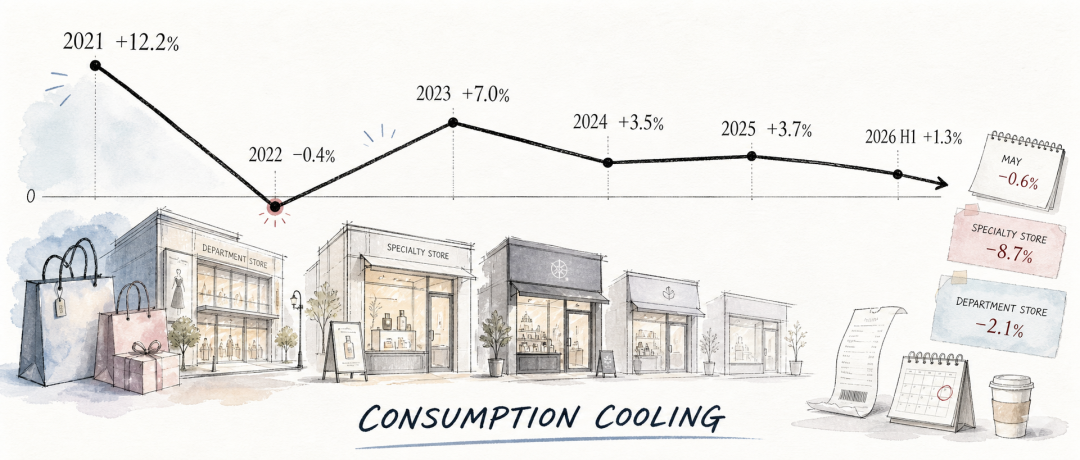
Total retail sales for 2025 came in at RMB 50.1 trillion, up 3.7%. Line up the past five years and it is clearer still: 2021 +12.2%, 2022 −0.4%, 2023 +7.0%, 2024 +3.5%, 2025 +3.7%. Growth has fallen from double digits to the low single digits, and the post-2022 rebound (+7.0% in 2023) was mostly a low-base effect; 2024 and 2025 are back to flatlining around 3.5%. The first half of 2026 dropped sharply to +1.3% (National Bureau of Statistics, 15 July), with May down 0.6% year on year. Brand-store retail fell 8.7%, department stores 2.1%.
The savings rate has climbed from its pre-pandemic level to a record 32.4%, and excess household deposits have reached RMB 57 trillion. In the third quarter of 2025, per-capita household nominal consumption turned negative at an annualised −2.9% quarter on quarter. The money is being kept, not spent: people do not dare, and do not want to.
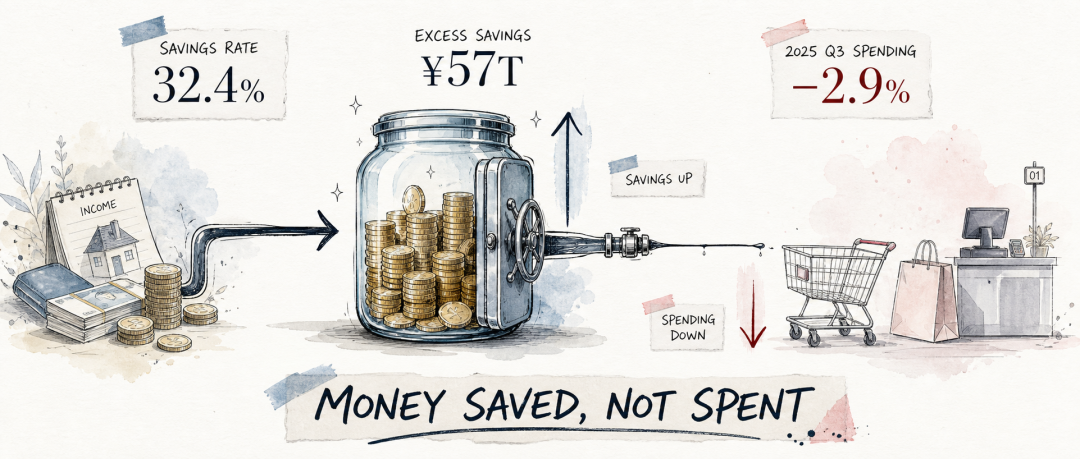
Willingness to spend is at its weakest point in five years.
In 2024, working on the China launch strategy for a regenerative injectable, I used China Merchants Bank Research’s retail-sales forecasts together with McKinsey’s consumer-confidence heat map (60 groups, split by city tier × income × generation) to screen for a target audience. I settled on four: high-income Gen Z in tier-one cities, mid-income 26–37s in tier-one cities, millennials in tier-two cities, and Gen X in tier-two cities. On the heat map they were relatively optimistic about the macro picture and willing to spend. On that basis I positioned the product between affordable luxury and mid-luxury.
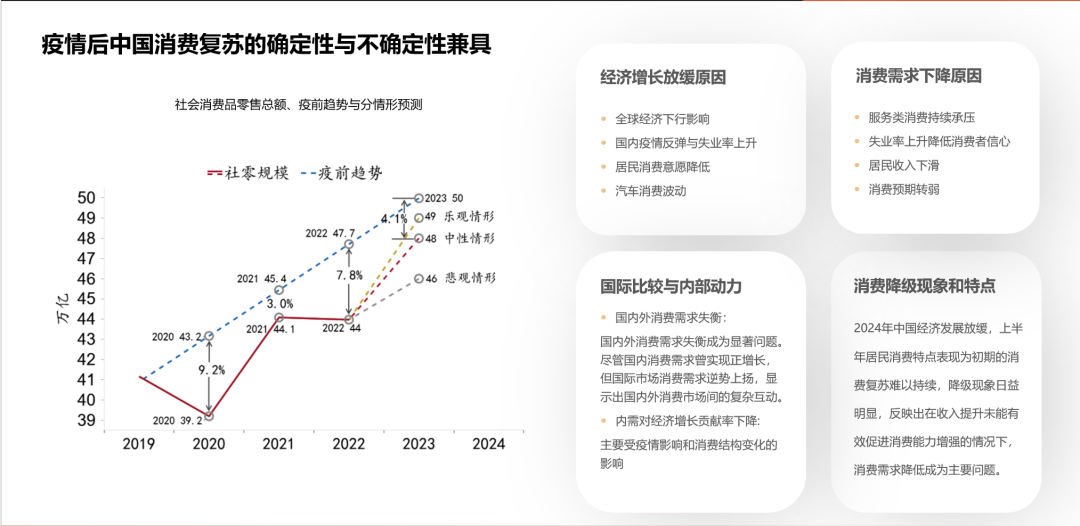
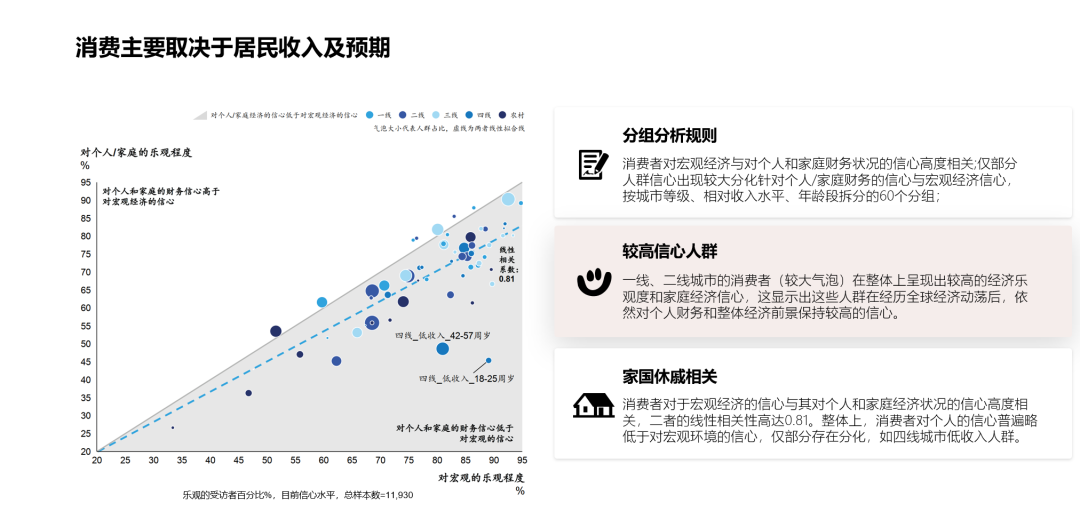
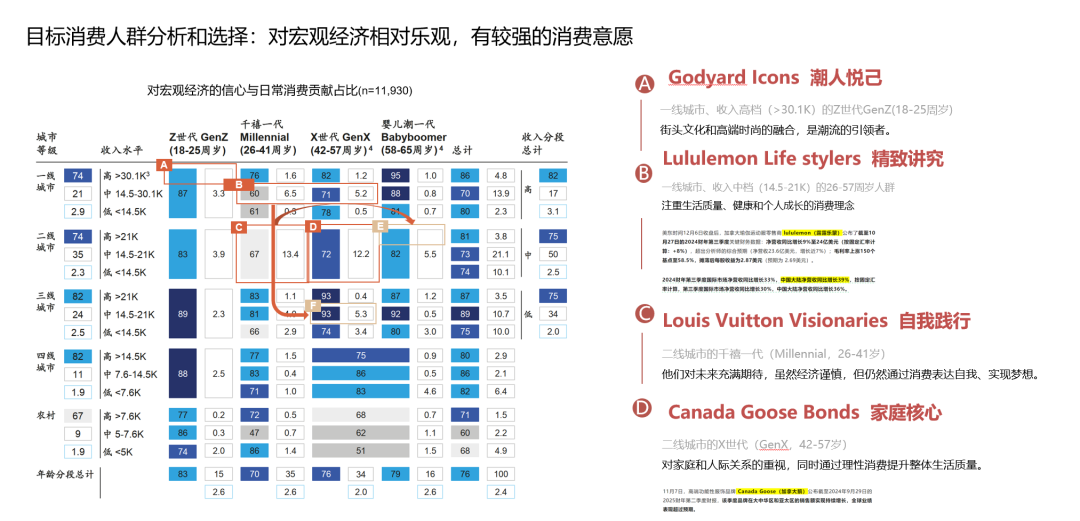
Two years on, how have those four groups fared?
McKinsey’s May 2025 report (Chinese Consumption Amid the New Reality; 17,000+ consumers, 108 demographic groups) offers one key finding: the link between confidence and spending is loosening. Consumers increasingly decide by their own assets and actual income, and macro confidence has less hold over what they do.
Confidence among high-income urban consumers has fallen, yet their willingness to spend day to day rose slightly, by 2.6% — they are pursuing personal satisfaction and will draw on savings to protect their quality of life. The first two groups I had settled on, high-income Gen Z and mid-income 26–37s in tier-one cities, are still there, and their spending on treatments may prove more resilient than the consumer confidence index suggests.
The other two — the 26 to 57 year-olds in tier-two cities — are receding. McKinsey notes the sharpest fall in confidence among lower-income millennials in tier-one and tier-two cities, driven by job insecurity and shrinking assets.
The conclusion: the core consumer base has not collapsed, but it is not expanding either. Meanwhile the number of product lines coming from upstream has doubled and tripled over the past two years.
Why the business has become so hard to make money in
WHY MONETIZATION FEELS HARDER
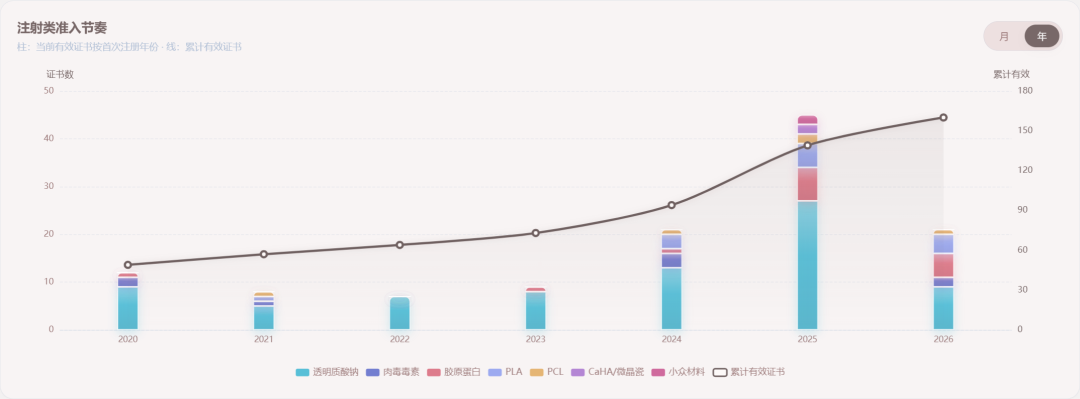
At the macro level: China’s total medical-aesthetics market ran to roughly RMB 364 billion in 2025, with light medical aesthetics at 53.3% and still rising. But growth is slowing while entrants multiply. More than 18,000 licensed clinics, 160 compliant product registration certificates — upstream supply is expanding far faster than demand. The pie has not shrunk. Each slice of it has.
What is actually fatal, though, sits at the level of value. Most companies lack the ability to give the market confidence in what something is worth.
As everyone knows, price is the only one of the four Ps that produces profit directly; the other three spend money. So everyone wants to price high.
But pricing comes in three orientations: cost, competition and value.
In practice, most companies have done no pricing analysis at all and have no pricing strategy. Whatever the other side charges, I will charge something close.
On the competitive orientation, even the basic definition of a competitor is left unclear. Following the market means handing pricing power to the market — and that is the breeding ground of a price war.
On the value orientation, the price has to be anchored to what the customer perceives it to be worth. It is the only one of the three that can support a premium, and the hardest, because it requires the customer to feel what you are worth: how much your target group is willing to pay for your product. And that differentiation in value has to be perceptible at every single touchpoint connected to the product and the brand.
How many brands can do that today? The overwhelming majority are caught wanting to charge a high price while being unable to articulate the value — and so end up locked in by the clinic’s consumables ratio.
Under a hard consumables-ratio KPI, a product that conveys a sense of value has more opportunity than ever, and a me-too product is finished. That, of course, also tests whether the clinic can tell the difference.
In closing
FINAL NOTE
The Chinese market does not hold that much potential, and each share of it is getting smaller and harder to win. The macro picture is decelerating, confidence is at the bottom, supply is inflating, the price war is intensifying.
The addressable market is in fact far smaller than the one imagined out of 1.4 billion potential consumers. It is large, concentrated, expensive — and its growth comes with conditions.
Penetration alone says nothing about real potential. Every increment of growth requires income, price, supply and consumer confidence to move together.
But nor is China’s market too small to be worth the trouble. A reachable base of 400 million people is still an absolute scale few countries can offer. The core audience’s spending has held up; the window for differentiation upstream is nowhere near closed. This market is large enough to support genuinely capable companies, and limited enough that it cannot hold everybody’s growth story.