Bombarded by market noise every day, and hearing the competitive pressure in every conversation with a business head, I always start with the numbers — industry data, competitor data, and the company’s own.
The market moves fast and the registration certificates keep piling up, but the industry is not necessarily getting any clearer.
What actually deserves attention is not simply “who got approved”, but the market structure and the trends forming behind those approvals — and where the remaining openings are.
From back-end data collection to verification against official NMPA records, to analysis, to the front-end going live — from Claude Code to Codex. Credit where it is due: this is what the current pace of AI development makes possible.
Deeply satisfying to build (though there is plenty to sigh about behind the scenes). Given the state of data quality in domestic media coverage and of corporate GEO practice, I scraped a large volume of material and found missing or incorrect certificate numbers, old certificates with new indications counted as new approvals, vague descriptions of overseas indication approvals, and much more — every one of which had to be untangled and verified.
All right, engineer steps back, product manager steps up.
The visible change in China’s upstream medical-aesthetics sector these past few years is not only which categories and materials run hot or cold — regulatory access has itself become part of the competition.
Even today, when I look at certain products and certain markets I still factor in Class II devices and products working the edges of their indications. But across almost all of the major markets, compliance is now the threshold. It defines the current structure and the future of the market: a clear registration pathway, indications that are specific enough, and whether a company can turn a certificate into a market position it can actually sustain.
This video is more than a good-looking dashboard. I tried to put the 176 records, 93 companies and 7 core categories of China’s “materials and products register” into a single view — to see what structure and what trends the compliant Chinese medical-aesthetics market is actually showing at the level of company, product, material and indication, and what openings that reveals.
When a product enters the market, or prepares to register, the real question is whether it is entering a high-frequency market or a small-volume, high-education-cost one; whether it faces mature competition over installed demand, or an early-stage category where the rules are still being written.
Overview
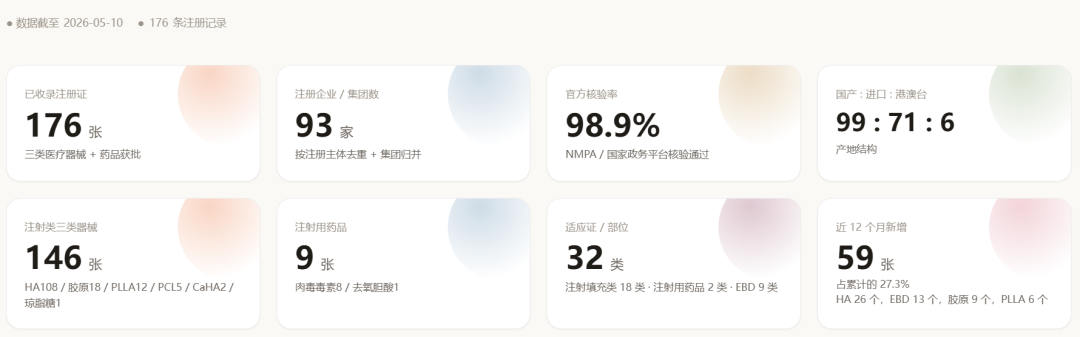
As of today, 176 registration certificates have been granted across Class III medical-aesthetics devices and drugs, covering 93 companies and groups after deduplication, with a 98.9% verification rate against official NMPA records. (Yes, you read that correctly — even where a company has announced an approval and the media has reported it, there are cases the NMPA site still does not show. Call it lag; I still treat NMPA data as authoritative and re-verify on a regular cycle.)
By certificate count, the domestic : imported : Hong Kong-Macau-Taiwan split is 99 : 71 : 6.
Of these, 146 are injectables and 9 are drugs, spanning 32 indication and treatment-area categories; the past 12 months account for 27.3% of everything currently on the market.
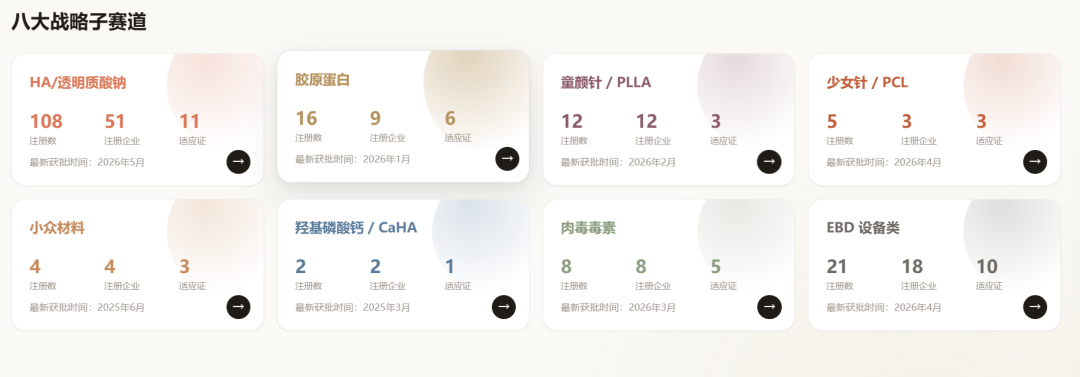
Each of the 8 strategic sub-categories tells its own story. HA is long-tail competition inside a large market; EBD is fragmented competition along a device pathway; PLLA and botulinum toxin look more like land-grab competition, one certificate per player. A hot small category is not the same thing as a mature market.
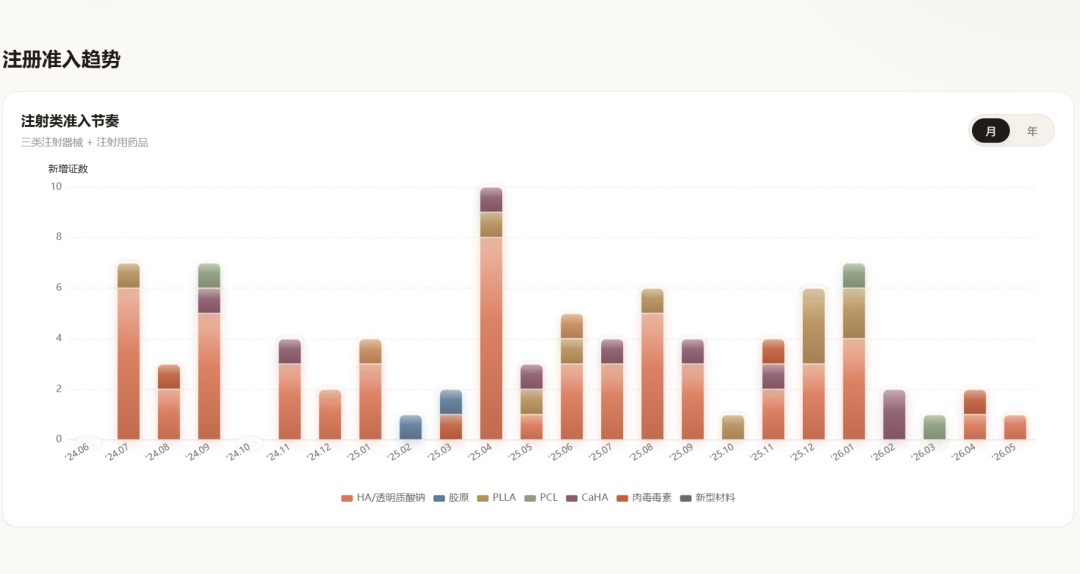
April 2025 marked the start of the surge — a hundred flowers blooming. Hyaluronic acid, collagen and PLLA saw new certificates or new indication approvals almost every month.
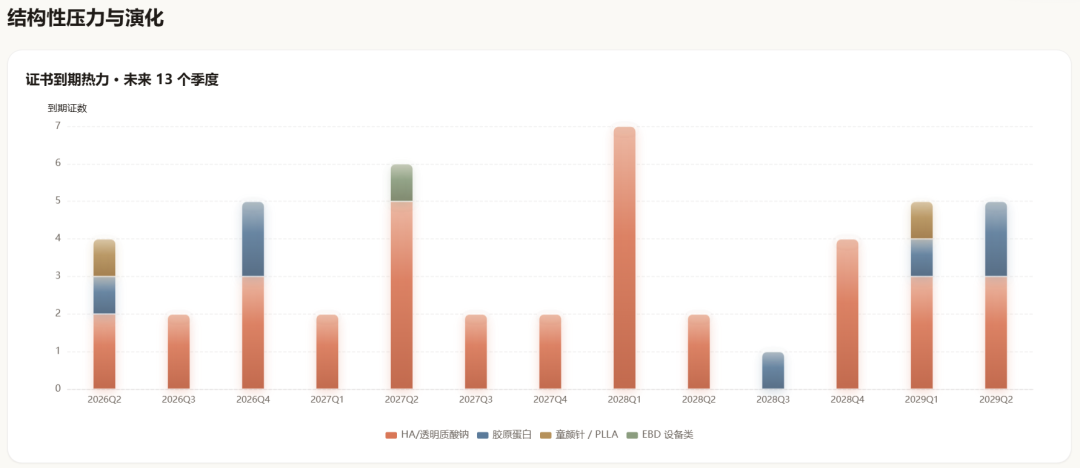
Certificates have a lifecycle, and that creates commercial pressure. Over the next 13 quarters, expiry pressure is concentrated in HA: 7 certificates expire in Q1 2028, 6 in Q2 2027, and 5 each in Q4 2026, Q1 2029 and Q2 2029.
In a mature category you cannot look only at new approvals. Renewals, indication extensions and the market maintenance of older products all matter.
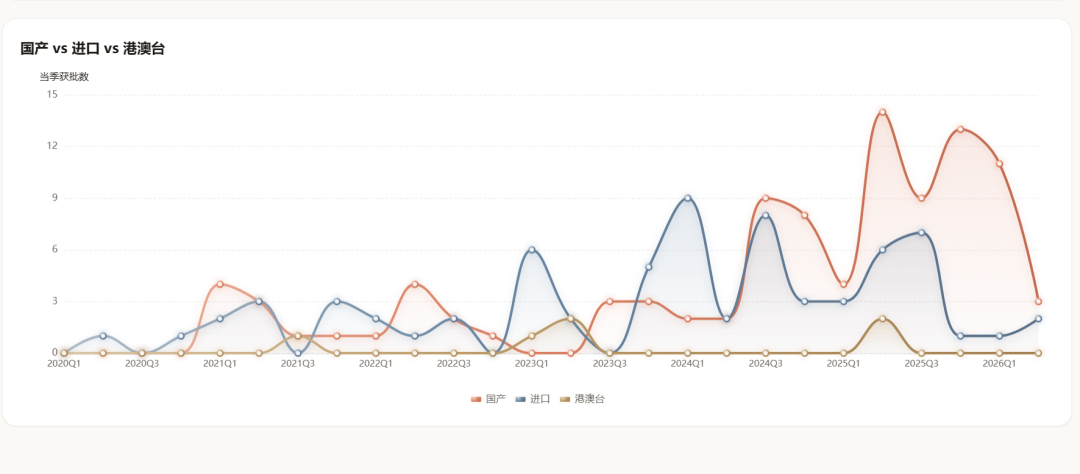
A market once dominated by imported products was decisively overtaken by domestic players from Q3 2024 onward. You can feel the pressure the multinationals are under in the recent leadership churn and performance at several of them.
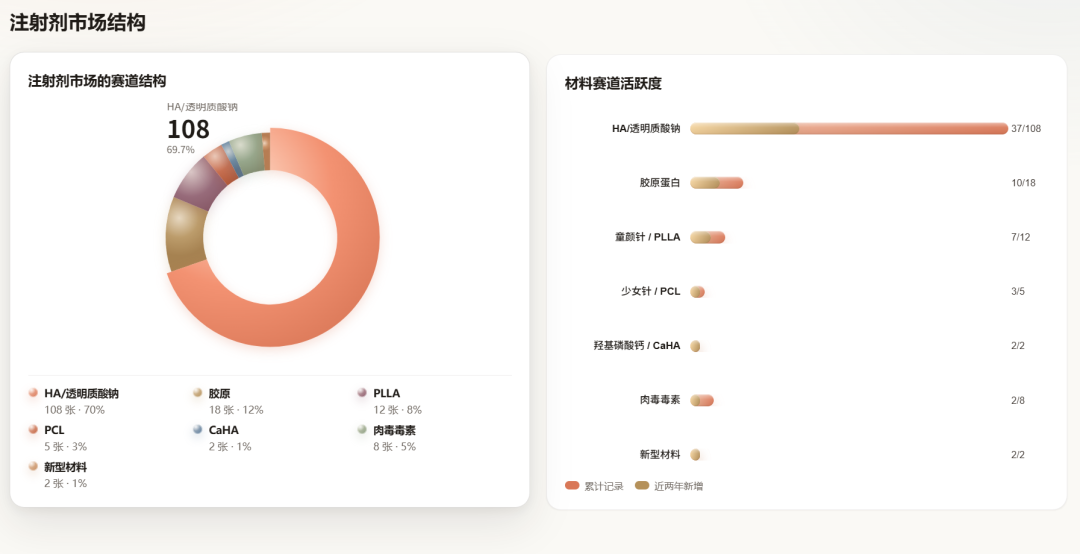
Injectables are the busiest arena everywhere in the world, and over the past two years China has caught up with — and in some newer materials moved ahead of — the global injectables landscape.
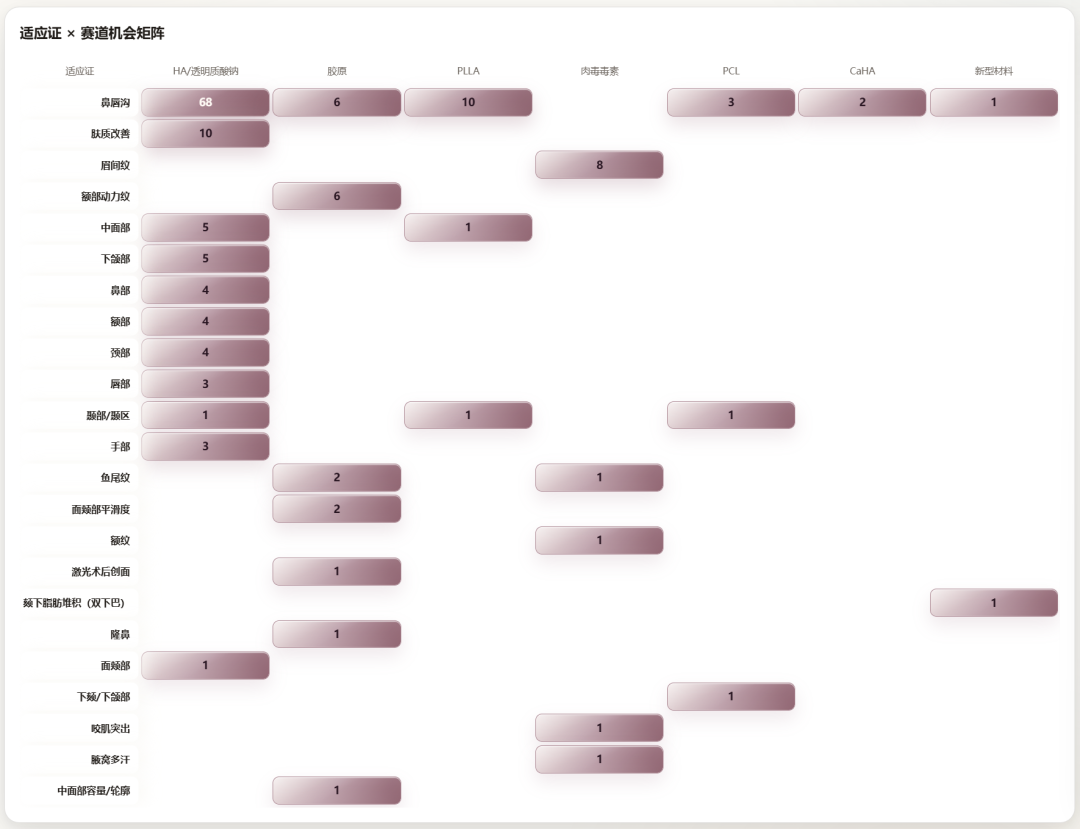
The nasolabial fold remains the most crowded battlefield, with 89 records in total. Of those, 68 are HA / sodium hyaluronate, 10 PLLA, 6 animal-derived collagen, 3 PCL and 2 CaHA. Skin-quality improvement sits mostly with HA, glabellar lines mostly with botulinum toxin type A, and dynamic forehead lines increasingly with collagen. For many new materials the first stop is still the nasolabial fold — and from a regulatory standpoint, creating genuinely new product value in a long-worked treatment area is an enormous challenge.
The real opportunity is not finding an empty cell on the grid, but working out why that cell is empty. Is the patient population too small? Is clinical need insufficient? Is the regulatory pathway still unclear? Is physician education too expensive? Or is it simply a corner nobody has noticed yet?
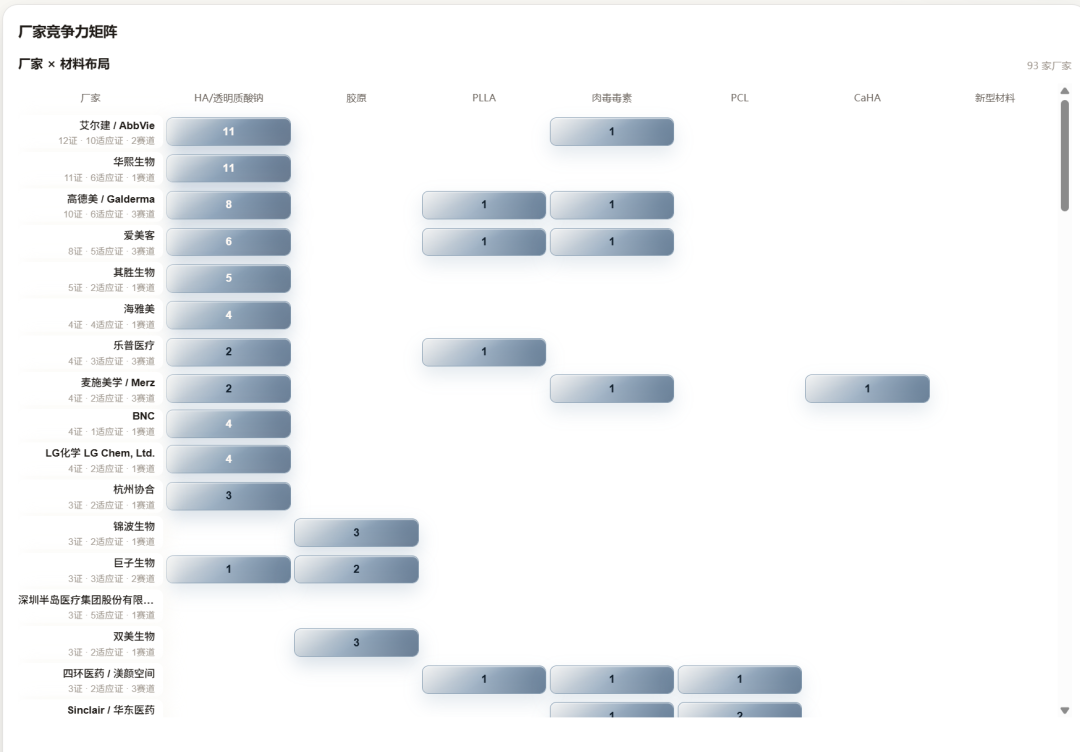
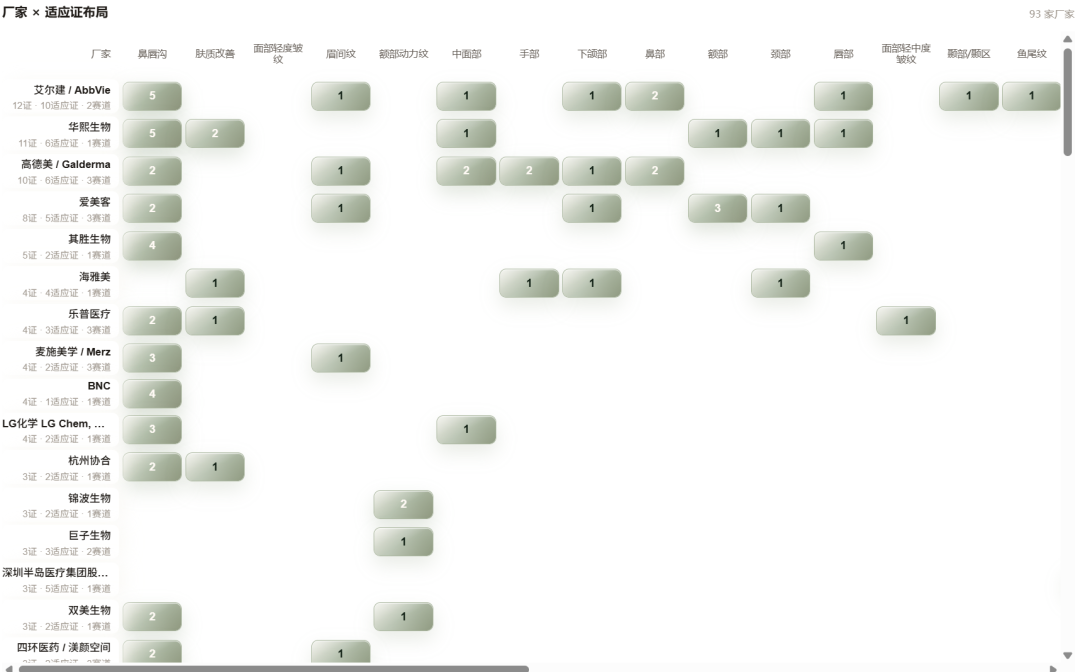
These two charts tell the same story at different levels of resolution.
Too much to cover, so only the front runners. The companies holding three material categories are visibly competitive today and will stay that way. The interplay of certificates, indications and category breadth rewards a close read: volume on a single dimension does not equal the strongest competitive position. In fact the companies holding a single category with a single product — small, sharp outfits — are holding a very good hand, provided their commercial capability keeps up.
HA is a mature category, and the one under the most pressure
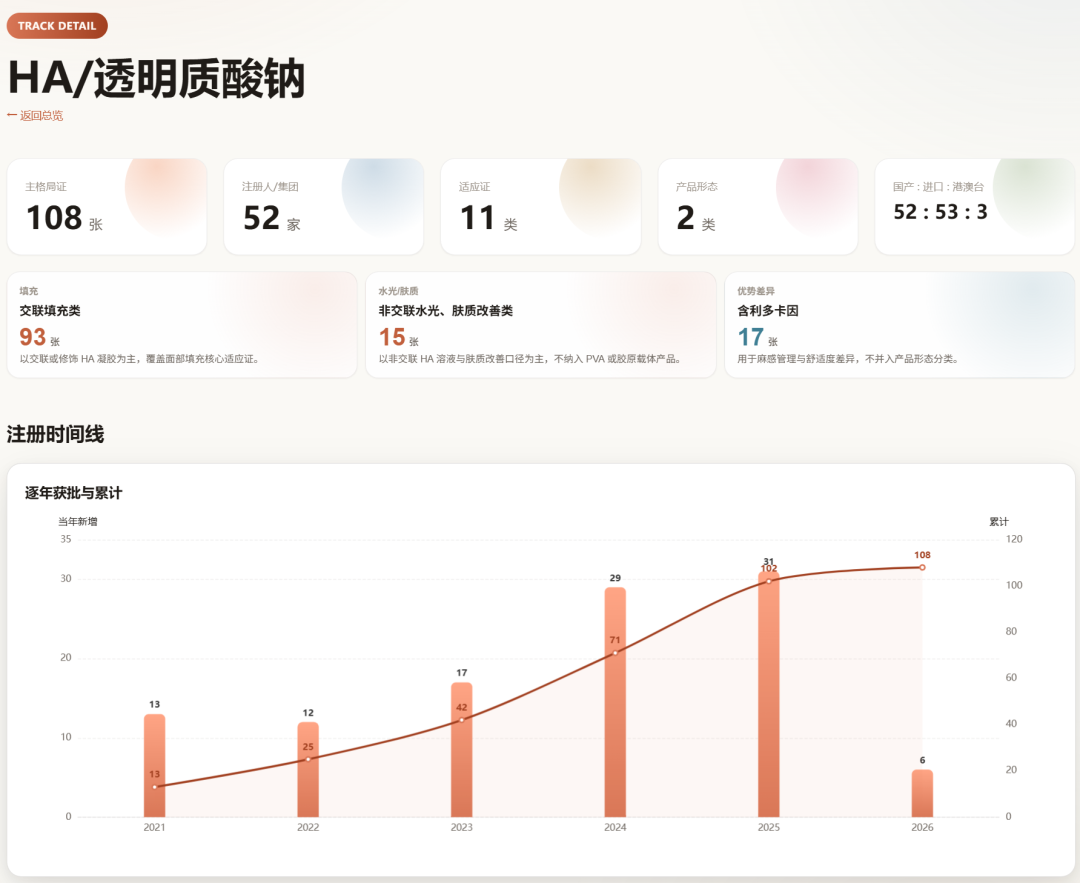
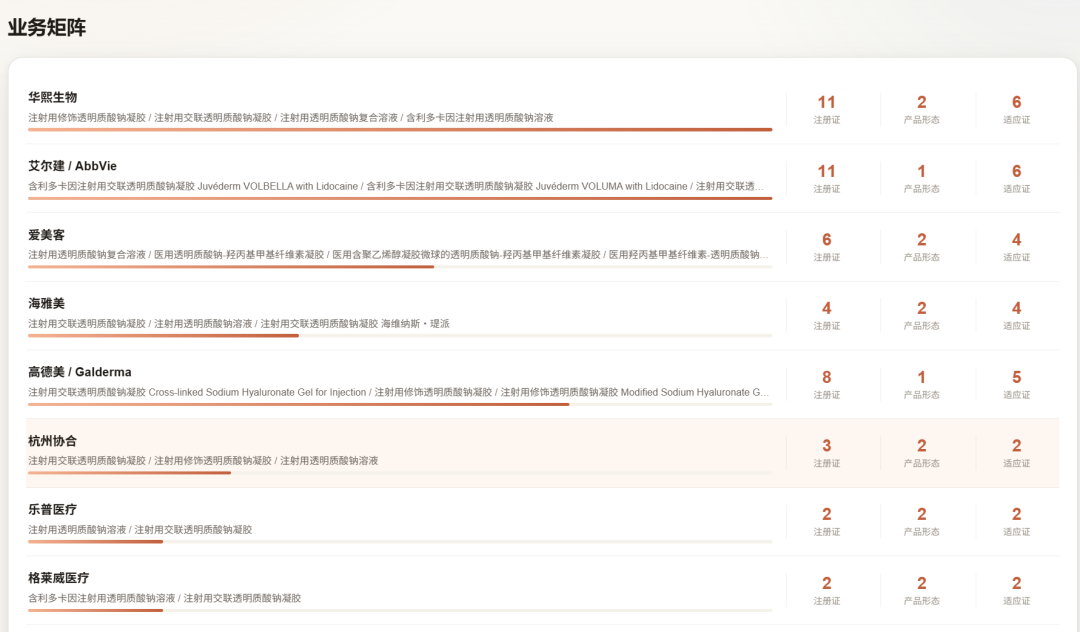
On data density alone, HA remains the most mature, most crowded and most representative category of the commercial reality facing China’s upstream medical aesthetics.
108 records, 51 companies. It holds both the long-accumulated equity of established brands and a steady stream of new domestic entrants; both cross-linked fillers and finer-grained formats such as non-cross-linked skin boosters.
Without a clear indication story, a defined product format and the ability to govern its channels, an HA certificate very easily becomes nothing more than an entry ticket to a price war.
Collagen
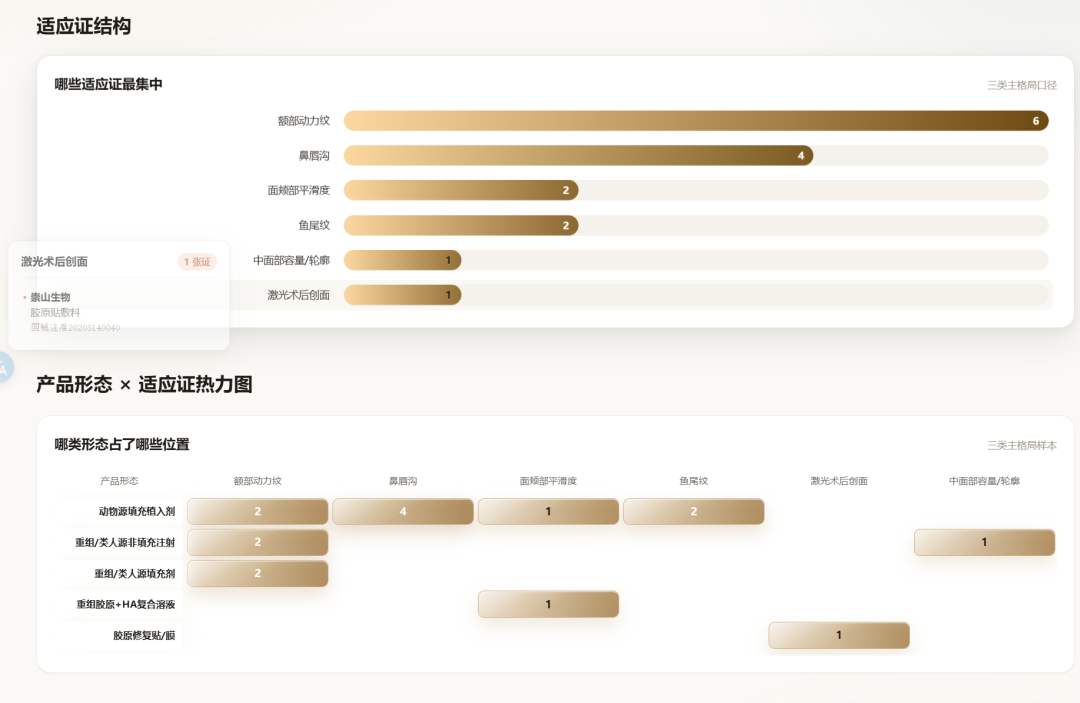
Collagen classification is intricate. Functionally it splits into filling and skin boosting; by format there are gels, solutions and even patches; by treatment area it is evenly spread. The category has plenty of certificates, but you can see that players in each niche have a genuine product-differentiation story to tell.
There is more I will not go into here — so, a short advertisement.
Every sub-category has its own detailed analysis, and all data is verified against the official NMPA site. The analytical lenses and classification logic are being refined continuously, and the full system is being prepared for launch as a commercial-grade product. If this is useful to you, get in touch — we offer customised industry and company work, updated reports and training.
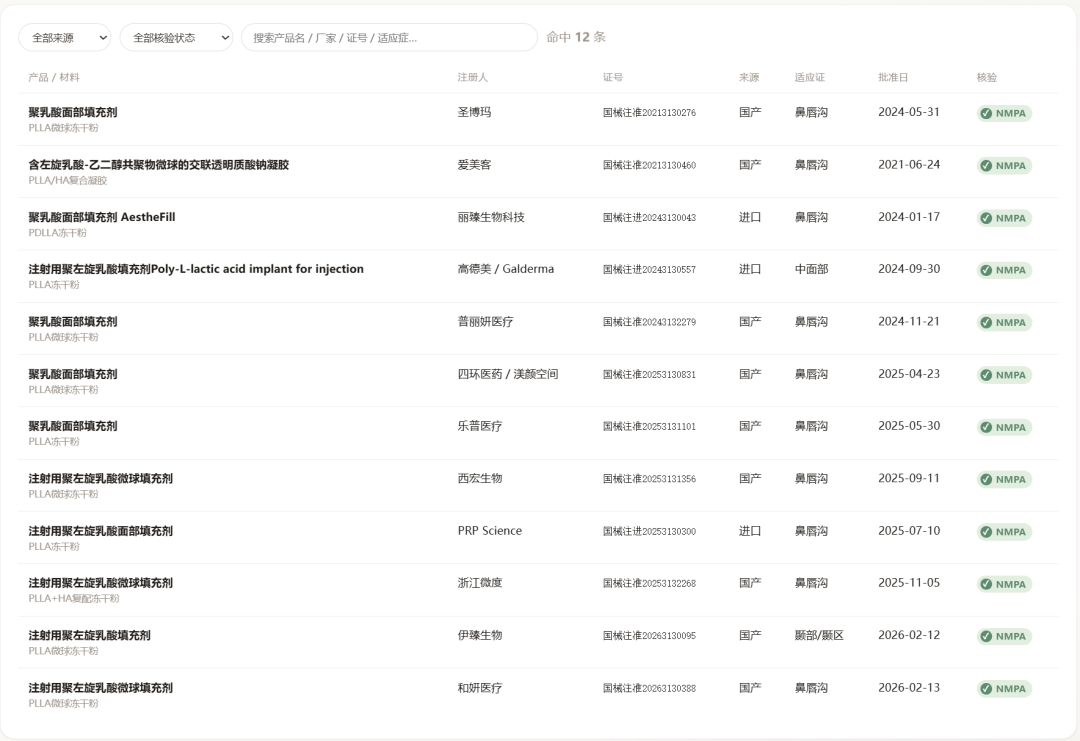
A registration certificate is the threshold the industry crosses toward proper regulation. It is not a guarantee of commercial success.
What a tool like this can do is help us judge a little less by feel and observe a little more by structure; get pulled along a little less by any single hot topic, and look back at the parts from the whole a little more often.
That is the value I want Aesthetic Reflections to bring.
Data source: Aesthetic Reflections’ internal dataset, “China Medical Aesthetics Market Access Landscape”; the current front-end view was generated on 2026-05-10.