I have been vibe coding my way through an analysis of the competitive landscape in medical aesthetics, and it is becoming genuinely hard to define what a pure upstream medical-aesthetics company even is any more.
More and more companies from adjacent industries are adding medical aesthetics as a new business line. Some of the leading upstream players are broadening their portfolios through capital as much as through R&D and manufacturing. And certain investors are very visibly pouring into the category, building positions across several pipelines at once.
Here is what I have observed about how capital is shaping this market.
1. What story is Chinese medical-aesthetics capital telling?
2. Once an upstream company is tied to capital, where can that end up?
3. How do venture-funded companies behave differently in the market from companies built on their own cash?
What capital is doing in the upstream market
Observation 1 — The total is shrinking, but within medical aesthetics it is really a reallocation
In aggregate, primary-market investment into medical aesthetics narrowly defined (excluding cosmetics, skincare and clinic services) has clearly contracted over the past few years. Chinese medical-aesthetics primary-market financing peaked at roughly RMB 2.374 billion in 2018, a ten-year high; in all of 2024 there were just three deals totalling RMB 150 million [1].
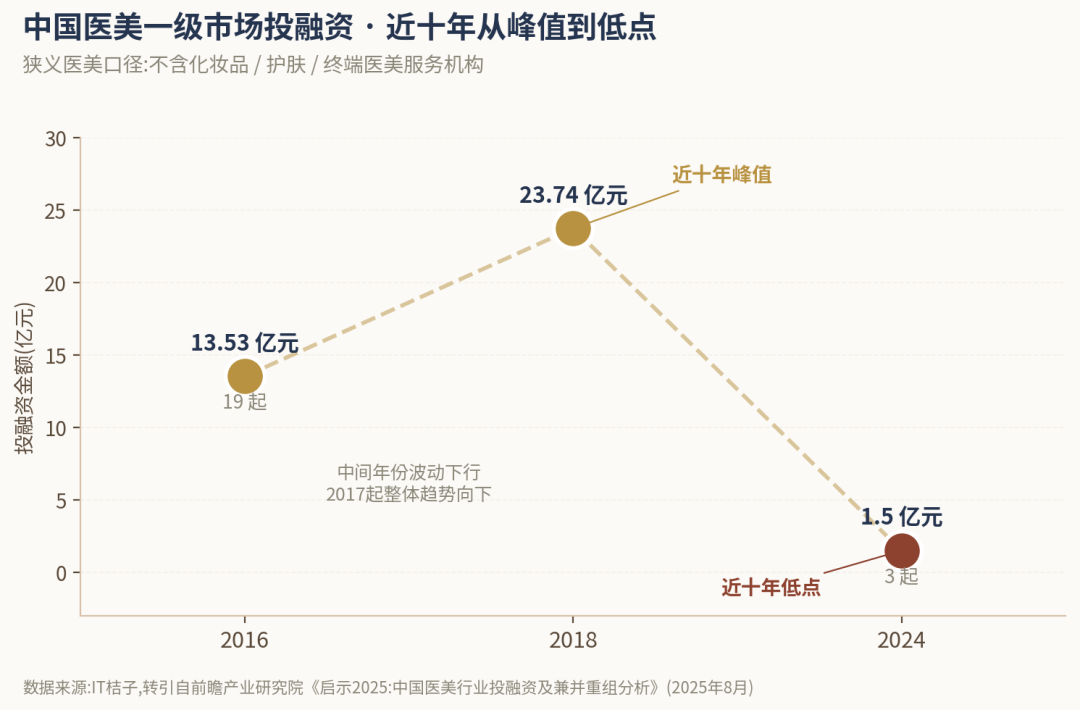
Different definitions produce different numbers. Vcbeat Intelligence uses a wider frame and counts 30 financing rounds in 2024 totalling more than RMB 1.1 billion — slightly warmer than 2023, not colder [2].
The two data sets do not contradict each other. The first counts upstream medical-aesthetics companies proper; the second uses a broader definition.
Whichever frame you use, the trend is the same: fewer rounds, with larger cheques concentrating into a handful of names, and the industry has taken on a clear barbell shape.
At one end sit early-stage projects. Seed, angel and Series A money is still flowing, though not in large amounts — capital is buying category optionality at a relatively cheap price.
At the other end sit mature leaders: the small number of companies that already hold registration certificates, can convert revenue, or are close to listing. They still attract large cheques.
The middle — Series B and C companies — is in the most awkward position of all. Revenue has not arrived yet, so they have to keep telling a story, and each new round is harder than the last.
Observation 2 — Category preference has moved from filling to regeneration and recombinant materials
In the early years capital was obsessed with hyaluronic acid; Imeik and Bloomage laid down the first generation of medical-aesthetics capital narrative. Today all three of the old guard trade more than 80% below their highs.
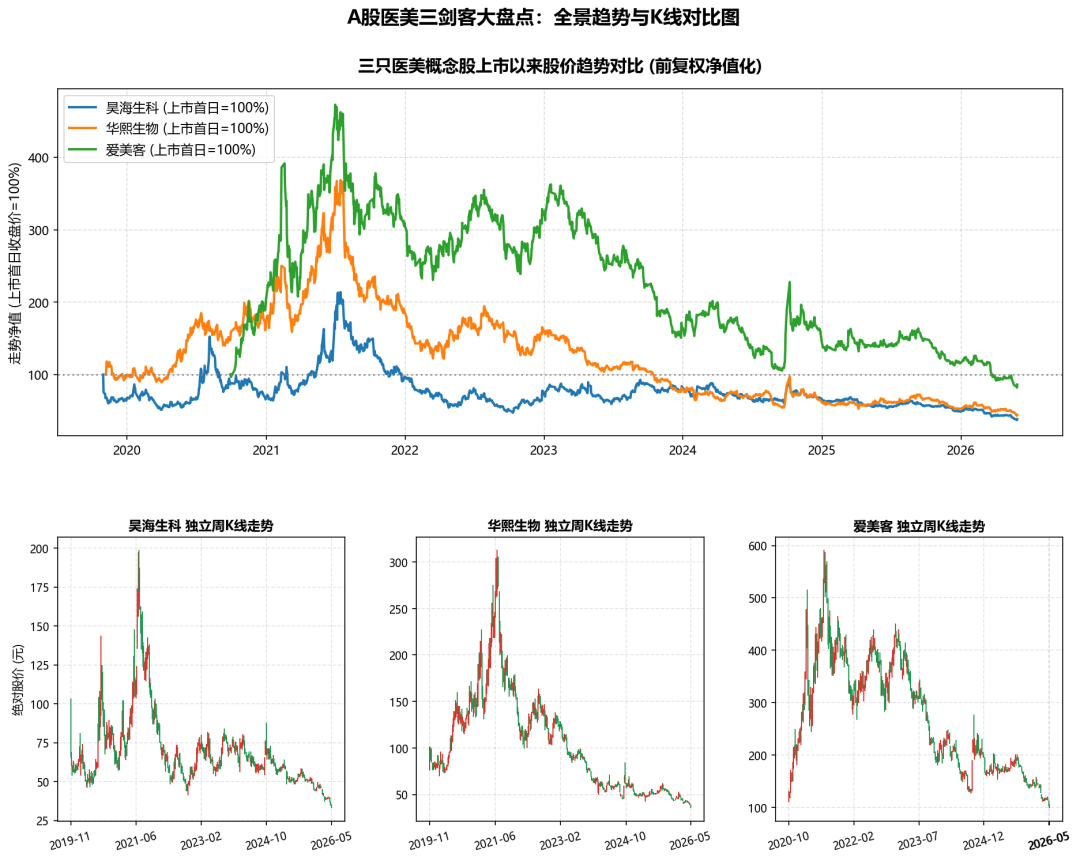
Latest closing prices as of publication on 29 May 2026. Analysis produced by Aesthetic Reflections from akshare data using our own Python scripts.
Haohai Biological is down about 82.7% from its all-time high of 14 July 2021.
Bloomage Biotech is down about 88.2% from its all-time high of 5 July 2021.
Imeik is down about 82.3% from its all-time high of 1 July 2021.
Look instead at where the large new rounds are going, and the keywords have changed: PLLA, PCL, CaHA microspheres, recombinant collagen.
Hyaluronic acid still has the largest number of companies in it, and it remains the most solidly established treatment category in medical aesthetics. But it is no longer the main battlefield for the capital narrative. What capital is looking for is the next category that can manufacture a story all over again: a higher price per treatment, a thicker technical moat, a longer consumer-education cycle.
Capital reads those as pricing power, as margin, as revenue. It is willing to pay a premium for difficulty, because difficulty is at least some kind of moat.
Observation 3 — Upstream companies have started making capital moves of their own
The other change worth watching is that upstream medical-aesthetics companies (and listed companies in neighbouring industries) have themselves become capital players. This is no longer a one-way flow of capital into companies; it runs both ways, and upstream players are increasingly the ones taking the initiative. There are at least five distinct moves.
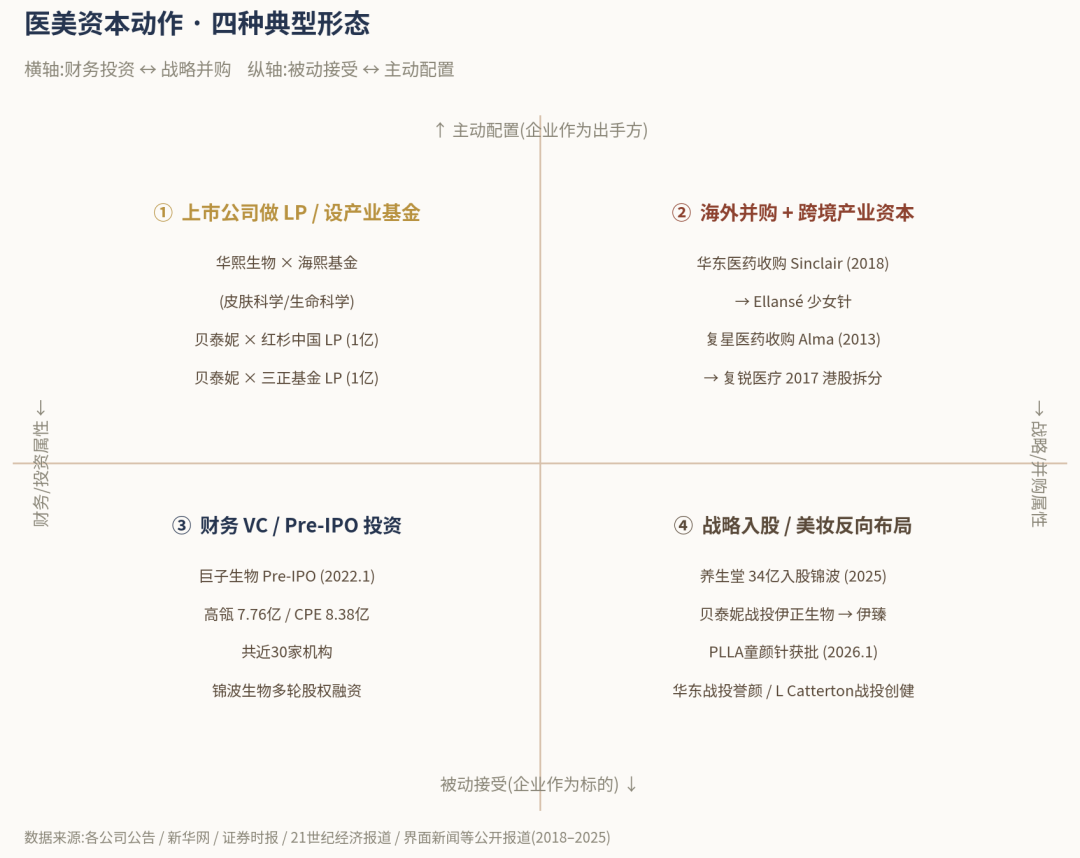
One: acquiring overseas assets.
In 2018 Huadong Medicine bought 100% of the UK’s Sinclair for around RMB 1.495 billion, indirectly securing the global rights to Ellanse — the PCL filler marketed in China as Yiyanshi — which in 2021 became the first PCL-class regenerative filler approved domestically [5].
Sinclair then continued: roughly RMB 660 million for Spanish energy-device maker HighTech in 2021, and overseas aesthetic-laser company Viora in 2022.
Fosun Pharma’s Sisram Medical acquired about 95.2% of Israel’s Alma Lasers through the Sisram platform in 2013 and spun it out onto the Hong Kong exchange in 2017. In 2023 Alma turned around and acquired PhotonMed, its own exclusive distributor in China, closing the loop between product and channel [7].
Two: listed companies acting as LPs and setting up industry funds.
Bloomage Biotech and related parties jointly established Hainan Haixi, a private fund investing in dermatological science and life sciences, with Bloomage subscribing RMB 40 million as a limited partner for a 32.44% share; it later helped set up the Fuyuan fund focused on synthetic biology [8]. Moves like this bring the entire upstream — and early-stage innovative materials — into the company’s field of view, to be invested in, acquired, or turned into a strategic alliance later on.
Three: health-and-wellness groups taking equity stakes from outside the industry.
In 2025 Yangshengtang took a stake in Jinbo Biological, the Beijing Stock Exchange leader in recombinant collagen, through two transactions — a RMB 2 billion private placement plus roughly RMB 1.4 billion of share transfers, about RMB 3.403 billion in total — becoming the second-largest shareholder. The RMB 2 billion placement was accepted for review by the Beijing Stock Exchange in September 2025, the largest placement on that exchange that year [4].
This is not a standalone VC financial investment. It is a family group with 3 million retail outlets and a portfolio of consumer health brands deciding to fold Jinbo into its own beauty-and-health ecosystem.
Four: listed companies taking strategic stakes in private targets.
In 2023 Huadong Medicine invested around RMB 150 million in the Series B of Chongqing Yuyan Pharmaceutical through its subsidiary Sinclair Pharma China, taking about 4.29% and simultaneously securing exclusive commercial rights to the recombinant botulinum toxin type A YY001 in aesthetic indications [6]. Unlike a conventional distribution agreement or a white-label deal, this is a textbook prelude to an industrial acquisition — financial investment traded for commercial rights.
Five: listed domestic beauty companies moving upstream into medical aesthetics in reverse.
This one deserves to be pulled out on its own.
From 2022 onwards Botanee set up a series of investment vehicles — Hainan Botanee Investment, Hainan Botanee Venture Capital, Xiamen Chonglou Private Fund and others — then used the cash flow from its beauty business for a run of deals: RMB 100 million as an LP in a Sequoia China fund, RMB 100 million as an LP in the Sanzheng fund, a Pre-A strategic investment in Suzhou Yizheng Biotech (now 15.73%, the single largest shareholder), and in October 2023 a strategic investment in energy-device maker Weimai Medical.
This is a different play from Bloomage’s LP model and from Huadong’s acquisition model. In essence it is a path that runs: beauty cash flow → industrial capital platform → strategic investments upstream in medical aesthetics → a closed loop into its own clinic channel.
Botanee has already placed its anti-ageing brand AOXMED into more than 600 combined dermatology-and-aesthetics clinics nationwide, and it owns clinics of its own — Shanghai Yanyue Medical Aesthetics, Kunming Winona Dermatology — which means the products it invests in will have both an independent channel and a way to feed back into the clinic network it has already built.
Botanee is not alone. Proya’s venture arm co-invested with Botanee in Weimai Medical and Weimu Medical; Bloomage Biotech and Syoung Group jointly invested in Ruijiming, a recombinant PDRN raw-material company; Freda launched the medical-aesthetics brand Kemi and moved it into aesthetic hospitals [12].
At least half of China’s top ten domestic beauty groups are now building positions in medical aesthetics.
Broadly, the upstream no longer waits passively for capital to knock. These companies have started allocating capital themselves — and in the process the boundary between beauty and medical aesthetics is quietly dissolving.
Observation 4 — Celebrity investors and family fortunes arrive
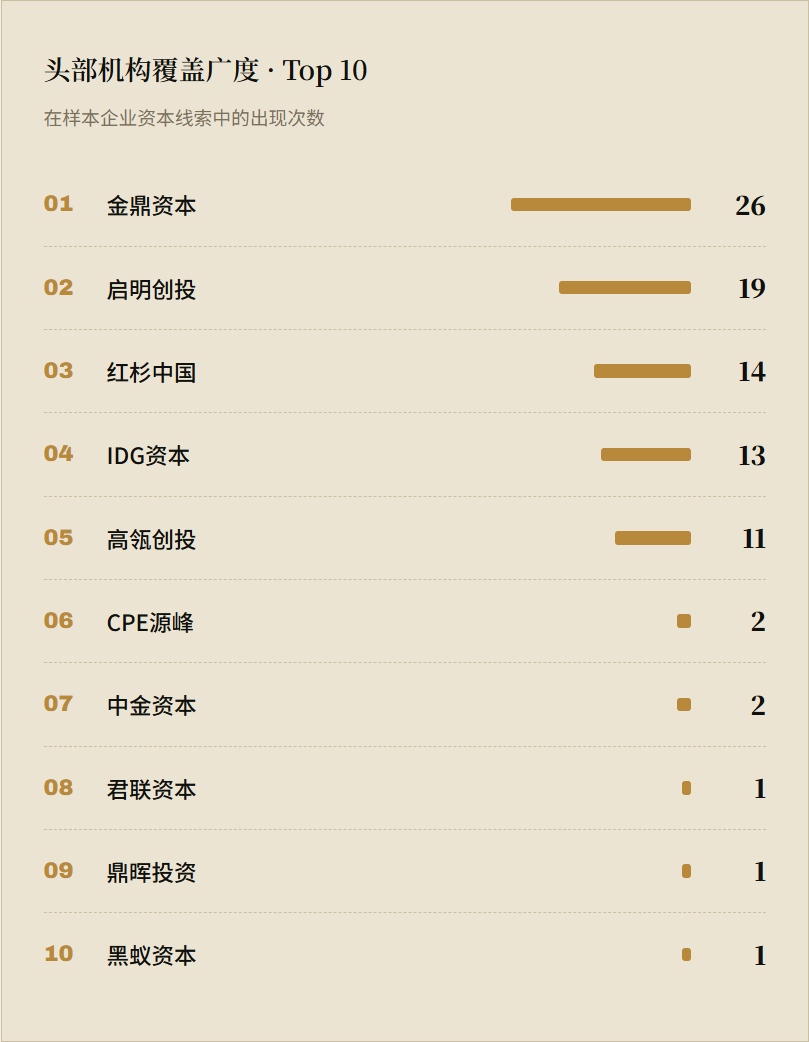
The Pre-IPO round Giant Biogene closed before listing in Hong Kong in January 2022 produced the most glittering shareholder list the industry has seen in years: Hillhouse, CPE, Legend Capital, Kingyi Capital, CDH, CICC Capital, Black Ant, Gaorong, Greenwoods, Highlight, CDB Innovation and close to thirty other first-tier institutions, plus Qianxun Culture, the firm owned by livestreamer Viya and her husband. CPE put in RMB 838 million and Hillhouse around RMB 776 million, for 4.33% and 4% respectively (a second Hillhouse vehicle brings the combined figure to about 4.99%), at a Pre-IPO valuation of roughly RMB 19.3 billion [3]. A family business that had never raised outside money before brought in nearly thirty first-tier institutions in a single round — in itself an extraordinarily rare capital event for this industry.
Leading medical-aesthetics assets no longer attract only specialist VCs. They have entered the territory of celebrity capital, family wealth and industrial giants backing the same name at once. Which is itself the raw material of a story.
The money going into medical aesthetics is not all the same money
Behind all this activity, the source of the money, the decision logic and the exit expectations are all different. Understanding that logic is what explains why companies holding different kinds of money behave and perform so differently in the market.
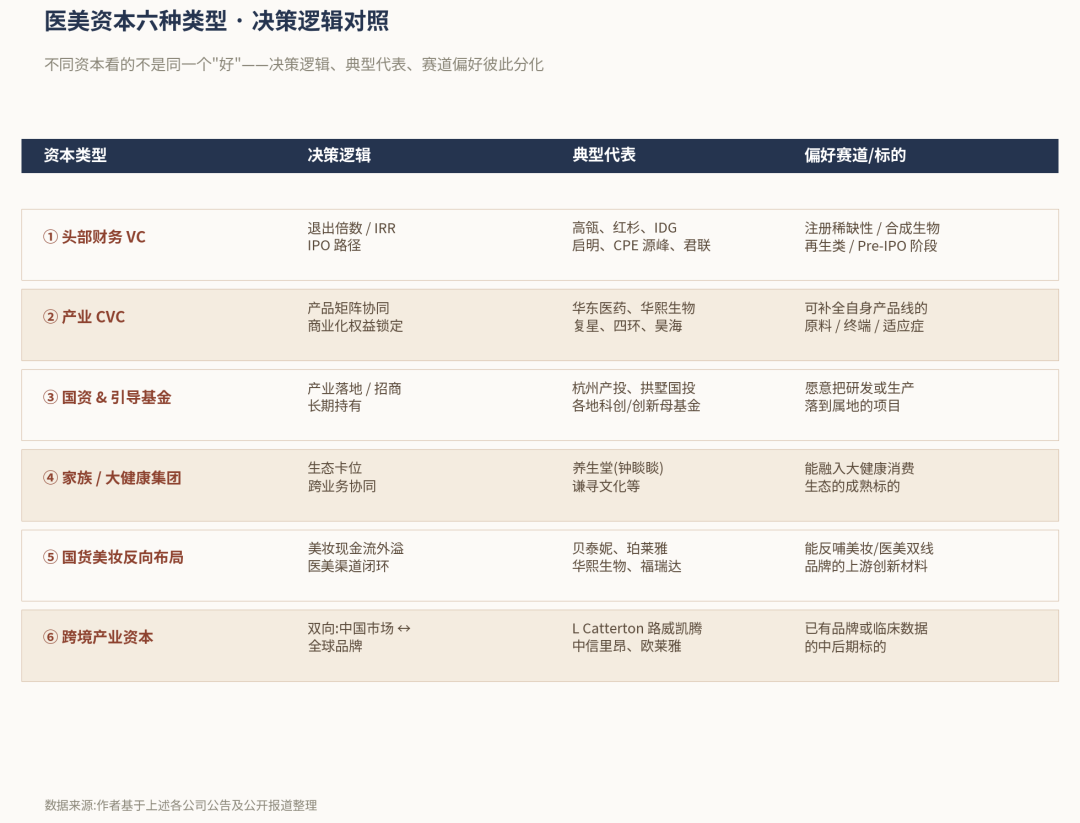
Type 1 — Leading financial VCs
Preferences differ even among the top funds, and some of the very best are decidedly cautious about medical aesthetics. But the names that keep appearing on cap tables are the familiar ones: Hillhouse, Sequoia, Qiming, IDG, CPE, Legend Capital, CDH.
These are essentially market-driven RMB and USD funds. Their logic is perfectly clear: assess the category, assess the moat, assess the path to an IPO exit. The targets they favour share certain traits. Regulatory scarcity (the first Class III certificate, a genuinely new category), a story that can be told in synthetic biology, regenerative medicine or globalisation, and enough valuation headroom to be carried all the way to a listing.
Hillhouse and CPE putting roughly RMB 776 million and RMB 838 million into Giant Biogene’s Pre-IPO round [3] is the textbook version of this bet: invest once, wait for the IPO, book the paper gain on day one of trading.
The flip side is that this kind of capital is growing steadily more cautious about early and mid-stage targets. In injectables, where channel and brand dependence is extremely high, standardised VC diligence can only reach so far — so they would rather wait for the inflection point, when the company already has a registration certificate and demonstrable revenue, than bet at the concept stage. Which is exactly why small and mid-sized companies have found early funding so hard over the past two years: the leading financial VCs have moved back down the timeline.
Type 2 — Corporate VCs: strategic investment inside listed companies
The representatives here are the capital arms inside listed companies: Huadong Medicine, Bloomage Biotech, Fosun Pharma, Sihuan Pharmaceutical, Haohai Biological, Lepu Medical.
Each of these has its own strategic investment department and funds. The vehicle might be the listed company investing directly, an industry fund it established or joined, or an overseas subsidiary making acquisitions in its own right.
Their logic is nothing like a financial VC’s. What they are looking at is not the exit multiple but the synergy.
Either they are completing their own product matrix (Huadong filling in fillers, then energy devices, then toxin), or locking down critical upstream raw materials (Bloomage acts as an LP so it sees new synthetic-biology materials first), or buying a commercial right outright (Huadong’s stake in Yuyan is really about exclusive aesthetic-indication rights to the YY001 toxin).
For the company on the receiving end this money has both benefits and costs. The benefit is that it arrives attached to real enablement in channel, brand, clinical work and registration. The cost is accepting, to some degree, that this listed company now has a say in where you go next — and independence inevitably suffers.
Type 3 — State capital and government guidance funds
This is one of the clearest changes in China’s primary market over the past three to five years: market-driven private capital is contracting while state capital and government guidance funds take up a larger share. It is now showing up in medical aesthetics too.
When Huadong Medicine joined Chongqing Yuyan’s Series B in 2023, Hangzhou High-Tech Investment Group and Gongshu District state investment came in alongside it [6]. Behind those two names sits the cluster of industry funds Hangzhou has been building — the “3+N” structure of three RMB 100 billion funds of funds (a municipal science-and-innovation fund, an innovation fund and an M&A fund) levering up several hundred sub-funds, with biopharma one of five priority industry ecosystems. By the end of November 2024, the funds approved under this system exceeded RMB 244.2 billion [9].
This kind of capital has very distinct characteristics.
First, it is investment-attraction driven. When local state capital invests in a company, it usually comes with a requirement that the R&D centre, the production base or the operating headquarters be sited locally. Behind the money sit industrial development, GDP, tax revenue and jobs. That is why so many medical-aesthetics materials plants have appeared in Changchun, Suzhou, Jinan and Zhuhai — places where local state capital is willing. There are reasons for all of it.
Second, the risk appetite differs from a market-driven VC’s. State investment carries accountability for losses, the decision chain is longer, and it tends to follow on into deals it has already backed rather than make an independent bet on someone new. So you often see a pattern of state capital entering one round and more state capital following in the next few — until the cap table takes on a steadily deeper shade of state and local-platform ownership.
Third, the exit requirements and the patience are different again. State capital neither chases an IPO exit as hard as a VC nor pushes for M&A integration as hard as a corporate VC. It is more willing to accept local operations plus long-term holding. For the company that means steadier funding — and some compromise of strategic flexibility.
Type 4 — Family wealth and health-and-wellness group capital
The logic here is neither purely financial return nor industrial synergy. It is staking out a position in an ecosystem. Yangshengtang taking a stake in Jinbo, Botanee investing in Sichuan Yizheng — the announcements say it plainly: by moving strategically into upstream biomaterials, the group is building a value chain with more layers and more technical depth for its long-term development in skin health. Market and channel enablement; industrialisation at speed (using mass-consumer manufacturing experience to get Jinbo’s products to market faster); transfer of commercial capability; R&D collaboration.
This is the classic move of a consumer health group folding medical aesthetics into its own ecosystem. For the company receiving the money the advantages are that there is plenty of it, that nobody is pushing for an exit, and that it comes with consumer channel and brand resources. The cost is that the investor will want the company to drift towards mass-consumer logic — which may not be the road a company positioned as a serious medical-device business had planned to take.
Type 5 — Listed domestic beauty companies
Their decision logic is neither pure financial return nor the corporate-VC instinct to complete a pharmaceutical portfolio. It is anxiety about the growth ceiling in functional skincare, plus the wish to close the loop and walk their consumers up into medical aesthetics.
Growth in Chinese functional skincare has slowed markedly, and Botanee and Proya have both worked out the same thing: however hard skincare is fought over, it cannot out-earn medical aesthetics on price per treatment. Rather than wait for consumers to trade up on their own, better to buy the right cards upstream in advance, then use your own clinics, pharmacy channels and customer network to catch that upgrade.
The signatures of this kind of capital are:
One, frequent but small cheques — mostly minority strategic stakes and LP commitments, and very rarely a controlling acquisition.
Two, a strong preference for targets in the skin-health ecosystem: energy-based radiofrequency (Botanee into Weimai), regenerative fillers (Botanee into Yizheng, then Yizhen PLLA), PDRN raw material (Bloomage and Syoung into Ruijiming).
Three, almost all of them are laying down clinic channels of their own at the same time. Botanee’s anti-ageing brand AOXMED is already in more than 600 combined clinics nationwide; add its own Yanyue and Winona dermatology clinics, and every product it invests in can eventually flow back through channels it owns [11].
For the company being invested in, the advantages are patient money, channel resources from a beauty brand owner, and no pressure to list and exit in the short term.
Type 6 — Cross-border industrial capital
International groups entering China through acquisition or strategic stakes
L Catterton, the LVMH-backed private equity firm, together with CITIC CLSA Capital, taking a strategic stake in recombinant-collagen company Trautec in 2023 [10] is the landmark case for this strand; L’Oreal has likewise kept building positions in Chinese clinics and brands in recent years.
Chinese listed companies buying global assets and bringing them home
Huadong buying Sinclair, Fosun buying Alma, then using those acquired assets to attack the Chinese market — this is a different route out of China [5][7]. Those are the relative successes. There are also overseas assets whose commercialisation failed, turning into long-term “story assets” that generate no cash. That is not rare in cross-border industrial capital.
A clinically driven industry versus a capital narrative
Put the observations and the taxonomy together, and the reason China’s upstream medical-aesthetics story looks so different from the rest of the world’s is, at bottom, a story about capital.
The first narrative is import substitution.
For more than a decade Chinese injectables have relied heavily on imports, and capital is betting on the next generation of domestic hyaluronic acid, regeneratives, recombinant collagen and toxin. That narrative underwrote the rise of Imeik, Bloomage, Jinbo and Giant Biogene, and it underwrote the funding a great many regenerative start-ups raised between 2021 and 2023. Essentially it is an industrial-upgrading story, and its audience is the domestic market.
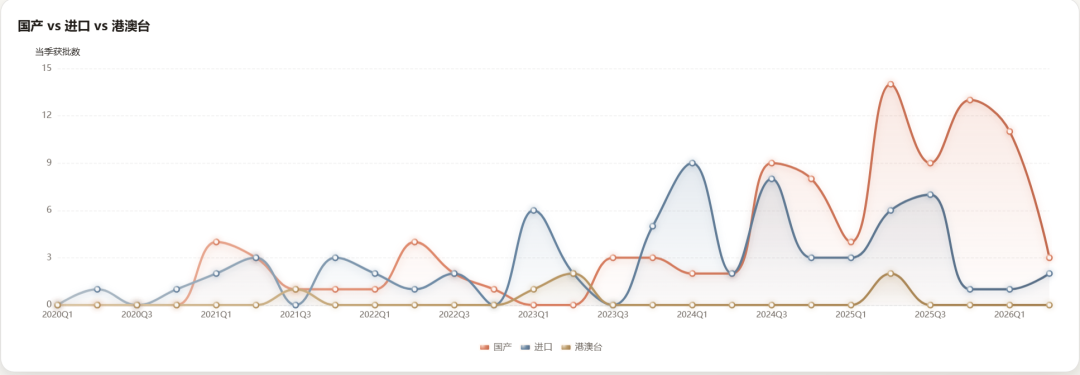
The second narrative is long-lasting regeneration and a high price per treatment. In the hyaluronic acid era the price of an injection was pushed down to a few hundred or a few thousand yuan; PLLA, PCL, CaHA and premium collagen pulled it above ten thousand in one step. Capital likes this story, because it corresponds to fatter gross margins, slower metabolism and stickier repeat purchase — which means market size and customer value get recalculated, and the valuation of the target can climb another rung.
The third narrative is an integrated beauty-and-health business. This is the story of consumer plus serious medicine plus wellness [4]; the story of four-wheel drive across raw materials, medical end-points, functional skincare and food; and the story of aesthetic devices, intimate health, dentistry and anti-ageing pulled together into one [7]. Capital will pay a premium for integration, because it means the same consumer can be monetised again and again across different stages of life.
What the three narratives have in common is that they all depend on delivery in the future. Import substitution has to be redeemed by real numbers once the product is on the market; long-lasting regeneration has to be redeemed by consumer understanding and a price point that holds; integration has to be redeemed by genuine cross-business synergy. None of them is an accomplished fact. They are beautiful stories the market is being asked to believe.
Where companies end up once they are tied to capital
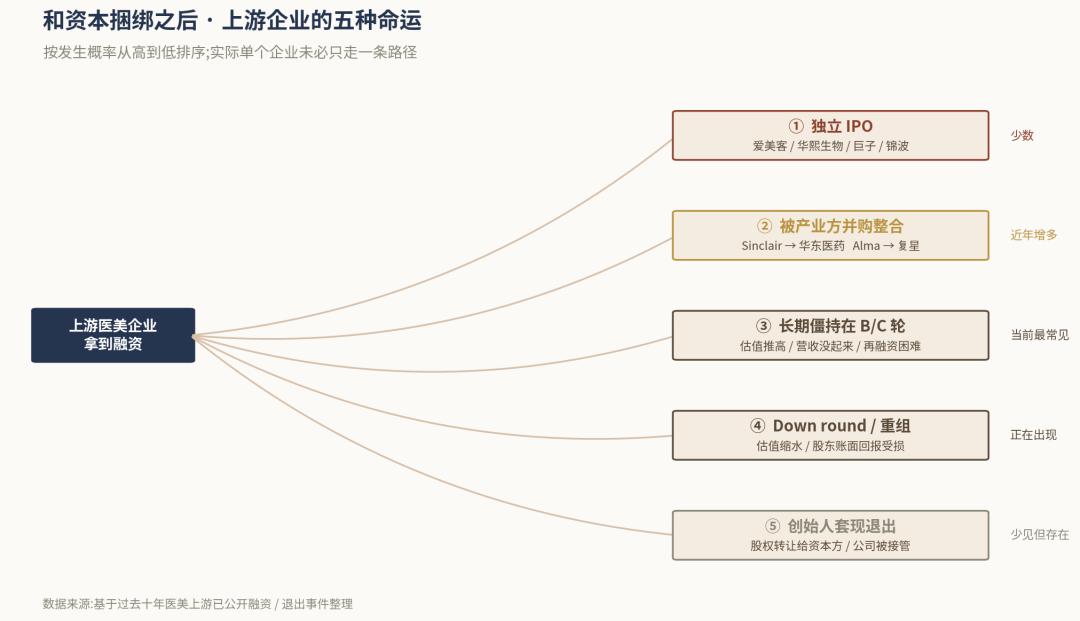
One — a few reach an independent IPO
Imeik, Bloomage Biotech, Giant Biogene and Jinbo Biological are the ones that genuinely completed independent listings over the past few years. This road looks the most dignified, and in practice it demands the most of a company.
You have to keep valuation and revenue in step through every round of financing, survive exchange scrutiny on compliance and accounting, and find the right window in the capital markets.
And after the IPO the capital story does not end. It is the start of a fresh round of pressure.
Two — acquired by an industrial buyer, becoming an asset inside a listed group
This outcome has clearly become more common. Sinclair wholly acquired by Huadong Medicine [5], Alma taken by Fosun [7], Yuyan’s aesthetic-indication commercial rights locked up by Huadong’s strategic investment [6].
All of them went from being independent medical-aesthetics companies to being medical-aesthetics assets inside a listed group. For the original shareholders and founders this road is a certain exit.
The cost is that brand independence, the pace of product iteration, even company culture get rewritten. What used to be an independent business becomes one product line in a group’s segment strategy, rather than a company in its own right.
Three — the most common: a long stalemate at Series B or C
This is where most funded upstream companies actually are. The first two rounds closed, the valuation was pushed to RMB 1 billion, 1.5 billion, 2 billion — and then it stopped. Revenue has not reached a level that would support the next valuation, there is no suitable window to file for an IPO, existing shareholders will not invest again at a lower price, and new shareholders cannot get in. On the surface the company is still operating, but inside it people can hear the capital clock ticking.
Four — a down round or a restructuring: accepting a lower valuation
When the stalemate runs long enough and the cash on the balance sheet is nearly gone, the next step is a down round — new money at a valuation below the last one. Every prior shareholder’s paper return shrinks; the founder is diluted further. This is the script most likely to play out more often in the medical-aesthetics primary market over the next two to three years.
Five — the founder cashes out and capital takes over the company
Nobody is really discussing this one, but it exists. In some round of financing or secondary transfer the founder sells their core stake to incoming shareholders, gradually withdraws from running the business, and the company ends up led by its investors. The details of these stories are rarely disclosed in the press, but the traces are visible in registry changes and equity look-throughs. (I did try to find a case, but Qichacha wanted to charge me, so — never mind. You will have heard of the equivalent in other industries.)
Funded companies versus companies built on their own cash
This part is genuinely interesting, because the difference is not simply how much cash is in the bank. It seeps into every market action the company takes.
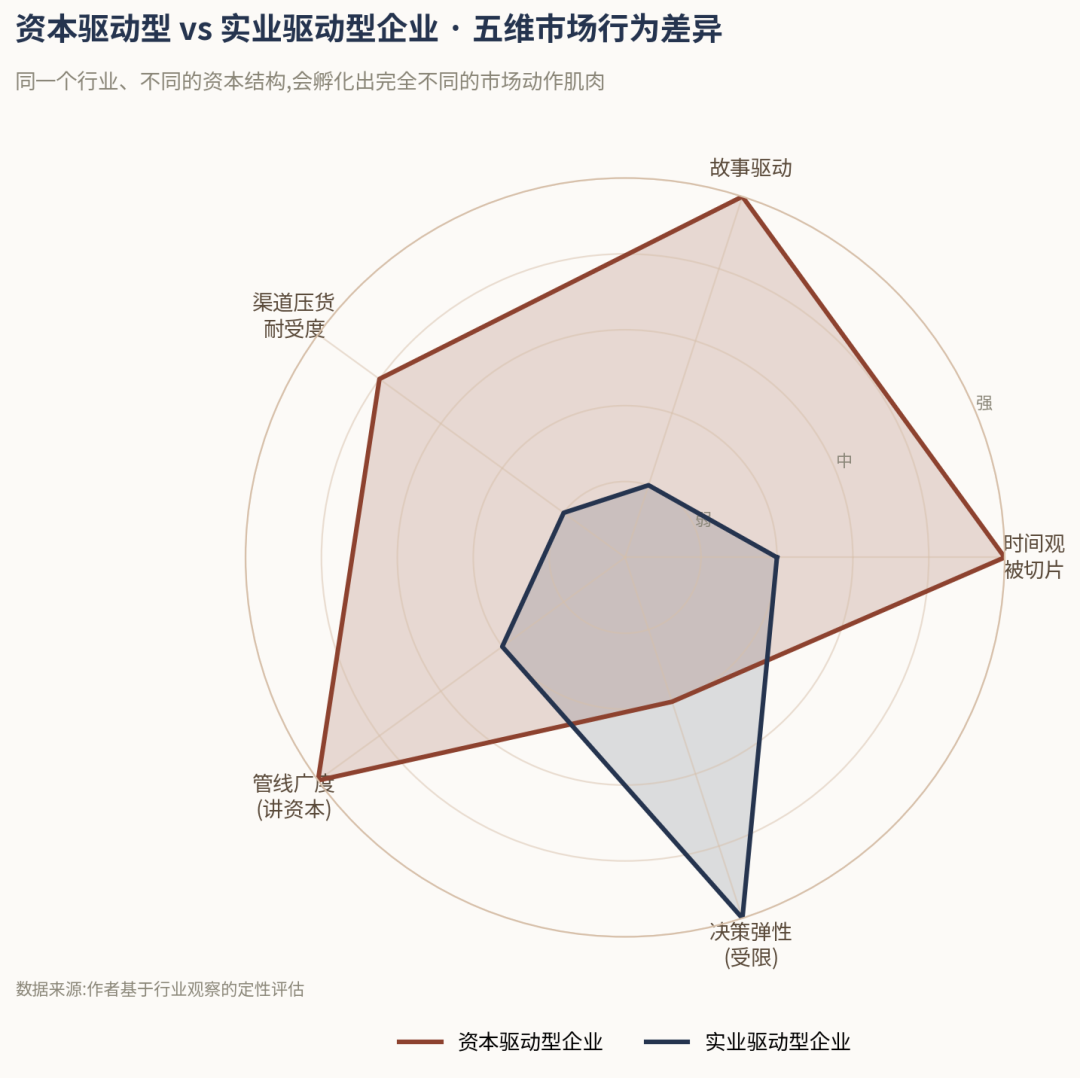
Difference 1 — Completely different sense of time
A funded company has a capital clock running behind it.
The next round, the deadline on a performance undertaking, the IPO filing window, the fund’s life. Its time is sliced up, and each slice has to contain a peak or an inflection that can be narrated to investors.
A company built on its own cash has no such clock. Its time is continuous — is the product good to use, are doctors using it, are consumers buying again? Those are measured in sales months and years, not in rounds.
Difference 2 — Attitude to the story
A funded company has to keep telling one: a sales breakthrough, a next-generation product, an overseas market, pipeline expansion, becoming a platform, synthetic biology, AI-integrated technology. Without a story the valuation will not hold and the next round will not close.
A company built on its own cash would rather talk about facts: this month’s real sales, coverage of target channels, what doctors actually say, repeat-purchase rates at the clinic. The two vocabularies train two different ways of speaking.
Difference 3 — Tolerance for stuffing the channel
A funded company carrying a performance undertaking, facing pressure on revenue, will find it easier to reach for aggressive terms in exchange for short-term sell-in volume.
A company built on its own cash tends to hold back, and leans towards protecting its channel policy and price architecture.
Difference 4 — Priorities in product iteration
A funded company tends towards many pipelines and broad coverage, because the pipeline is one of the assets you narrate to investors, and the more R&D reserve there is to describe the better.
A self-funded company tends to drive one product deep and get it right, making the first product an industry benchmark before considering the second.
Difference 5 — Flexibility in decision-making
In a funded company every significant decision goes through an investment committee and a board — two or three shareholders at the low end, a dozen or more at the high end. Where there is state capital in the structure, the process is more cautious still.
The decision chain at a self-funded company is far more flexible. In a market as fast and as fluid as medical aesthetics, that difference in flexibility is sometimes fatal.
In a founder’s eyes a good project has technology, a product, and the endorsement of doctors. In an investor’s eyes a good target has a story, valuation headroom, and a path to exit. Most of the time those two standards do not overlap.
The rhythm of capital can let you build in three years what someone else could not build in ten. It can also mean that one day in year three you look up and find the company is no longer the company it was.
China’s medical-aesthetics capital story is still being told. How the next chapter gets written depends largely on whether the companies funded in this cycle can deliver over the next two to three years — and on how patient capital itself proves to be in a changed macro environment.
Keep watching. Keep your head clear.