Rampant free-riding is drawing down the whole industry’s sense of value.
Look closely at the commercial logic of medical aesthetics and an uncomfortable pattern emerges: from upstream suppliers to end consumers, from platforms to investors, the entire chain is caught in an invisible war of value extraction. This is not a moral failure of any one group. It is the systemic imbalance of an industry in rapid expansion.
Everyone is inside the game.
Why has medical aesthetics become the epicentre of free-riding?
One falling leaf tells you the year is ending
KOLs and influencers free-riding on clinic treatments
Xiaohongshu and WeChat Channels have become the main ground for brands and clinics to seed recommendations.
That content marketing spans ordinary users, KOSs, KOLs and everything in between.
On both reach and quality, brands want a certain volume of voice whatever tier the creator sits in, and follower count has become effectively the only basis for setting the fee.
“Run the ROI and it’s all loss. And creators are still picky — free product, free treatment, refuse the injection, staged photos as standard, everything fixed in post.”
Tens of thousands of yuan buys a filler post with no retention rate, no engagement rate and no conversion rate. Sometimes the creator alone is not enough, and their team and friends come along for the free treatment too. Which is why so many company owners now feel cheated the moment influencer partnerships come up.
Freebie-hunting has become standard for consumer acquisition
Free trials have become the default way to acquire customers — energy-device treatments, new product trials, sample giveaways. A segment of consumers hunt these relentlessly, and low willingness to pay traps clinics in a traffic problem where spending more actively destroys the profit model.
This industry has trained a population of professional freebie hunters.
A 2023 medical-aesthetics consumer white paper found that 68% of trial users made no second, paid purchase within three months, and 32% of clinics saw gross margin fall below 15% because of excessive trial marketing.
Companies harvesting proposals
Manufacturers and channel players use “intent to partner” or a competitive pitch as cover to consult for free, harvesting large volumes of marketing ideas and campaign plans. Worse, some withhold and shave payment on various pretexts after a supplier has delivered.
One experienced service provider told me: “For the same project, a few thousand yuan, they still want three quotes. For something bigger, some companies get more than twenty suppliers to prepare proposals.”
Some genuinely excellent suppliers have told me plainly: we would very much like to work together, we can walk you through our previous work and talk through what you need to see whether we match — but we do not pitch competitively.
Harvesting through the interview process
Plenty of companies hiring senior people require candidates to submit a complete marketing plan, answer a defined set of problems and present it in detail. In the end there is no offer — and the plan is executed exactly as submitted.
“Please prepare this year’s market strategy and execution plan, and while you’re at it look at the market situation.”
“If you were running the business, set out the commercial plan and talk us through it.”
“We have these problems in the business right now — how would you solve them? Put a deck together and explain.”
“This interview is very important. There are fourteen questions about the company’s development. Please prepare.”
“We were very happy with your plan last time. Our investors would like to hear it too — come and present it again.”
Lots of nodding in the room. Two weeks later: we’ll keep looking for now.
Ask around, and it turns out dozens of people have interviewed and prepared plans.
A month later, your recommendations start going to market.
Six months on, the position is still unfilled.
Companies use fake recruitment to acquire candidates’ complete solutions, then refuse any form of consulting fee on the grounds that no offer was made. This practice is destroying the industry’s talent ecosystem.
Companies free-riding on human resources
More than a few companies use probation as cover: hire someone to acquire their customer relationships and channel contacts, then terminate before probation ends — dodging the recruiter’s fee and taking everything the employee brought.
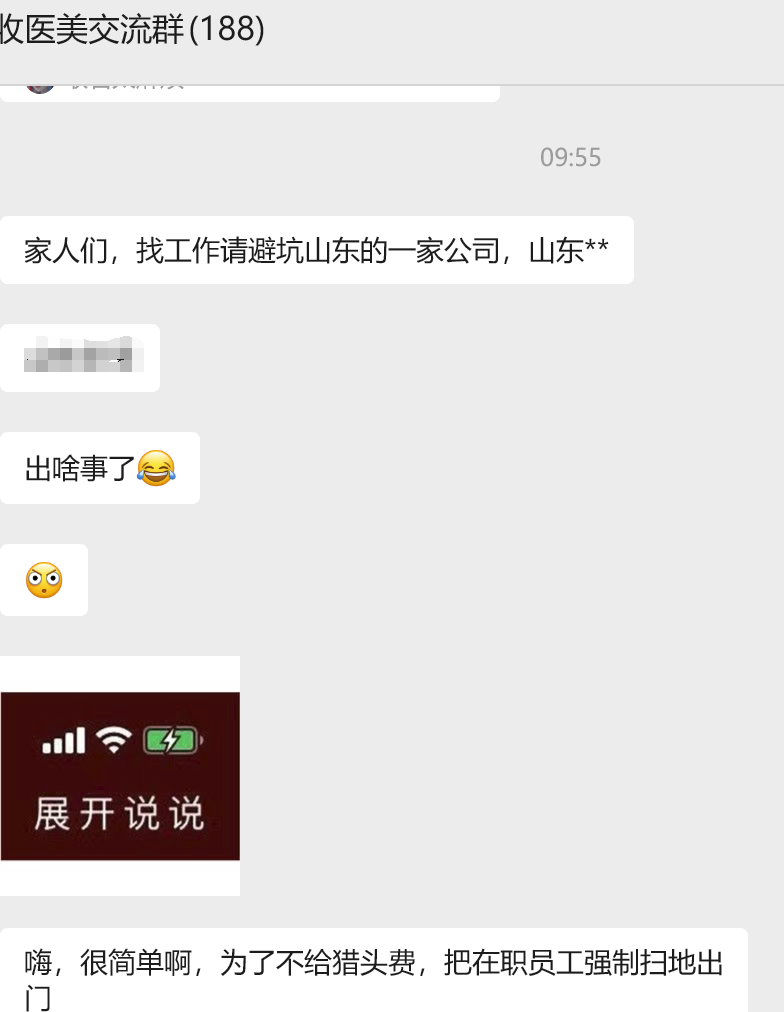
Note: the screenshots above were volunteered by several of the people involved. They are used here solely for the study of industry patterns, and identifying details have been redacted. Responsibility for their accuracy rests with those who provided them. This publication makes no conclusive judgement about any individual company; the material is cited only as one illustration of a pattern that is widespread in the industry.
Investors free-riding through diligence
Investment firms take frequent meetings with good projects, collecting business models, data and industry knowledge — and then take that information to a competitor or another interested party.
“We really like your model. Let’s get the partners in next week.”
You hand over the carefully polished deck, the financial model and the market plan in full.
The investor nods along: “Your team has real potential.”
Six months later you discover a competitor has been acquired by the same firm.
Your dream became somebody else’s diligence memo.
A real case. Can you guess who?
Free-riding on clinical evidence
Products register and launch on the back of a trend, with no technical advantage or performance difference of their own.
They accumulate no clinical evidence and run no research on their own product, and instead use published data and literature from overseas products of the same material class as endorsement for their own.
No disclosure, no one to hold them to account, and it becomes the norm. Clinics look only at price, margin and the marketing story. The result is products launching in swarms and severe undifferentiated competition.
The value paradox: why free became the optimal strategy
The root of pervasive free-riding is not moral decline but a structural flaw specific to this industry’s commercial model.
(Though the recent run of tasteless clinic marketing incidents and malicious reporting by some companies does show the industry’s ethical standards slipping — and both government and platform rules are tilting toward strict enforcement rather than support.)
The value gap created by information asymmetry:
Medical-aesthetic services are non-standardised, so assessing the result is subjective and lagged.
Consumers cannot accurately assess the value of a service before buying, which makes a free trial a rational way to reduce decision risk.
This design flaw is what gives free-riding its economic logic.
Wild growth in a regulatory vacuum:
Rapid expansion in non-surgical aesthetics ahead of regulation created room for pseudo-innovation to survive.
When neither compliance cost nor genuine technical innovation forms a competitive barrier,
a free treatment name, a product nickname and a packaging colour become the most direct means of differentiation.
Stones from other hills: why is free-riding so prevalent in China?
Widen the lens and it becomes clear that free-riding is not a universal industry ailment. In developed Western markets, nothing comparable is anywhere near as widespread as it is in China.
Trying to think through the root causes:
Institutional rules:
Western legal systems are well developed, respect for contract runs deep, and infringement is expensive. In China, enforcing your rights is costly and penalties are light, so “take first and see” carries almost no price.
Consumer attitudes:
Mature markets are long accustomed to paying for knowledge and service, and respect both talent and intellectual property. China leans toward paying for hardware you can touch, and has little appetite for paying for intangible intellectual work and plan design.
Cultural values:
The West emphasises efficiency and credit within a framework of rules. Chinese society broadly admires the small cleverness of getting something for nothing.
Industry maturity:
Western medical aesthetics has been through long competition, with clear rules and stable trust. China is still expanding fast, short-term opportunism pays quickly, and the long-run harm of disorderly operation has not yet arrived at scale.
Social trust:
In a high-trust society, cooperation rests on contract; legal systems are more mature and breaking an agreement is very costly. In a low-trust environment, people lean on personal networks and the culture of the dinner table.
Ecosystem logic:
In the West, paying is understood as a responsibility that sustains the ecosystem. In China, even business owners treat a product as a tool and give no thought to whether the industry’s ecosystem can be sustained.
Taken together, it is possible to understand why free-riding is so prevalent in Chinese medical aesthetics. It is not an isolated industry phenomenon but the combined product of social culture, market attitudes and the institutional environment.
“When value cannot be quantified and results cannot be protected, free-riding becomes the optimal survival strategy.”
Systemic collapse: when a value chain loses its centre of gravity
The prevalence of a free-riding economy is fundamentally restructuring how value is created in this industry, and shaping how it develops.
Value collapses, and bad money drives out good.
Across the whole chain, labour and value no longer receive matching returns.
The atrophy of the innovation ecosystem:
When the system of professional training for physicians cannot be conveyed,
when experts’ intellectual output cannot be protected and good plans are copied freely without any return,
when R&D investment earns nothing back and products are imitated immediately,
when knowledge services are taken for free so that quality suppliers gradually stop pitching, leaving only those who work relationships and talk a good game,
who will still be willing to genuinely invest in sustained creation and development?
Who will still have any incentive to innovate?
The industry inevitably grinds toward sameness. Technical progress and innovative thinking wither, service quality stagnates, and the field settles into homogeneous, low-insight competition.
The comprehensive disintegration of trust:
Before trust exists, all a clinic can do is trade freebies for a consumer’s willingness to try.
Once free becomes the default option, the perceived value of a paid service goes to zero.
Whether consumers free-ride on clinics or manufacturers free-ride on proposals, the end point is a crisis of trust inside the industry and outside it.
In the end everyone competes on who is cheaper — not on who is better.
And when distributor agreements are torn up, when the conversation is all about sales data and ignores the value of the registration work, the clinical work, the brand equity and the data itself,
distributors will become cautious about investing in those apparently free but genuinely valuable intangibles — or invest defensively.
Once the cost of self-protection exceeds the return from cooperating, the whole commercial ecosystem falls into a prisoner’s dilemma with no way out.
The marginalisation of professional services:
Consumers grow used to low prices or free, care less about expertise and safety, and become easier to harm with poor-quality service.
Once free-riding becomes companies’ default posture toward paying for knowledge, high-value professional content providers are replaced by relationship-based, low-quality ones and gradually leave the company, the industry, the market.
This reverse-selection mechanism strips the industry of any internal engine for continued evolution.
“When everyone wants something for nothing, the industry becomes an enormous black hole for value.”
In closing
Medical aesthetics is a discretionary consumer industry. What sustains it is the sense of value it creates in products, knowledge and service.
Standing here in a period of turbulence and iteration, free-riding may be a stage the industry has to pass through. Just as the internet went through its free-model baptism, we are now gradually starting to subscribe and pay for good software and good content — which is why the market keeps producing more useful software and developers keep iterating. Medical aesthetics is looking for its own path to monetising value.
Everyone in the chain has some degree of influence on the industry. How do we make products about value rather than price? How do we make sure value creators get paid? How do we keep the industry’s engine for evolution running? These are the habits of thought we need to build.
Once an industry’s value collapses, no individual escapes it. Only by protecting this industry’s professionalism and trustworthiness together do we keep the ground we stand on.