Foreword
Last time we published “Working Upstream in Medical Aesthetics: The Complaints”. In the weeks since, both online and off, we have had a great deal of feedback and recognition from readers.
A lot of people took the survey. Others messaged privately, and it came up over dinner too. Some friends even chased me for the next instalment: when are the results coming, and which companies took part?
Ahem — there will be no exposés and no names. My position has always been to find the problem and then analyse the root cause behind it. Different angles produce different thinking, and therefore different readings.
Let me start with the results.
Total sample: 43. I could not quantify the private messages and conversations; some of those points are folded into the “other” category, but I think the main views are all represented. Since a confidence interval cannot be calculated for this quantitative data, the conclusions are indicative only.
01Who took part
Company size
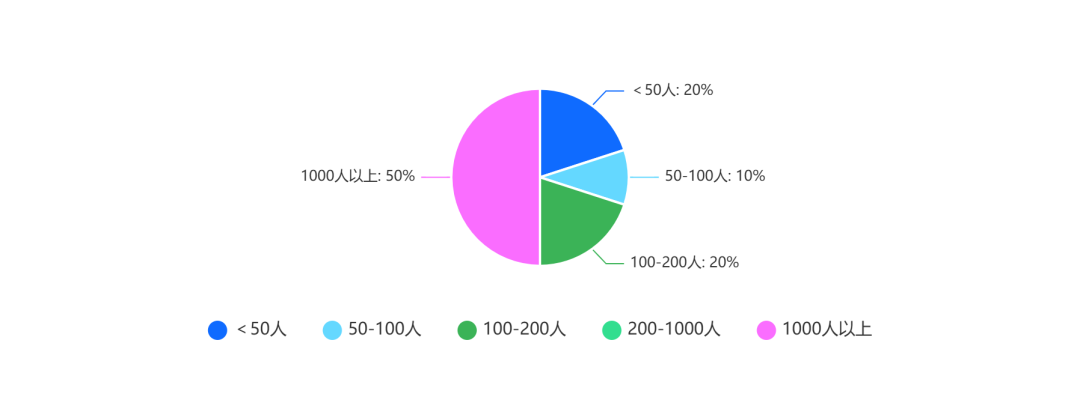
- Over 1,000 employees: 50%
- 100–200: 20%
- Under 50: 20%
- 50–100: 10%
- 200–1,000: 0%
Function
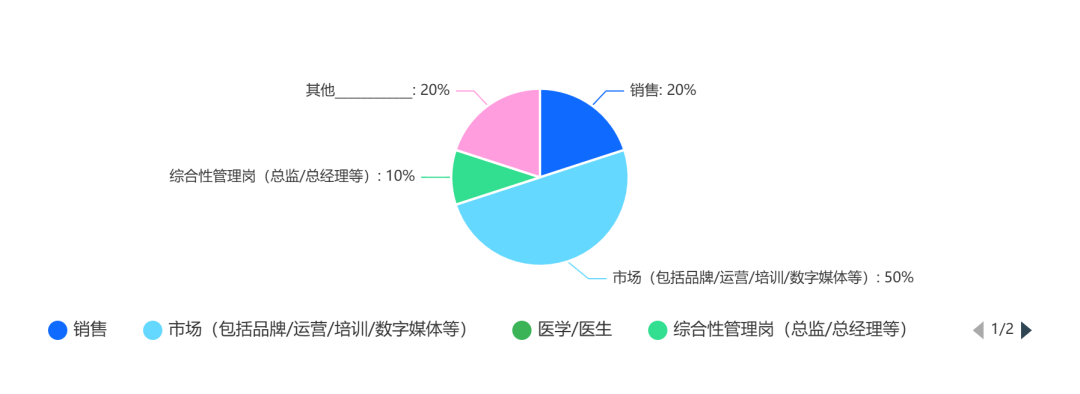
- Marketing (brand / operations / training / digital): 50%
- Sales: 20%
- General management (director / general manager): 10%
- Medical affairs / physicians: 20%
*A few medical managers selected the wrong option and noted their actual role under “other”; this has been corrected manually.
Reading the data
100% of respondents work for upstream medical-aesthetics brands.
Roles are mainly in marketing and sales management, plus some senior general management.
Voices from both large companies and small teams of various sizes are represented.
It cannot speak for the whole industry, but it is at least a genuine cross-section of what people are living through at work.
02The problems people find least acceptable — and that make them leave
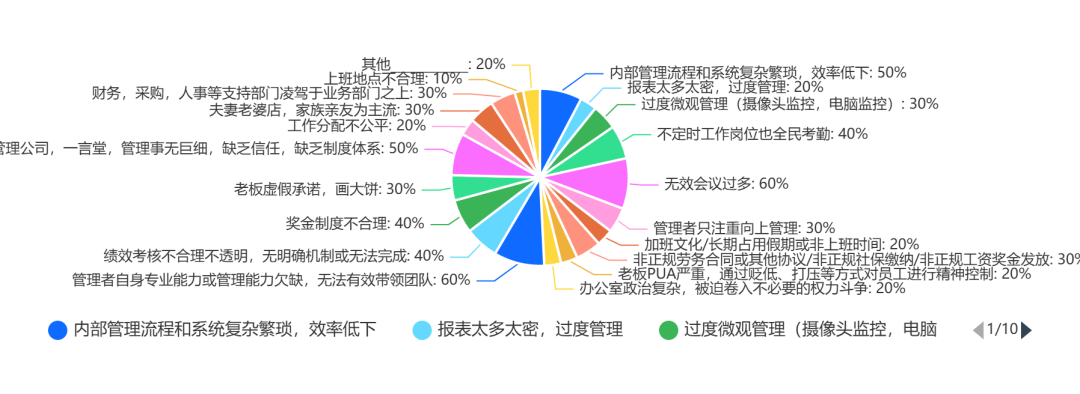
- Too many pointless meetings — 60%
- Managers lacking the professional or managerial ability to lead a team effectively — 60%
- Complicated, cumbersome internal processes and systems; low efficiency — 50%
- Owners running the company on personal preference; one voice; micromanagement of everything; no trust; no institutional framework — 50%
- Clocking in enforced on everyone, including roles with irregular hours — 40%
- Performance reviews that are unreasonable and opaque, with no clear mechanism or impossible to achieve — 40%
- Unreasonable bonus schemes — 40%
- Excessive micromanagement (camera surveillance, computer monitoring) — 30%
- Managers who only manage upward — 30%
- Irregular employment contracts or other agreements; non-standard social insurance payment; irregular payment of salary and bonus — 30%
- Owners making false promises and painting castles in the air — 30%
- Husband-and-wife shops, run mainly by family and friends — 30%
- Finance, procurement and HR overriding the business units — 30%
- Too many reports, too often; over-management — 20%
- Overtime culture; holidays and non-working hours routinely taken — 20%
- Serious manipulation by owners, using belittlement and suppression to exert psychological control — 20%
- Complicated office politics; forced into unnecessary power struggles — 20%
- Unfair allocation of work — 20%
- Unreasonable office location — 10%
- Other
In the open comments, several people mentioned:
“The whole company’s commercial direction is chaotic. The two owners don’t agree, so the plan gets rewritten almost every year, changed and changed again.”
“The worst part on the execution side is two bosses each giving instructions, and then being blamed with ‘who told you to do it that way?’”
A textbook case of multi-headed management plus disagreement at the top. For an execution team the nightmare is not the workload; it is direction that keeps reversing and responsibility nobody owns.
Summary in keywords
Going through the motions, a crisis of trust, broken incentives, conflicting direction. These are more or less the sharpest pains of working in this industry.
03100% say it affects the business
Beyond the effect on your own work, do you think the things you have described have a negative effect on the business?
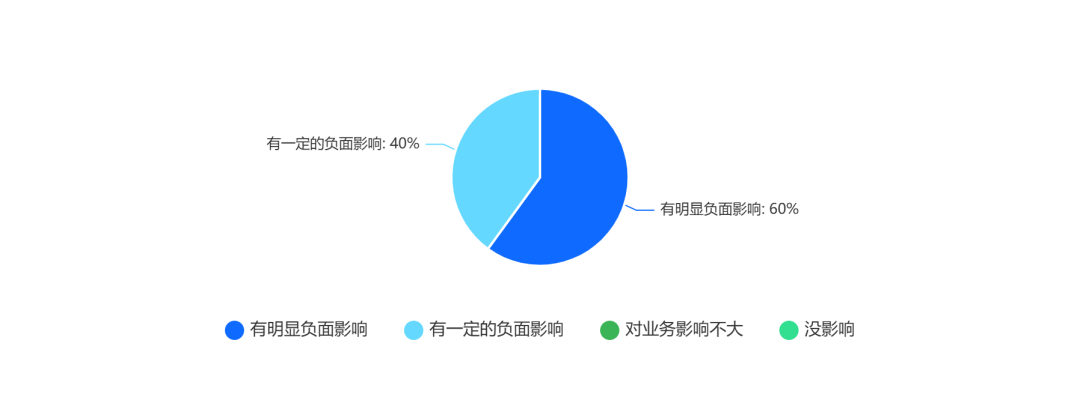
- Clear negative effect: 60%
- Some negative effect: 40%
Reading the data
As a consensus among professional managers — 100% of them — these pain points really are genuine obstacles to business development and efficiency.
These management patterns work through team stability, cross-functional collaboration, and process efficiency to produce wasted resources, discounted strategy, and reputational decline.
, ultimately degrading the company’s market performance and organisational competitiveness. None of which has anything to do with the product, or with the registration certificate.
04Would improvement help?
If these problems were addressed, would it help the business?
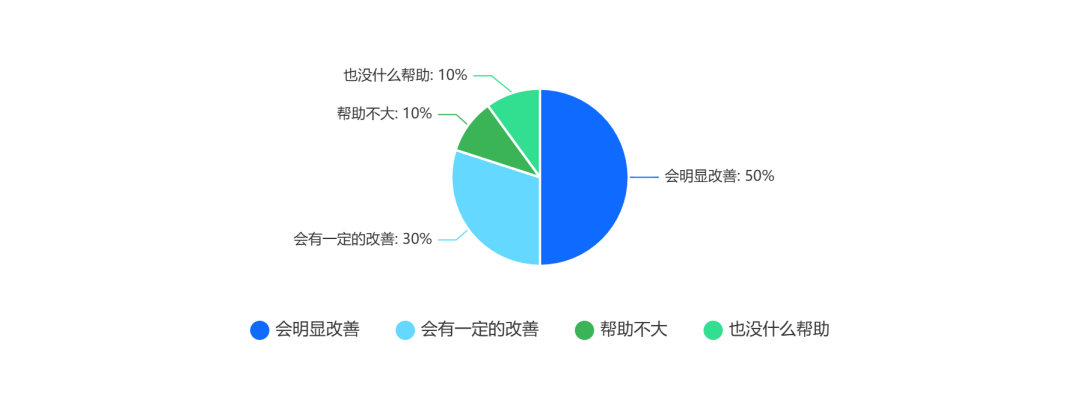
Would clearly improve it: 50%
Would improve it somewhat: 30%
Not much help: 10%
No help: 10%
Reading the data
More than eight in ten participants believe change would have a positive effect.
Which tells you: the complaints are not resistance. They are expectation..
People are not simply grumbling; they believe that if this could be fixed, my company would do better business.
05What most needs fixing first
Which area of management does your company most urgently need to improve?
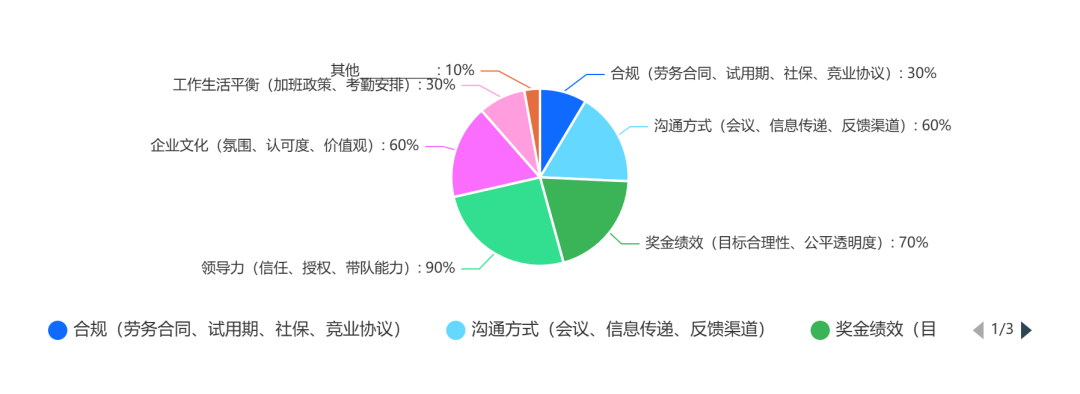
- Leadership (trust, delegation, ability to lead): 90%
- Bonus and performance (realistic targets, fairness, transparency): 70%
- Communication (meeting efficiency, feedback channels, information flow): 60%
- Company culture (atmosphere, identification, values): 60%
- Compliance (contracts, probation, social insurance, non-compete): 30%
- Work-life balance (overtime, holiday scheduling): 30%
- One respondent added a suggestion of their own: “agreement at the top.”
Reading the data
So what people most urgently want is not a few extra percent on salary. It is more professional leadership, professional management and incentive mechanisms, and a healthy company culture.
Raising the professional standards and capability of senior management has become urgent.
In closing
There is no shortage of inspirational quotations about working hard. Kazuo Inamori’s philosophy is popular; personally I find it too much like chicken soup, and not well suited to this industry as it stands.
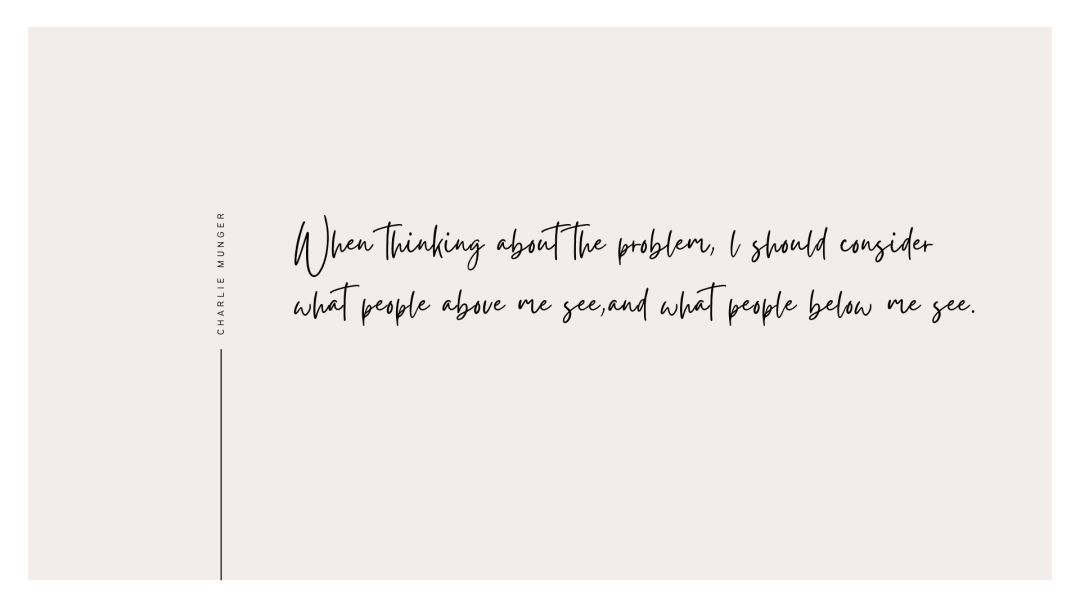
I find Charlie Munger’s approach to work and life more persuasive.
Three principles about work
- “Don’t sell anything you wouldn’t buy yourself.”“Don’t sell anything you wouldn’t buy yourself.”
- “Don’t work for anyone you don’t respect and admire.”“Don’t work for anyone you don’t respect and admire.”
- “Work only with people you enjoy.”“Work only with people you enjoy.”
Economically speaking, salary is only part of what work returns. What actually keeps people is trust, fairness and the chance to grow.
It is a way of growing up.
In moving a project forward, in the friction of a team finding its feet, in resolving conflict —
we are tested, and we grow.
And in the end we become the uniquely valuable version of ourselves.
The next few years will be a period of iteration and elimination in this industry, and the great majority of companies will face a test of survival.
A professional manager thinking through a business problem cannot stand only in their own position; they should also consider what the person above them sees, and what the person below them sees.
At the same time: read widely, keep learning, and invest in amplifying what makes you distinctly valuable.
Every stretch of patience and every complaint, every test and every layer of experience, ultimately becomes the armour we wear when we face the storm alone.