Late one night a friend forwarded me the video of the half-empty hall at the MWS congress. One look at the engagement numbers and the question was obvious: what do you make of it? So let me ride the trend for once, and ask the larger question — why is our industry so easily carried along by a single clip or a single remark?
The trial a single video set off
A clip of a few dozen seconds can set off a reaction across an entire industry — and that fact deserves more reflection than a thin day at a conference.
A fragment gets taken for the whole picture, a moment for a trend. Add one vague, leading verdict and you have what looks like a complete chain of evidence.
It resembles a collective ritual of the social-media age: there has to be a target, and there has to be an outlet for the feeling. Whether the target really has a problem, and where that problem lies, turns out not to be the point. What matters is having joined the discussion, expressed a position, picked a side. The pleasure of passing judgement beats calm analysis every time. And this way of consuming information out of context has become far too common in our industry.
Headcount is not value
Following that thread, let me stretch a piece of common sense that keeps getting overlooked: the number of attendees has never been the only measure of a conference’s value.
Over the past few years more and more differently positioned industry conferences have entered the market. They start small, sometimes only a few hundred people. But within their own niches — expert, academic, industrial — they cultivate deeply, and keep asking how their programme can deliver genuine industry insight.
I have watched several of these earn real market recognition. They are small, but everyone in the room arrived with a specific problem, and leaves with value and information they can act on — often worth far more than some of the general-purpose sessions in a hall of ten thousand.
Competition among industry conferences is shifting from who draws the most people to whose content is worth showing up for. Any congress, however large or long-established, that does not analyse the industry trends behind its own data and think hard about its programme will find itself gradually drained by the specialist events. This is not a question of who is capable and who is not; the whole conference ecosystem is levelling up.
How do you define “good” and “not good”?
The argument about the conference is only the tip of the iceberg. In day-to-day work I hear the same kinds of statements constantly: “I hear that product is selling really well”; “that company spends a fortune on marketing”; “this product is priced far too high”.
Every time, I want to ask: the “well” you mean — measured against what standard? Compared with whom? Over what period?
And there it usually ends. Most of these assessments come from hearsay, and after a few rounds of retelling they have left their original context behind and become an adjective with no coordinate system.
“Expensive” works the same way. A high price — expensive relative to comparable products, or relative to the value delivered? Is the end price high, or is the margin structure across the distribution chain simply irrational? Without separating those dimensions, a verdict on price is an empty shell.
“Is the strategy right?” is another. Everyone’s yardstick differs, and what matters is the comparison: against your own history, or against competitors in the same category? Within the same track, or against substitutes from another one? Can the product’s value carry its price? Is the channel strategy right for this stage of the market? Discuss none of that and any conclusion is a castle in the air.
An undefined adjective is the most dangerous instrument of judgement there is. It leaves you believing you hold a view when all you have done is absorb someone else’s feeling.
More worrying still, many judgements carry a position at their source. A manufacturer saying its product “sells very well” may mean shipments are large while sell-through at the clinic is poor. A distributor saying the market is “cold” may mean something has gone wrong in that distributor’s own channels, not that the temperature of the whole market is falling. When we do not trace information back to its source and its motive, we are adopting someone else’s position as our own judgement. In this industry, that is a very expensive form of laziness.
The Crowd: herd psychology projected onto an industry
The Crowd describes a phenomenon: once individuals enter a group, the capacity for independent thought degrades markedly. Groups are not driven by reason but form their judgements through emotional contagion and the suggestions of opinion leaders. Professional competence and logical ability tend to count for little against a group’s emotion.
That was written more than a century ago. Applied to the medical-aesthetics feeds of today, it is still exact.
Someone sees a strongly slanted comment from an “opinion leader”, sees the comment section agreeing in one direction, and their own judgement begins to wobble. Not because the argument is sound, but because “so many people are saying it” is itself a form of pressure.
Le Bon also noted that crowds are especially moved by formulations that are simple, extreme and vivid. Saying a congress is “finished” travels far better than “it needs to differentiate its programme for practitioners at different levels”, because the first is an emotional verdict and the second is an analysis that requires thought. In the competition for attention, emotion always outruns reason.
The information environment in medical aesthetics amplifies this crowd effect naturally. New products arrive endlessly, marketing language fills the air, the chains of interest are complex, and at every link someone is broadcasting information with a position attached. Without a filter of your own, you absorb a standard without noticing — and forget that the standard was never yours.
When the discussion in an industry is driven more by emotion than by data, we have arrived exactly where Le Bon said we would: everyone is talking, and nobody is thinking.
The bubble effect: what you take for common sense is one small circle’s consensus
Perception hardened by the bubble you sit in is very hard to change. Respect other people’s frames.
Here is something amusing. I have invested regularly in a Nasdaq index fund for years, and have recommended the same to friends and family instead of trading A-shares. It has almost never worked. To many of my business-school classmates, the opportunity is in inside information. Yet time is the greatest compounding force there is, and far more reliable than any speculation with its swings.
The same thing happens in AI. Inside the GitHub developer community I have always felt like a learner, a beginner — there are so many people around me who are far better at it. But when I talk about the same things on Xiaohongshu, the response is unexpected: many people find it remarkable, and are willing to pay to learn and to buy. I like Xiaohongshu’s sense of real people, and I understand that this is the value created by an information gap — clear-eyed, and rather fun.
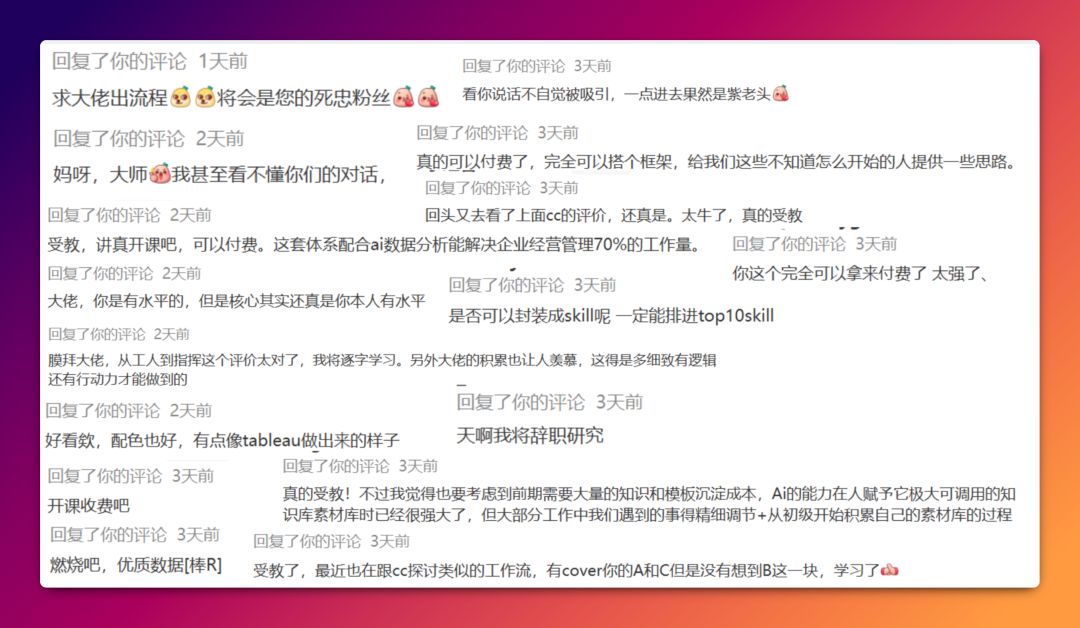
The same person and the same thing draw opposite assessments in different circles. This is not a question of who is right. It is that every judgement is anchored in a particular frame of reference. What you take for “everyone thinks so” may only be you and the circle you chose.
Back to MWS. Perhaps there really were fewer senior executives and owners from the large manufacturers in the hall this year — and the venue was still packed. Small companies, new brands, new products and people who have just entered the industry all want a platform where they can gather a lot of information through conversation; third-party businesses that need to meet many customers need a platform where they can reach a large pool of contacts in a short time. MWS does have a unique and irreplaceable value, and it holds a competitive advantage that will last a good while.
The same logic applies elsewhere. Some categories are already called a red ocean, and everyone says there is nothing left to do. Yet in a specific target market, in a specific vertical, there is still room to dig. Has our work really reached the point of complete homogeneity, where only price is left to compete on? Plainly not.
When the head of a small company tells me the product is too hard to sell now, I ask back: how many companies do you think are doing this well? And where do you feel confident you could do it better?
Everyone says the industry is full of amateur outfits. So with the same product, if we set out to be the team that is not an amateur outfit, would things not go rather better?
A clinic finds a product “priced high and hard to push”, yet in front of end consumers that same product may sit exactly where a segment happy to pay a premium for quality is waiting. Whose judgement is right? Both, and neither. They are standing in different circles, looking at the same thing.
Pull yourself out of the fixed angle and the fixed circle, and stop making judgements bounded by them.
How not to be part of the crowd
Diagnosing the problem is not hard; finding the path to improvement is. Given how widespread herd thinking is in this industry, what can we do to keep from falling into it?
Define the standard first, then give the verdict
Before saying “good” or “not good”, answer three questions first: from what angle are you assessing? Are you running a clinic, selling for an upstream manufacturer, or observing the industry independently? Different roles have completely different interests. A distributor saying a product “sells well” and a physician saying a product “works well” are two entirely different kinds of good. Being clear about your own position is the first step towards an honest judgement.
Trace the source, assess its reliability
That assessment you heard — who said it first? Might they hold a position? Is it based on data or on impression? Do the data and the information stand up to scrutiny? The gap between individual experience and systematic data is usually far wider than we imagine. Forwarding and agreeing without tracing the source is, in essence, free distribution for somebody else’s position.
Watch the trend, not the emotion
Even where a phenomenon is real, what trend does it point to? What does that trend mean for your own business? What direction can you take from it? Rather than wrestling with a binary verdict of works or does not work, spend the energy on: what does this mean, what does it have to do with me, what should I do? Emotion is a consumable; trends are an asset.
Make a habit of delayed judgement
When an industry take is flooding your feed, do not rush to pick a side — give yourself twenty-four hours. Come back once the emotion has ebbed and you will most likely find the take far less persuasive than it looked. Delayed judgement is not the absence of a view; it is the strongest possible expression of one, because you have chosen not to be governed by the crowd’s tempo.
None of these methods is complicated, and few people manage them, because they all point at the same thing: you have to resist being swept along by group emotion, admit that what you see may only be a part, and accept the uncomfortable answer that begins with “I am not sure”.
The noise in this industry is not going away, but the filter in your own head can be upgraded. Be the one who defines the standard before delivering the verdict, rather than the one the crowd’s emotion carries off. That may be the scarcest capability in medical aesthetics: not knowing more than everyone else, but keeping your own tempo of thought while everyone is talking at once.
Ideas cited in this article: Gustave Le Bon, The Crowd: A Study of the Popular Mind