Now that compliant products are being approved in volume, medical affairs is no longer a pure “scientific support” function. A strong medical affairs team should be a core engine of commercial growth. This piece works through the levels medical affairs operates at, and how to maximise market impact on a limited budget.
Introduction: redefining where medical affairs creates value
Competition between brands in this industry has long since moved beyond the product itself to the whole value chain. Medical affairs plays an increasingly important role in that contest — not only as the voice of a product’s scientific credibility, but as the critical link between the clinicians who sit inside the purchase decision and the commercial teams selling to them.
So how should the value model for medical affairs be constructed for it to genuinely drive growth? Let us work through it, starting with the levels the function operates at.
Level one: from “telling a story” to “telling the product’s medical story well”
The basic job of medical affairs is to tell a convincing product story.
That story has to be built on professional foundations and presented with internal logic to physicians, marketing, sales and even the end consumer. Whether the product can be explained clearly determines directly whether it can be sold.
Most medical affairs teams begin with the ingredient and performance profile. The core task at this stage is to build the product’s basic scientific support: working through the evidence on the same ingredient or comparable products to give your own product’s safety and efficacy a theoretical foundation.
But finding papers and packaging them is nowhere near enough. A competent medical affairs function should be able to do the following:
Build a multi-layered evidence base: clearly distinguish between, and appropriately use, materials-science research, animal data and human clinical results. Materials science establishes physicochemical properties and biocompatibility; animal data speaks to baseline safety and biological effect; human clinical trials are the final verification of both efficacy and safety.
Use levels of evidence properly: different types of evidence carry very different persuasive weight. Systematic reviews and meta-analyses sit at the top of the pyramid, followed by randomised controlled trials, then cohort studies, case-control studies and so on. Medical affairs has to pick the most persuasive type of evidence for the product and the communication objective at hand.
Distil the key message precisely: faced with a mountain of literature, extracting the most valuable core points and expressing them in language both physicians and consumers understand is what separates an excellent medical affairs team from an ordinary one.
Finding papers ≠ assembling raw material
A competent medical manager should at minimum be able to:
- clearly distinguish the hierarchical difference between materials science, animal studies and human clinical research;
- read and summarise the key data in English-language papers, rather than lifting a translated conclusion;
- extract the core arguments on safety versus efficacy and build a coherent case for trusting the product;
- map findings on a shared ingredient onto the brand’s own differentiated positioning, defensibly.
Medical affairs needs a systematic literature management process, a regularly updated evidence base, and a relatively objective and neutral scientific posture.
Level two: technical training is not about handing out certificates, it is about building clinical confidence
For products that depend on physician technique, hands-on training is effectively mandatory for every brand. The reality, though, is that most of these courses are going through the motions — the outcome is brand certification, not a genuine improvement in differentiated treatment knowledge and technique. Plenty of courses are all form and no substance: physicians turn up, the faculty presents, the company posts a video, sales follow up, and conversion is mediocre.
A course worth running has the following characteristics:
Protocols designed around the product’s actual properties: analyse the technical parameters in depth — the layer it works in, its duration of action, metabolic pathway and degradation time, and how the injection technique fits the underlying anatomy. Designing the treatment areas and protocols that genuinely suit those properties is the product’s real moat.
Playing to strengths, managing around weaknesses: there is no perfect product, only well-matched applications. A good course honestly presents both the advantages and the limitations, picks the indications and anatomical regions where the fit is strongest, and shows physicians how to maximise the advantages and avoid the risks in real practice. That is what produces word of mouth and repeat purchase.
Evidence-based treatment protocols: standardised workflows drawn from clinical data and expert experience, framed around how clinics actually operate, with tiered pathways for different customer types that help physicians improve their consultation and service. Protocols like this are not only predictable in outcome; they are also far more likely to build consensus among physicians, and to drive clinic operations more effectively through those physicians’ influence.
Systematic risk warning and management pathways: adverse events are not a taboo subject; they are where trust begins. Setting out the possible adverse event types, incidence rates and management approaches in detail does not reduce physician confidence in the product — it raises the brand’s professional standing. Provide standardised handling protocols for the common events so that physicians have something to follow when a problem arises, reducing panic and mismanagement. The clearer the management strategy, the stickier the physician relationship.
Clinical evidence for product upgrades: medical affairs is the bridge between the clinic and R&D. Systematic post-treatment follow-up gathers real-world safety data that informs the next generation of the product and the next generation of training.
Presenting a professional brand: medical training events are often executed by vendors the medical team brings in — some branded collateral, some video, a quick edit, post it, done. The result is a disconnect between how the event presents and what the brand actually stands for. The message a brand carries to the professional audience is necessarily different from the one it carries to the sales audience; keeping them distinct while keeping them aligned is a real test of cross-functional collaboration. Medical affairs has to work closely with brand marketing so that the tone and style of the follow-up communication are consistent.
Training pitfalls to avoid
- Over-optimistic product claims. Some manufacturers oversell performance in training in order to highlight results, physician expectations run too high, and real-world use lands with a thud.
- Chasing large doses. Recommending oversized doses to lift the value of a single sale ends in frequent adverse events and, ultimately, damage to the brand.
- Ignoring individual variation. Standardised protocols matter, but physicians also need to be taught how to adapt them to the specific patient in front of them.
Level three: from “physician volume” to “physician influence” — managing physicians as an asset
Many brands still assess a physician’s value by units used. It is an intuitive measure, but it is a single-dimension, short-sighted way to manage the relationship.
A physician’s value to a brand is multi-dimensional, and as the industry matures I would now recommend building the assessment framework on three core dimensions:
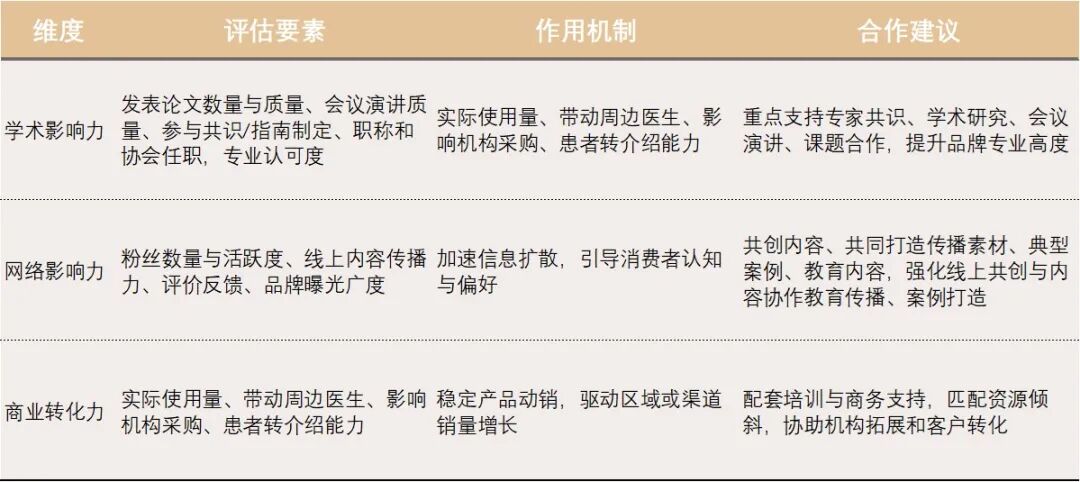
In practice, physicians should be managed in tiers. Build a more precise engagement strategy off a multi-dimensional assessment, adjust how much you invest in different physician types according to the product’s purchase decision chain, and design differentiated engagement pathways.
Level four: medical communication is not about appearances — measure the efficiency
The value of medical content lies not in its existence but in being seen.
Efficiency of distribution often matters more than the content itself.
Getting the most out of the budget
Medical affairs budgets tend to be limited, and choosing the right channels is a real challenge. It requires systematic analysis of what different approaches actually deliver:

*Table shown for illustration only; strategy and quality of execution change both the cost and the result dramatically.
Level five: team building — being good with a needle does not win the battle
Many brands assume, when building a medical affairs team, that the more practising aesthetic physicians they hire the more professional the team will be. In reality, a team that emphasises injection skill above all else ends up short on medical strategy. Unlike medical affairs in a traditional pharmaceutical company, medical affairs in this industry has to carry far more commercial responsibility — which demands not only scientific capability but sharp market instincts and strong communication.
A well-designed medical affairs organisation has clear division of labour and complementary strengths:
- Medical strategy: owns the product’s medical positioning, treatment pathway design and content narrative; works with senior management and across functions; shapes the whole picture.
- Medical content: strong on data interpretation, argument construction and writing; the armoury for frontline sales and marketing.
- Medical execution: clinically fluent and good at training; can deliver, can teach, works with sales and opens up channels.
Beyond that, the organisation can be split into central medical affairs and regional medical:
- Central team: strategic — owns expert relationships, content production and brand tone.
- Regional team: close to the market — responsible for execution, co-creation with physicians and local conversion.
Every medical affairs activity should have an explicit mechanism for assessing return:
Short-term measures: attendance, quality of engagement, immediate feedback.
Medium-term measures: change in physician usage, new customer development, movement in market share.
Long-term measures: improvement in brand awareness, expert endorsement secured, standing established in the field, clinical evidence accumulated.
Assessment across these layers lets medical affairs adjust course in time and ensure every unit of investment earns its maximum return.
In closing: from support function to engine of growth
A medical affairs function that genuinely enables sales does more than run training, tell stories and publish papers. More importantly, it:
- has clear strategic logic — it knows what it is doing and who it serves;
- has a professional division of labour — it does the work deeply and thoroughly, without standing aloof;
- is aligned with sales and marketing — it understands KPIs, talks in ROI, and executes to a plan.
Medical aesthetics is a fast industry, but medicine is slow work. Doing medical affairs well is how a brand actually puts down roots; using medical affairs well is how sales actually scales.
As competition intensifies, medical affairs is no longer a support function in the traditional sense; it should be a core engine of company growth. Making that transition requires breakthroughs in several areas:
A shift in mindset: from purely academic thinking to commercially aware academic thinking — retaining rigour while paying attention to commercial value.
An upgrade in capability: not only solid medical knowledge, but market insight, commercial analysis and project management.
Better working methods: systematic processes and assessment mechanisms; decisions driven by data, value verified by results.
New models of collaboration: closer, more efficient working relationships internally and externally, producing genuine synergy.
None of this happens overnight. It takes sustained learning, practice and refinement. But for a medical affairs team willing to take on the challenge and innovate, this is not only a chance to raise its own value — it is a chance to create real competitive advantage for the company.
Throughout, each medical affairs team needs to find the development path and strategic priorities that fit its own circumstances. In an industry still developing out of a certain amount of chaos, what suits you is what is best.