— Hit products landing cold, strategy going silent, and a function whose value is under challenge
The Fall and Rebuilding of the Upstream Marketing Department
Introduction: thinking through the winter
For many people working in this industry, 2025 has been a year of fire and ice at once:
Compared with the years when a registration certificate was a trump card, 2025 has brought a near-weekly drumbeat of Class III approvals across treatment categories and new materials. On the other side: shrinking end-consumer demand, clinic closures, less footfall and lower average tickets.
For the upstream brands still entering the industry, marketing — the function that acts as the strategic engine in healthcare and in multinationals — is stuck in many local companies as the events department, or the collateral department.
Against that backdrop, this piece asks: in today’s commercial environment, how does a marketing function survive? How does it break out? And how should it rebuild a value that cannot be replaced?
A downturn meets oversupply: new products launching into a cold room
Structurally, Chinese medical aesthetics is in a winter where a boom in registration certificates has collided with weak consumption:
Weak demand: discretionary spending has clearly traded down, and average treatment prices are broadly off 30–40%.
Supply keeps expanding: multinationals are widening their indications, domestic companies are accelerating, and capital and newcomers from other sectors keep entering the upstream. Competition intensifies.
Undifferentiated pricing strategy: multiple new products launch high without a clear differentiated position. The market hopes to replicate the fast success of past hits while ignoring the differences in the consumption environment, clinical performance, brand foundation and channel infrastructure.
Several products in this wave launched straight into a cold room. One brand fell below its official guide price within months of launch, with serious channel inventory. Another cycled through management teams shortly after launch and is facing a cash-flow break and a collapse in sales. Some have gone further and, because marketing spend did not return what was hoped, questioned their marketing people’s compliance.
Demand is weak, sales miss the number, and then: sales says marketing did not support them; clinics say marketing set the wrong prices; owners ask where the money went. Marketers — have you had that moment of not knowing what your role is?
One core reason sits behind all of it: there was no marketing strategy prepared before launch.
Many new products are brought in under the regulatory function, with the emphasis on law and compliance and little clinical understanding or market insight. The marketing team is usually “informed” only once the certificate is in hand — arrange the launch event, write the product film, put out posters, post on Xiaohongshu. By then, however you package or educate, the underlying logic is already congenitally short.
Functions dissolving, boundaries blurring: marketing is losing dimensions
Across the industry today, marketing is watching its remit get broken up and parcelled out:
Four ways the function gets weakened:
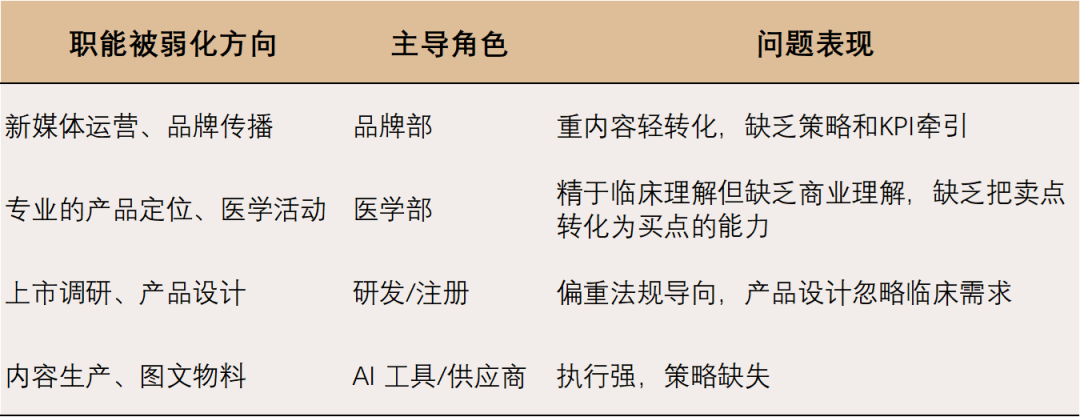
Take product design as an example
Before launch, plenty of products do this: borrow a luxury brand’s colour, drop the product into a carton weighing under 300g, and go. But who ever asked: what is our brand’s tone? How do clinics actually display product? Do the carton dimensions match the optimal depth and height of warehouse shelving? Do they match the planned promotional and baseline sales volumes? When KOLs and KOSs film short video, is the box visible, and is the syringe recognisable at a glance? In the physician’s hand, do the grip and size of the syringe, and the quality and gauge of the needle, match the product’s viscoelasticity? Does the overall design and packaging carry the brand message we want to convey?
These look like small questions, and they quietly shape sales and promotion after launch. The best moment to plan for them is during registration and packaging design.
Marketing being involved early is not a nice-to-have; it is participation in the underlying logic. Physicians and clinics read your attitude to the product in the details.
. A medical-aesthetics product has long since stopped being just a registration certificate. It is perceived value — and the competition over that value quietly begins with every pre-launch detail you take part in.
What marketing is actually for: not an executor, a connector
Back to first principles: marketing exists to be the hub between strategy and tactics — the middle-office engine connecting R&D, medical affairs, brand and sales.
A real marketing function carries these responsibilities:
- Product strategy designer: builds the differentiated proposition and coordinates the product portfolio.
- Content ecosystem builder: owns the content architecture for physicians, clinics and channels.
- Participant across the whole launch cycle: involved from pre-registration naming and packaging through product design.
- Sales enablement partner: provides selling tools, conversion narratives and training.
- Brand co-driver: co-builds the brand identity system and defines the value proposition.
- Medical translator: turns complex clinical language into something understandable and shareable.
On structure, for a mid-sized medical-aesthetics company the recommended marketing set-up is as follows:
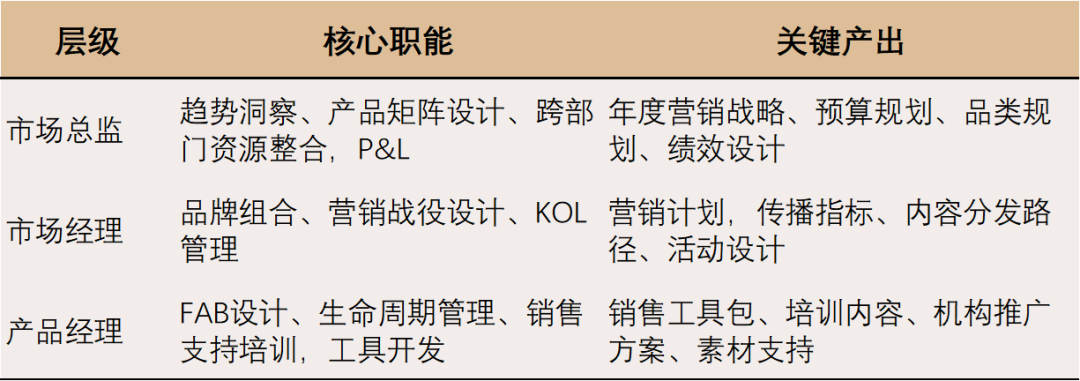
In reality, in this industry today, the vast majority of marketing departments have been reduced to transactional execution roles.
Brand and marketing: a division of labour, but above all a joint act of creation
The particular structure of this industry — facing clinics (physicians, consultants, operations, owners) while also shaping consumer perception (end consumers, aesthetic norms) — means brand was never simply design, and never simply an expression of the owner’s taste.
Brand is strategy, not a colour and a name someone happens to like. It determines whether a product can sell on value, and keep selling.
. Communication is not how many posters you put out, how many videos you made or how many brochures you printed. It is the impression and the reason to choose that you left in your target audience’s mind.
. Brand strategy has to answer three questions:
- Who am I?— the brand’s proposition, position and tone.
- Who am I speaking to?— who the target customer is and where the touchpoints are.
- How am I remembered?— differentiated output in identity, language and experience.
Building a genuinely valuable brand strategy is not a patchwork of design plus social. It needs experienced brand people leading it: market insight, understanding of the audience, communications planning and commercial judgement, able to drive the whole sequence positioning → content → design → communication and close the loop on brand value.
Whether something is 80% beautiful or 95% beautiful is a matter of taste, but sustained, stable, consistent brand output is what actually shapes customer perception and builds trust.
High-quality brand strategy rests on deep strategic analysis, visual identity systems, content asset development and channel management, and ultimately delivers three things to the business:
- It raises perceived product value
- It opens a gap on competitors
- It extends the product’s life
A well-built brand will not necessarily produce explosive growth immediately, but in an era of price grinding it will win the company a stable, durable, high-trust pool of customers.
Marketing × brand: the best collaboration is joint strategic ownership
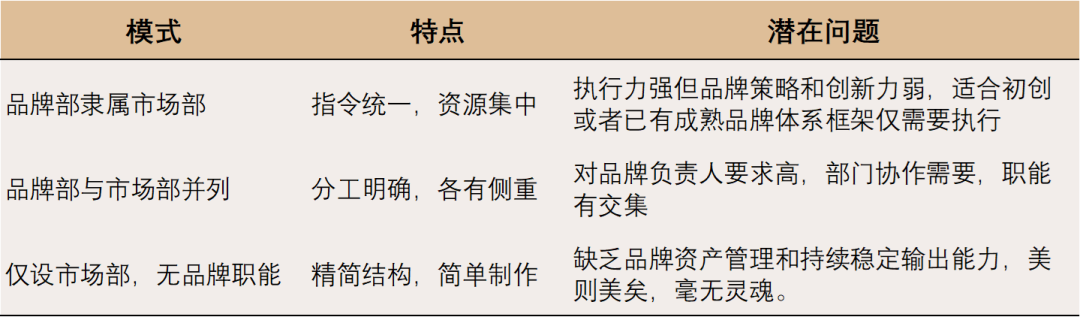
- Marketing: the middle office for product strategy and sales support — focused on setting strategy, on the conversion path and on enabling the front line.
- Brand: the custodian of identity and perception — manages brand assets and keeps the language and style of communication consistent.
Brand strategy worth the name starts from the product and works with marketing strategy so that each makes the other work.
The marketer in the age of AI: not using the tools, but commanding them
Rather than asking whether AI will replace marketers, ask who can create more professional value in the age of AI.
So far AI cannot substitute for professional industry experience and judgement. For a marketer’s individual capability it presents a great many tests and a great many openings. Right now AI is an amplifier, and what it amplifies is the judgement and strategic sense you already had — up to and including letting you assemble your own project team.
A few of the AI tools I use most and would recommend are in the table. New tools and developments arrive daily; going further, learn Python and explore open-source projects on GitHub.
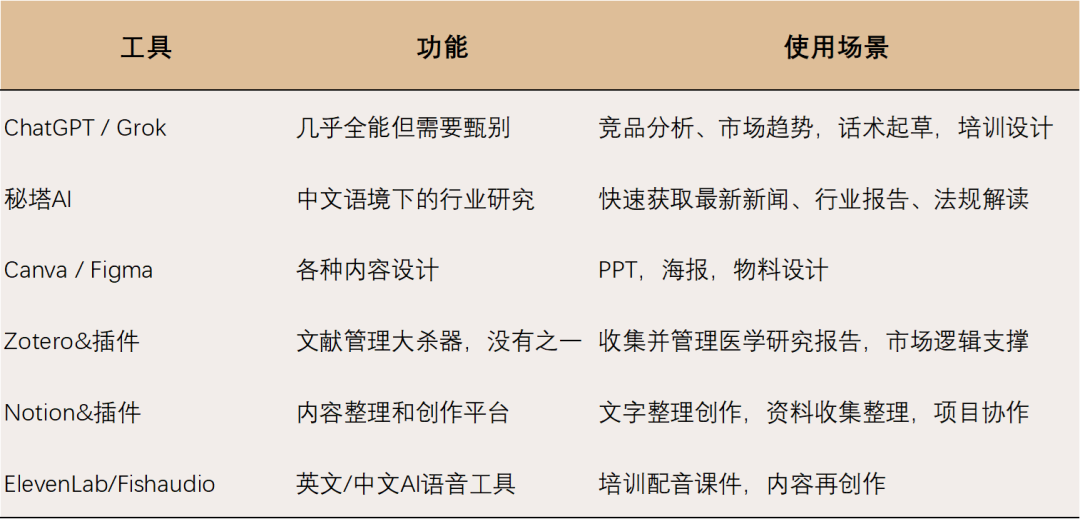
A marketer who keeps up and keeps learning is, in this era, both luminous and well buffered.
Rebuilding the value: how does a marketer break through?
To company decision-makers:
- Put strategic impact into marketing’s KPIs: judge the short-term posters, events and Xiaohongshu output on whether they fit the strategy and on their quality — but also look at market strategy, positioning, content architecture and lifecycle design, which are what make sales sustainable.
- Stand marketing up early, during R&D and registration: do not wait for the certificate to build a marketing team. Create a mechanism for early marketing involvement so the team is present from late clinical work through promotion. For a new product, start at least four to six months before launch. Marketing moves from supporting to leading.
- Build a collaborative structure: I would suggest three core units — market strategy, brand communications, and digital media support — connecting data with content and product with channel. Online and offline, B2B and B2C, cannot be fully separated; strategy and execution need a clean division of labour and good coordination. Staff the team according to the product’s business model, growth model and marketing budget.
To marketing practitioners:
- Don’t wait for budget and resources to arrive; learn to create possibility inside constraints.
- Understand the product deeply and build the reason to buy from the market’s side, converting the traditional FAB approach.
- Break through the translation wall between what physicians need and how the brand speaks.
- Get involved in designing the key business metrics: pricing, volume forecasting, supply-chain cost structure, purchase-decision-chain analysis; take part in thinking about the P&L and the structure of customer growth.
- Keep sharpening your commercial understanding and your ability to express it..
- Build your own AI toolkit: let the tools serve your thinking rather than replace it.
- Move from understanding content to understanding growth.
Is medical aesthetics marketing-led or sales-led? Or do we need a third answer?
In this industry today, sales-led and marketing-led are not either/or. They have to coexist and win together.
- First, it has to be acknowledged that sales-led is what keeps the company alive: it protects cash flow and takes channel positions. It suits the start-up phase, when grabbing resources quickly matters.
- Marketing-led emphasises building brand equity. It supports short-term sales, but it also thinks about long-term repeat purchase so the company can go further: seeking differentiation as competition matures, purchase decisions lengthen and products converge.
The third answer: joint drive, with strategy in the lead
Marketing as the steering wheel, sales as the accelerator — strategy first, tactics to win; medium and long horizons fused with short cycles; brand and volume weighted equally. That is how a company develops over the long run.
Compare overseas markets. Radiesse, Sculptra and many other classics have sold globally for more than 20 years; Restylane and Juvéderm have been in China for over ten. That comes from a steady strategic cadence, accumulated clinical evidence and strong brand influence. Many domestic products peak in one or two years, then the price collapses, volume stalls and no brand equity settles. The roots of it:
- an entirely sales-oriented tilt, with every marketing resource configured around collections;
- no medium- or long-term market strategy behind the product, so launch means loading the channel;
- no closed loop of product + brand + repeat-purchase ecosystem.
In closing: may every marketer refuse to be defined, and define instead
China’s medical-aesthetics industry is still young, but sooner or later it has to climb out of the price-war mud and onto the high ground of value competition.
Marketing’s real mission is to make the product seen, understood and trusted — to be the value hub connecting brand, physician, channel and consumer.
A real marketer is the translator of how an industry evolves, the sensor for shifting trends, the amplifier of a product’s value.
On this journey toward the light, may every marketer willing to explore and willing to connect be understood, be accepted, and in the end be treated gently by the world.
May the industry’s winter still find you warm and undaunted. Be the light you seek.