With so many products launching this year, the industry’s sales roles have cycled through almost a full rotation again.
Sales teams are generally seen as the people who carry a product’s value to market. Some salespeople I know have talked about what makes them move jobs — see “The Talent War in Medical Aesthetics: Salary and the Logic Beyond Salary”.
An effective bonus scheme is usually one of the most important tools for attracting sales talent and driving a team to hit, and beat, its numbers.
But a bonus scheme is far more than a commission percentage. It is a systematic expression of the company’s strategic intent, its culture and its philosophy of talent.
Bonus design works like a precision navigation instrument. It requires managers with deep insight into both the market and human nature, so that every step the team takes points toward the healthy development of the business.
Aligning incentives with strategy
Before designing an incentive system, put the numbers down and go back to strategy. If the company has not yet settled its business model or product positioning, any bonus scheme will simply accelerate the mistake.
Money is an amplifier. It amplifies a strategy that is right, and it amplifies one that is wrong.
An example. One new product chose a low-price distributor model, against a comparable product’s premium direct model. To attract sales talent quickly, the company adopted a bonus scheme barely different from the competitor’s.
In the short term the design did produce fast volume growth. But with comparable marketing investment, net profit stayed persistently low. Behind the lively numbers, nothing had actually settled into earnings. More to the point: once salespeople decide the return is disappointing they can leave quickly, while the company’s investments and commitments remain — and the pressure lands on the owner.
Plenty of companies in this industry copy a competitor’s bonus system wholesale. But if the incentive logic does not match the product’s positioning and the company’s business model, what it produces may not be growth. It may be a burden.
Product category and business model
The underlying logic of an incentive should be determined by how the product actually sells. This is the first step in prescribing for the actual condition:
In the compliant market, categories divide broadly by sales characteristics into high-value devices, high-value injectables and low-value consumables. Within each, the business model — direct, distributor or hybrid — changes what capability and experience a salesperson needs and where their value shows up. That translates directly into the weighting and proportion between behaviour-based and volume-based bonus.
Product lifecycle
The same product needs the emphasis of its incentive adjusted dynamically at different points in its life.
New product development (0–1)
Building market awareness and channel foundations quickly. Reward should be relatively high to encourage the team to break new ground, focused on new target-clinic accounts opened, first-order volume and share.
Mature maintenance (1–100)
Maintaining and extending the product’s life and serving existing customers stably. Weight toward a stable base salary and behaviour-oriented bonus, emphasising repeat purchase, price maintenance and channel health, with attention to margin and business quality.
The compensation mix: balancing security against explosive drive
When a salesperson weighs up a job, they look at the total package.
Broadly, within that package, base salary provides the security that supports long-term customer development; bonus provides the drive that fires ambition.
Within the common framework of per-unit commission, bonus design also uses tiered commission, fixed-rate commission and performance bonus pools.
Fixed-rate commission
A fixed percentage or fixed amount per unit sold. The simplest and most transparent approach, common for consumables where the business model is simple and gross margin is stable.
Tiered commission
Different tiers by sales value, with the commission rate rising as attainment rises. This drives salespeople toward higher targets.
Team bonus pool
A total bonus accrued at an agreed rate against the project’s gross profit, revenue or collections, then allocated internally. Suited to complex sales that require teamwork.
Wager-style commission
Usually an agreement between a start-up and its commercial lead. A stretch target is set, with an excess reward on achievement and part of the commission forfeited on a miss. It brings out a partner mentality at the top of the sales organisation, stabilises talent and pushes potential — but the risk is high.
The craft of the design: from numbers to behaviour
An excellent bonus scheme works like a precision instrument. It does not only compute a sales result; it calibrates day-to-day sales behaviour so that it stays aligned with the company’s long-term interests.
Differentiated measurement: matching function and level
The incentive system has to distinguish clearly between levels and management responsibility. The more senior the level, the greater the strategic and managerial weight in the bonus structure should be:
Frontline sales representative
The simplest and most direct structure, weighted heavily toward personal attainment and new-account development.
Sales supervisor / regional manager
Responsible for team management, territory planning and budget control. Their bonus should include personal attainment, total team attainment and control of selling costs.
Sales director / general manager
Their core value lies in strategic execution, developing people and building the market long term. Bonus design should consider annual profit-sharing and equity, with long-term measures such as team stability and the share of strategic new products.
Behaviour-oriented design: setting the invisible baton
While pursuing growth, a company also has to consider whether the numbers are healthy and sustainable. Those hard-to-quantify things behind the numbers can also be reinforced through bonus design.
Consecutive attainment bonus:
Designed to offset cyclical swings in salespeople’s behaviour. It rewards sustained, stable contribution, so the team hits its monthly or quarterly numbers smoothly.
Cross-functional collaboration bonus:
In this industry, professional support from medical affairs and marketing frequently creates commercial opportunity. If the sales bonus system reflects nothing of that collaboration, those teams’ motivation will suffer. Establish a team collaboration bonus or a professional enablement bonus, to encourage generosity and resource sharing.
Treat existing and incremental business differently:
To drive new products or new markets in a multi-product portfolio, raise the bonus weighting on strategic products. Where more new-market development is needed, adjust the commission rate on existing customers down and new-customer development up.
Deferred payment:
Defer part of the commission, or tie it to subsequent collections, binding the salesperson to the long-term interests of the business. This removes at source the risk of channel loading and bad debt created by chasing a number, and protects cash flow.
Bonus caps:
Set a ceiling per deal or per year, to avoid a single large order making the bonus unmanageable, while still encouraging sustained effort.
An example
Suppose a salesperson at one company is responsible for three products, and the company calculates bonus as (fixed role base bonus + behaviour bonus + consecutive attainment bonus) × weighted attainment rate, with an appropriate assessment method for each element.
A diversified design of this kind, built off the business model and strategic plan, puts the emphasis on the strategic quality of the numbers.
The same material — product C — is not a flagship at this company and so carries only 10% weighting; at another company a new product in the same material class might carry 100%.
Which means that confidence in, and the outlook for, that material in the regional market will shape a salesperson’s career choices.
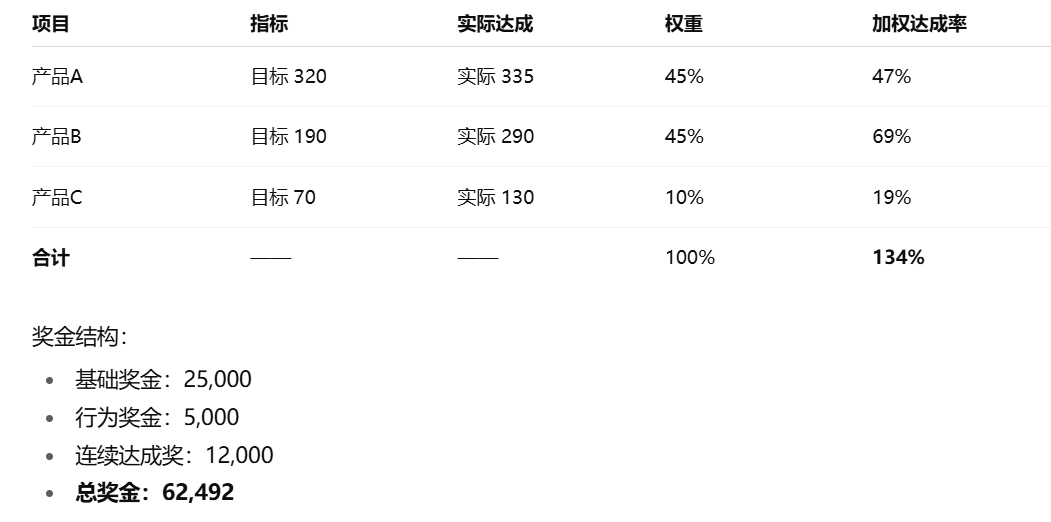
*This case is illustrative. Any resemblance is coincidental.
Beyond money: a manager’s warmth and trust
However perfect the bonus formula, without the three foundations of trust, fairness and growth it will not win salespeople over.
Beware lazy management: manage by outcome, not by hijacking the process
Plenty of upstream companies still run the traditional large-pharma management model: salespeople clock in daily, write daily reports, weekly reports, monthly plans, monthly summaries, and fill in assorted forms. Managers frequently argue that without all this they would have no grip on sales behaviour and no idea what people do all day.
In fact this is a fairly clear indication of managerial incapacity.
A medical-aesthetics sales team is not a traditional pharma team. It has a simpler hierarchy, mostly new products and new business, and breaking through depends on salespeople being flexible, mobile and fully committed, driven by incentives rather than paperwork. Spend too much of their energy on documents and you waste time and weaken the force at the front.
The healthier approach is for managers to be outcome-oriented and put their energy into field visits, enablement and solving real problems — rather than sitting in an office proving their own relevance through documents and reports.
This does not mean sales should run free. In reality the company’s own sample requests, event approvals, order system, marketing and medical activity processes, and the WeChat and Feishu groups all leave a substantial daily trail of sales behaviour.
A manager who uses these existing channels well can see progress clearly without extracting it a second time through excessive reporting.
If a company already has complete processes, systems and communication tools and managers still insist on daily paperwork from every salesperson, it is worth asking where the real problem lies.
Loyalty: the long view on incentives
Bonus is a hygiene factor. It removes dissatisfaction, but it does not create real commitment. When a competitor offers a higher and more achievable commission, a purely bonus-driven salesperson is easy to poach.
Real loyalty comes from motivators:
A clear career path: more than the bonus in front of them, core people value achievement, recognition, the challenge of the work itself, room to grow, promotion opportunities and responsibility.
Non-cash recognition: honours, care for the employee and their family, high-quality training, direct access to senior management. These often create far stronger emotional attachment and belonging than a bonus.
* Herzberg’s two-factor theory
Transparent communication: forging a sense of fairness
The thinking behind a bonus scheme can be complex, but the calculation itself must be simple and direct. It has to be communicated to the sales team clearly and concisely, and they should be taught to use the ready-made formula so they can work out their own bonus at any time.
When salespeople know exactly where they stand on their own earnings, they feel the scheme is fair and put their energy fully into the market.
“Pay is not the only motivator, but it is the touchstone of fairness.”
In closing: from an allocation mechanism to a shared enterprise
For most start-ups, the bonus plan may not need much thought: find a comparable product, ask what their bonus policy is, adjust for your own circumstances.
The question is whether those predecessors designed their bonus schemes well in the first place — and whether those who come after can do better. My view is that at this stage there is room to improve.
A sales bonus scheme ultimately tests the overall judgement of the company’s leadership. It is about more than how the money is split; it is about how authority is shared and how people are brought together.
A good bonus scheme is the most sincere invitation a company can extend to its people: an invitation to take part in creating and sharing the company’s value. It stops being a cold numbers game and becomes a powerful extension of culture and leadership.
When a company can build an incentive platform that is fair, transparent and deeply aligned with strategy, what it gets is not only strong performance but a group of people who see the company as a shared enterprise and will weather the storm with it.
Letting salespeople realise the company’s greatest value while pursuing their own — that is the highest form of bonus design.