On age, judgement, and a hard look in the mirror for managers in medical aesthetics
The nineties-born peers around me have replaced “boss” and “executive” with a sardonic vocabulary of their own. Meanwhile, on the industry’s main stage, the veterans born in the sixties and seventies still hold forth — bathed in the glow of past achievement, still cast as the protagonists.
And it is true. Plenty of the old guard hold on to their management posts, involved in every detail, doing everything themselves; some go back to the front line for a second venture, hoping to write another chapter of past glory.
Some say the old guard were the beneficiaries of the first wave of entrepreneurial dividend in medical aesthetics — the era has changed, the tailwind is gone, and traditional industry experience is now worthless. Others say the industry’s rapid development places new demands on a manager’s judgement and capability, and that the multinational-style rules, dogma and hollow management thinking carried over by the middle guard not only fail to keep pace but have become an obstacle to fast-growing private companies, and a lid on younger people’s room to grow.
Every time I take part in a conversation like this, I quietly wonder: do I already belong to the middle guard, being complained about behind my back? If someone used the term about me, honestly, I would probably fall silent and find nothing to say.
But what I want to do is not simply defend an age bracket. I am interested in opening the subject up — in seeing what industry anxiety and what management difficulty these labels are actually hiding.
What do “old guard” and “middle guard” actually mean?
Where the term came from
I looked it up. Lǎodēng comes from Northeastern dialect and originally meant an older man who behaves without dignity, with a colloquial, mocking edge. From last year the meaning suddenly expanded online, and the dialect slang became a term of cultural criticism.
After the Yu Minhong Antarctic open-letter episode in particular, the label came to point specifically at the figure of authority whose judgement has fallen behind and who lectures from a high position anyway.
The middle guard is a derivative coined online: people in their thirties and forties, between the old guard and the young ones who apply the junior version to themselves in self-mockery. They tend to describe themselves as having the looks of someone born in the seventies and the mindset of someone born after 2000. In practice they may hold neither.
Why did the word take off so suddenly?
The Yu Minhong episode was the marker. Last month, on New Oriental’s thirty-second anniversary, Yu Minhong sent an internal letter full of personal reflection from Antarctica. He stood before a glacier expounding on the meaning of perseverance while his staff sat at their desks watching renewal rates. “The boss is in Antarctica watching penguins; I’m in a rented flat watching KPIs.” That contrast detonated the feelings of working people instantly.
Some say the popularity of the term reflects Gen Z’s disenchantment with traditional authority. Young people no longer buy the narrative of grand promises, ideals and struggle. What they care about is: what does any of this have to do with me? Do you understand what I am going through?
The essence is not age but posture
Young people’s attitude reflects a broader social awakening: authority is no longer followed blindly.
And what I want to say is that whether someone belongs to the guard has little to do with biological age and everything to do with their posture towards knowing.
What does that posture look like?
- It is holding fast to past success while refusing to understand how the market has changed;
- it is the habit of broadcasting views one way, with no capacity to listen or to converse;
- it is occupying the resources and the airtime without creating real value for the team;
- it is using “I have crossed more bridges than you have walked roads” to suppress dissent, instead of earning respect through expertise and foresight.
I have met senior figures born in the sixties whose minds are utterly open: constantly learning about AI and new media, some studying for a master’s or doctorate in a subject they love, brainstorming alongside people born in the nineties. I have also met middle managers just past forty whose thinking has set like concrete, who open their mouths and say “the way I used to do it…”.
A few days ago, Harvard Business Review carried a piece noting that more and more consumer-sector CEOs spend an hour every day on Xiaohongshu, following the consumption trends of young people.
My question: today, with Xiaohongshu at the centre of medical-aesthetics marketing, how many chief executives of upstream companies spend time studying content trends there, or feeling out what clinics actually need?
So please do not draw the line by age. The real watershed is whether you are still evolving.
The industry’s own guard problem
The path dependence of the first-dividend generation
There is indeed a cohort of managers born in the sixties who were the beneficiaries of China’s first wave of medical-aesthetics entrepreneurship. In that era the market was growing fast, competitors were few, regulation was loose and information was asymmetric — get hold of a product, build a channel, and the numbers followed. Put bluntly: a pig standing where the wind blows hard enough to fly.
But the era has changed. The market has entered a phase of restructuring: products are heavily homogenised, the channel dividend is gone, consumers grow more rational, and compliance tightens. The old playbook — spin a story, lay the channel, load the stock, work the relationships — rarely works now.
The problem is that some managers have not registered this. They still guide today’s business with how they did it back then, without seeing that the success of that era was largely given by the era itself. The so-called experience and method came after the success, not because the methodology was in any way advanced.
The awkward middle layer of the seventies generation
Then there is the cohort born in the seventies. Most of them missed the entrepreneurial dividend and were instead shaped by the professional systems of multinationals or large pharmaceutical companies. They have a clear dependence on process, a strong sense of hierarchy, and a deep understanding of how to survive and be promoted inside a mature organisation.
That brings its own problem: some have been domesticated by professional process, forming an inertia that depends on the platform. Inside a large company they are competent middle managers; away from that platform they may lack both the nerve and the energy for a venture, and the hands-on experience and whole-picture view needed to run something independently.
More to the point, when dependence on process turns into worship of process, it becomes another version of the same problem — using what was learned on a mature platform to bound today’s organisation and today’s business, with no continuing self-improvement and no appetite for change. That is precisely the source of the younger generation’s misery at work.
What the guard problem looks like to younger people
From where the younger ones stand, their dissatisfaction tends to gather around a few points:
First, plenty of preaching, little practice. Fond of talking strategy, scale and vision in the meeting room, but short on support and resources once it comes to execution — and when something goes wrong, it is the subordinate’s fault.
Second, the information bubble. No idea what is happening on the front line, no idea what young consumers are thinking, no interest in the real conditions their team is in — and yet certain they understand everything.
Third, power first. More concerned with their own position and face than with actual business results. Wary of anyone more capable than they are, and in the habit of making compliance the first criterion for judging a subordinate.
Fourth, misplaced emotion. Posting inspirational thoughts while watching glaciers in Antarctica, without seeing a team working under heavy pressure. Consuming villas and luxury goods at home and therefore assuming an injectable priced over ten thousand yuan can casually sell hundreds of millions. That assumption of “I am moved, so you should be moved too”, the mindset of “I can afford it, so you should be able to afford it”, is no different from asking why the starving do not eat cake. It is ignorance and arrogance in one.
What should a good manager look like now?
Enough of the problems. Let us get to the constructive part: in a slowing economy and an industry shake-out, what qualities should a good owner or manager in medical aesthetics have?
The ability to keep updating your own judgement
This is the core of it. This industry grows fast and changes fast. Technology changes, policy changes, spending power and consumer awareness change, the competitive structure changes. If a manager’s understanding is still where it was three or five years ago — or ten — then every decision they make may be wrong.
What does updating your judgement mean? Not that you must scroll video feeds and Xiaohongshu daily (though that does help), but that you stay sensitive to industry trends, are willing to spend time understanding new things, admit what you do not know, and then actually go and learn it.
Real empathy
Not the official line of “I know you are all working hard”, but genuinely standing where your team stands, feeling their pressure and understanding what they are asking for.
I have even heard that plenty of owners in this industry habitually “educate” their teams like this: the economy is bad right now, and the fact that you have a job here is something you should be grateful for and treasure.
Set that against figures from the 2025 Work Trend Report: nearly 30% of employees doubt whether their manager considers their interests, 33% believe their career prospects are dim under their current manager, and 31% have left a job because they lacked trust in the leadership. Behind those numbers is the accumulated disappointment of countless individuals.
A good manager should be the team’s safety net, not its source of pressure. They give their people a visible path to grow, the confidence to disagree out loud, the confidence to point at problems, and support rather than blame when a mistake is made.
Digital literacy in the AI era
This one matters particularly. A manager does not need to be a technical expert, but does need to understand: what AI can and cannot do; how it will change our business processes; what new capabilities the team needs; which AI tools I myself should learn in order to make decisions faster.
When I studied at CEIBS, Professor Xin Rong asked us a question: what is the difference between leadership and management? Back at the school for a lecture recently, Professor Fang Yue added that a manager’s role is shifting from managing people to leading them — not only working alongside AI, but guiding a team to find its direction through technological change. A manager who knows nothing about AI and still directs the team’s digital transformation is, in himself, an illustration of judgement that has fallen behind.
The instinct and the ability to develop people
This is the point I feel most strongly about. One of the biggest pain points in medical aesthetics today is a structural shortage of talent.
Players have poured into the industry, all in too much of a hurry to monetise, and have neglected the development and accumulation of professional talent. At the same time, the people already here are not growing as fast as the market demands, which holds back the industry’s professionalisation.
A good company should treat developing people as one of its core responsibilities. Not hiring a few people to do the work and leaving it there, but building a talent bench: a clear path of growth for team members, so that good people want to stay, want to use what they can do, and want to take on more.
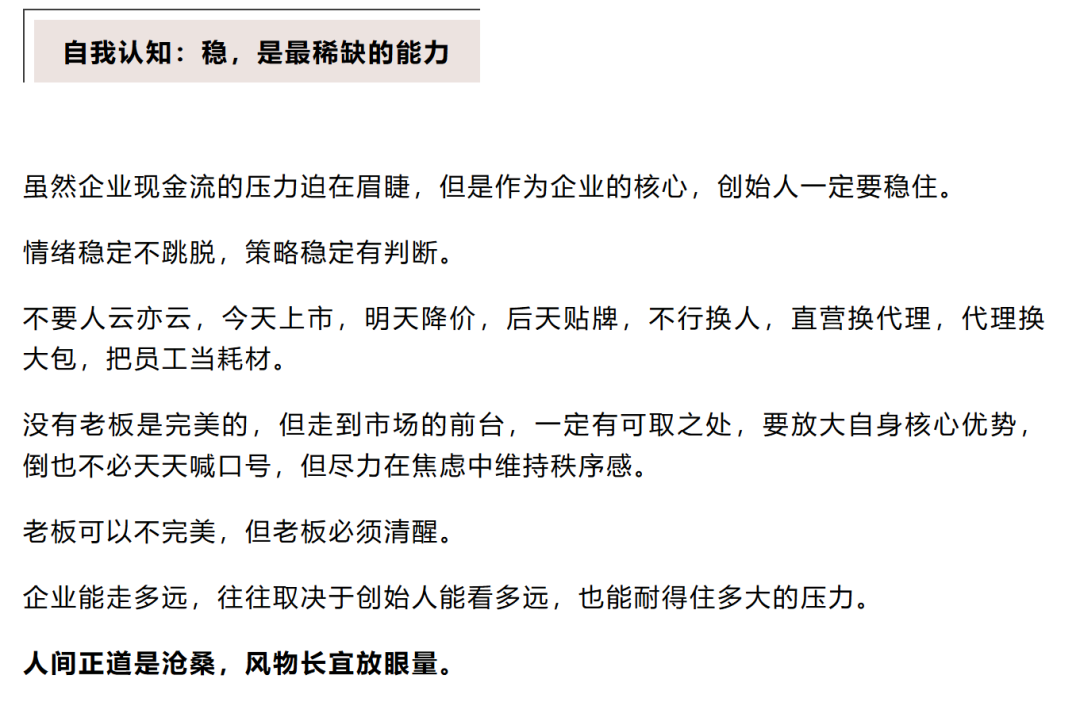
Strategic steadiness and resilient execution
In a downturn, what tests a manager is not the extra flourish added when the wind is behind you; it is strategic steadiness when the wind is in your face.
I wrote about this in an earlier piece, The Upstream Shake-Out: Not a Contest of Price but of Judgement — steadiness is the scarcest capability there is. I will not repeat it here.
A word to the younger ones
I understand what the younger generation in this industry is facing: rapid growth but no clear career path; no systematic training inside companies, so you feel your way alone; multinationals in upheaval and private companies wildly different from one another; the same job title carrying very different responsibilities and very different pay depending on the company.
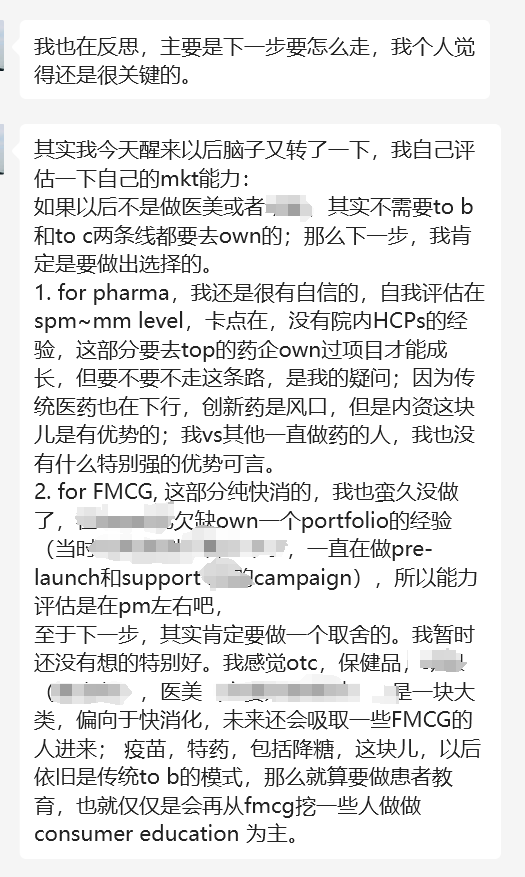
One person born in the nineties talked through their career plan with me, having laid out their capability model and their gaps with real seriousness, along with an analysis of fit across different tracks and roles.
I am glad to share what I think with people who take it seriously:
Take the long view
Do not look only at the skills your current role requires. Think about what this industry will look like in five or ten years. How will AI and LLMs change the way we work? Which capabilities will become scarcer and more valuable?
The talent this industry will need, I think, will not be the single-dimension specialist or pure empiricism, but people who can combine aesthetic judgement, product analysis, industry trends and AI application into an all-round player. Rather than grinding away inside one narrow track, widen the boundary of what you can do.
Build the ability to learn on your own
In an industry with no mature training system, the most important capability is self-teaching. Do not wait for a company to develop you — at this stage the industry genuinely cannot. Go and learn, read, try, and talk to people yourself.
Industry perspective, market analysis, competitor research, data visualisation, content creation, even filtering information — all of it directly affects how efficiently you work and how professional your output is.
Dig for differentiated opportunities
The global medical-aesthetics market is genuinely diverse. Look at markets overseas and you will find plenty of small and mid-sized companies cultivating even a very small technical difference with real care.
China’s market is going through a structural clear-out, which also means this: if you can find a differentiated niche, the opportunity is larger, not smaller.
Look back at today from the future
Consider: if you were running a business of your own one day, what kind of people would you need? What kind of person do you want to become? What does the business genuinely require?
Work backwards from there and it becomes much clearer what you should be studying now, and what capability you should be accumulating.
In closing: age is not the label — judgement and breadth are
Back to where we started.
I do not accept using age alone to decide who should retire and who should step aside.
The claim that circulated on social media recently about “youth” being redefined as eighteen to sixty-five has been confirmed as an online myth, one that served the anxiety or the wishful thinking of certain middle-aged groups.
From a management standpoint, there is no need to force people into an old guard or a middle guard by age. We should be looking at actual roles and actual contribution rather than falling into stereotypes.
What I do agree with is this: if a manager’s judgement has fallen behind the times, whether they were born in the sixties, seventies or eighties, they should ask themselves whether they are still right for the position.
This deserves attention from investors and founders too. Capital investing in medical aesthetics tends to focus on materials and technical patents, which of course matters. But what actually determines whether a company succeeds and survives the cycle is usually how fast the leader’s judgement updates, and how much room they have to grow. In an era of certificate grinding and shifting policy, the human factor decides a company’s ceiling more than any single product.
A company that means to last does not rely on one all-powerful figure. It relies on clear strategy, a sound organisation, a team that works together, and a manager who is deeply involved in the industry and keeps evolving.