I have realised I can no longer concentrate on reading for any length of time. To finish a few good books I ended up learning audiobook production and converting them to audio — and only just got through them that way.
All I do now is read in fragments
All I do now is read in fragments.
I subscribe to well over a hundred WeChat accounts, yet the writers I actually want to read keep “inexplicably” vanishing from the feed. Subscriptions used to be delivered chronologically: follow someone and you saw them. Open the list today and what you get is the system’s guess at your interests, ranked from your past reading behaviour. Anything “insufficiently mainstream” gradually disappears.
Over time the range of views you encounter narrows, your thinking hardens, and you start losing dimensions of your own informational world.
Subscribing no longer has anything to do with intent. The algorithm decides what you get to see.
We are trapped in a fragmented information world, force-fed short, fast, single-angle content. Every item looks “useful” or “interesting”, but think back at the end of the day and all that remains is a vague impression — no systematic understanding, let alone the kind of deep thinking that runs on real evidence and logic.
It is like snacking all day: by the time the proper meal arrives, you cannot eat. Keep it up long enough and you are malnourished.
Algorithms and walled gardens
WeChat blocks nearly every external search engine; none of its articles or videos are retrievable on Google, Bing or even Baidu. Xiaohongshu is the same — content circulates only inside the platform. Zhihu is comparatively open, at least insofar as external search engines can still index part of it.
Compare that with how it used to work. Search a topic on the internet and you saw independent blogs, academic journals, news sites and forum threads — sources that corroborated and contradicted one another, and together formed a reasonably complete picture.
China has over a billion internet users, yet Chinese-language content accounts for just 1.3% of the global internet, against 60% in English. It is not that Chinese creators produce little. It is that an enormous amount of high-quality Chinese content is locked inside the cocoons of closed platforms. Their anti-scraping defences are formidable, and from outside the wall that content simply does not exist — each platform busy building its own independent kingdom.
Taking back the initiative
Once I saw the problem clearly, I went back to RSS.
The change was immediate. Every day I receive everything I subscribe to, in full, with nothing lost. It is ordered by topic and time, so I can see how a story develops and how different sources relate to one another chronologically. No recommendation algorithm, no ad interruptions, no “picked for you” — only what I chose.
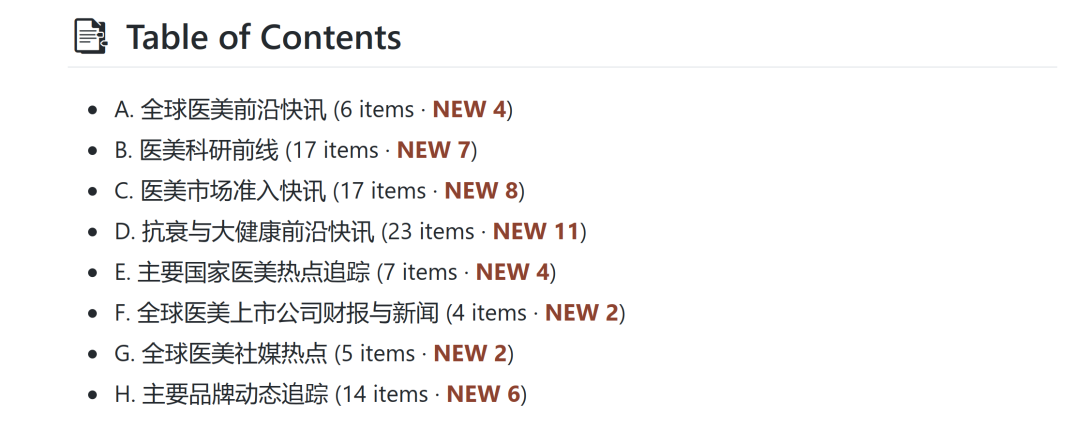
When I want to understand what is happening in a sector, I get genuinely varied sources: academic papers, industry reports, independent blogs, coverage from media in different countries. Different languages let me compare how the same question looks from different cultural vantage points.
The total volume of information I take in each day has gone down, but the share of it that is actually worth reading has gone up enormously. Instead of sifting through an endless recommendation stream, I spend that attention reading things I chose. I encounter more perspectives, see the same question presented from different angles, and have my sense of control over information back.
Chinese medical-aesthetics brands are “disappearing” from the open internet
Beyond the personal filter bubble sits a subtler problem: the invisibility of Chinese medical-aesthetics brands on the open internet.
On open platforms — whether through a search engine or an AI — you can find detailed technical specifications, clinical data, certifications and in-depth trade-press reviews for overseas brands, right down to physician discussion and FAQs on professional forums. Domestic brands are an entirely different story. Plenty of technically capable companies either have no findable website, or a site that stopped being updated long ago and reads like a display piece. What you do find is scattered press releases, trade-show notices and distributor marketing — very little authoritative, systematic product information.
Almost all information about domestic medical-aesthetics brands is concentrated on WeChat official accounts, WeChat Channels and Xiaohongshu. For the domestic market that may not be a problem yet — the industry and its consumers are, after all, currently on those platforms. But as search engines for professional information they are extremely partial, and the risk is significant:
The moment AI search displaces search on WeChat and Xiaohongshu, every piece of brand content published there was built for nothing. Change the platform’s rules and brand content cannot be preserved or moved. And when you want to enter international markets, to any prospective customer who does not use Chinese social media, your brand effectively does not exist.
Subtler still: in the age of AI search, that invisibility becomes a systematic disadvantage. More and more people get information and recommendations through AI tools. When someone asks for “a few product recommendations”, the AI answers from the open internet it can actually reach. If all your brand information lives on closed platforms like WeChat and Xiaohongshu, the AI cannot see you, and you will not appear on the list. Not because the product is not good enough — because in the AI’s picture of the world you are not there.
Which is precisely why a new service category has sprung up recently: GEO, generative engine optimisation — optimising brands and products for the results AI search engines produce.
At bottom, this is a failure to take information visibility seriously. Many brands pour resources into content marketing, livestreaming and KOL work on WeChat and Xiaohongshu. None of that is wrong. But if that is all you do, every egg is in a closed-platform basket. Change the platform rules or shift your audience’s habits and everything accumulated can go to zero overnight. Worse, you have missed the chance to build brand recognition on the open internet at all.
A two-track strategy
Individuals need to break out of the filter bubble. So do brands.
The two-track strategy is not complicated:
Use closed platforms for distribution and engagement; use open platforms for durable information and brand building.
Most of the effort goes into WeChat, Channels and Xiaohongshu. Those platforms genuinely deliver traffic and interaction — but traffic that arrives quickly leaves quickly, and it is entirely dependent on platform rules. Information accumulated on the open internet, by contrast, is a long-term asset. It does not vanish when an algorithm changes, and it does not go to zero overnight because of a ban.
More important is the shift in thinking: stop treating every platform as a traffic funnel and start distinguishing what each is for. Open platforms — your own website above all, plus professional platforms — should carry the most important and most authoritative information, addressed to the professionals, prospective customers, investors and journalists who need depth in order to decide. Social platforms are better suited to brand communication, audience interaction and content marketing. The ideal is that someone meets you on social, becomes interested, searches, finds your site, gets complete and professional information there, and completes the journey from awareness to trust.
Appetisers are not enough — brands still have to cook the main course
Filter bubbles are not unbreakable. Individuals and brands alike can choose a different path. It may take more effort and it may not pay off immediately, but over the long run it produces a healthier information diet, more independent thinking, and a truer picture of the brand.
The internet is open and interconnected by nature, not partitioned and closed. The current configuration of walls may be a phase, but it will not be the end state. As technology develops — and as AI spreads in particular — information that exists only on closed platforms will end up invisible to the wider internet. Rather than waiting passively for that shift, embrace openness and start building a presence on the open internet today.
Freedom of information starts with taking back the initiative.