Shanghai in late August, at IMCAS China.
I was struck by the scale of the Korean presence: more than a third of exhibitors were from Korea, and roughly three quarters of those were appearing in China for the first time.
On September 28, Korean media reported that Premier Partners, the private equity firm and majority owner of VAIM, had put the Juvelook maker up for sale. Premier had appointed Goldman Sachs as sale adviser in June. Juvelook had received its Chinese NMPA registration certificate only two months earlier, with Bloomage Biotech as general distributor.
From a Market to a Factory
We have long treated Korean medical aesthetics as a domestic market: its penetration rate, prices and techniques, clinics in Myeongdong and the aesthetic influence of the Korean Wave.
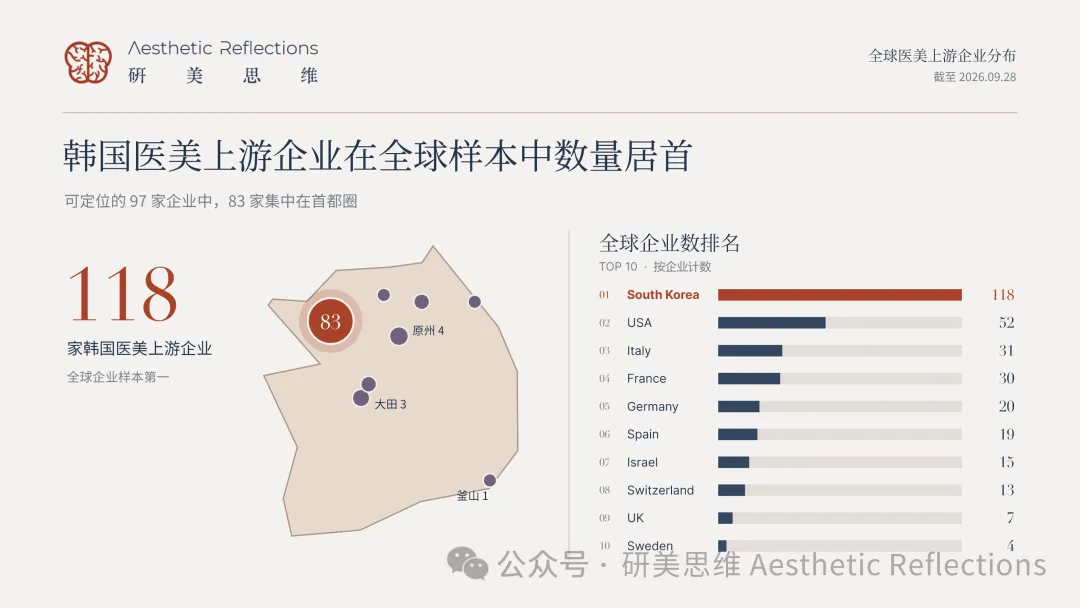
Over the past two years, I have increasingly seen a different role emerge. Korea is shifting from a destination for aesthetic treatments to a factory producing aesthetic products for global markets.
Look more closely at the news behind yesterday’s headline.
The deal involving Juvelook’s parent company is a business-school textbook case. In 2023, Premier acquired existing VAIM shares and convertible bonds for about KRW 80 billion (roughly USD 60 million), then raised its stake to around 90% through further purchases and an affiliate merger. VAIM’s annual revenue was just over KRW 10 billion at acquisition. As Juvelook sold strongly at home and abroad, revenue reached KRW 126.1 billion last year, with operating profit of KRW 80.3 billion and a margin above 60%. The market now values the company at around KRW 2 trillion, or approximately USD 1.5 billion.
In three years, VAIM’s current estimated value has risen to roughly 25 times Premier’s acquisition price. That would be a striking capital story in any industry.
There is another significant development. In the first half of this year, US pharmaceutical group Eli Lilly, through Lilly Ventures, approached Korean aesthetics companies including Hugel, Classys, Medytox and GC Wellbeing. Reports suggest it is considering joint development as well as equity investment.
One of the world’s most valuable pharmaceutical companies is looking beyond weight management to Korean medical aesthetics.
Capital Had Written the Script
VAIM alone might look like the story of one successful product. Put it alongside Korean aesthetics transactions from recent years, and a wider pattern emerges:
In 2022, Bain Capital acquired a 60.84% stake in Classys, a leader in radiofrequency and ultrasound devices, for about KRW 670 billion. It later acquired another device maker, Ilooda.
In 2023, Korean private equity firm Hahn & Company acquired laser device maker Lutronic for about KRW 970 billion. The following year, it also bought the established US aesthetics device company Cynosure.
In 2024, European healthcare private equity firm Archimed acquired Jeisys Medical for about KRW 1.08 trillion.
In 2025, VIG Partners launched a tender offer at KRW 12,500 per share, acquired more than 95% of aesthetic device maker Viol, and took it private from South Korea’s KOSDAQ market.
The private equity playbook is direct: acquire, reorganise, expand abroad or buy adjacent companies, increase scale and valuation, then sell.
Upstream aesthetics companies are naturally suited to this playbook: product strength and access to multiple markets translate into revenue and valuation.
That is quite a way for investors to recoup their capital.
Bain Capital did not rush to sell Classys outright. In 2024 and 2025, it carried out two recapitalisations, recovering more than KRW 550 billion through block trades. Together with dividends, this returned a substantial part of its initial investment. In September 2024, CVC invested KRW 200 billion in redeemable convertible preferred shares of PharmaResearch, the maker of Rejuran, for an approximately 10% stake. A year later, a recapitalisation of roughly KRW 190 billion returned most of its principal early without reducing its shareholding.
In the first half of this year, private equity firms were the sellers in 20 Korean acquisitions; in 11 of those deals, the buyers were also private equity firms. The transactions totalled KRW 2.06 trillion. One Korean investor said that private equity’s investment cycle in domestic medical aesthetics is “entering its next phase”. Ownership may pass from strategic operators through successive rounds of private equity.
Lee Byung-gun, a special adviser to Flagship Pioneering in Korea, takes a more positive view. He argues that partnerships, investment and acquisitions by global groups can help Korean companies expand abroad. Korea’s venture capital and M&A markets remain small beside those of major economies, he says, and need more activity.
China Became a Key Supporting Player in Korea’s Capital Story
Few markets escape intense competition in China. Domestic injectable prices have continued to fall, while clinics and distributors seek differentiation. For many Chinese buyers, ‘imported’ still commands a premium.
LG Chem’s YVOIRE long held a position in China’s mid market. Now many Korean brands are seeking Chinese distribution partners and rapidly building channels at several levels. Demand from China helps support the output of Korea’s aesthetics producers.
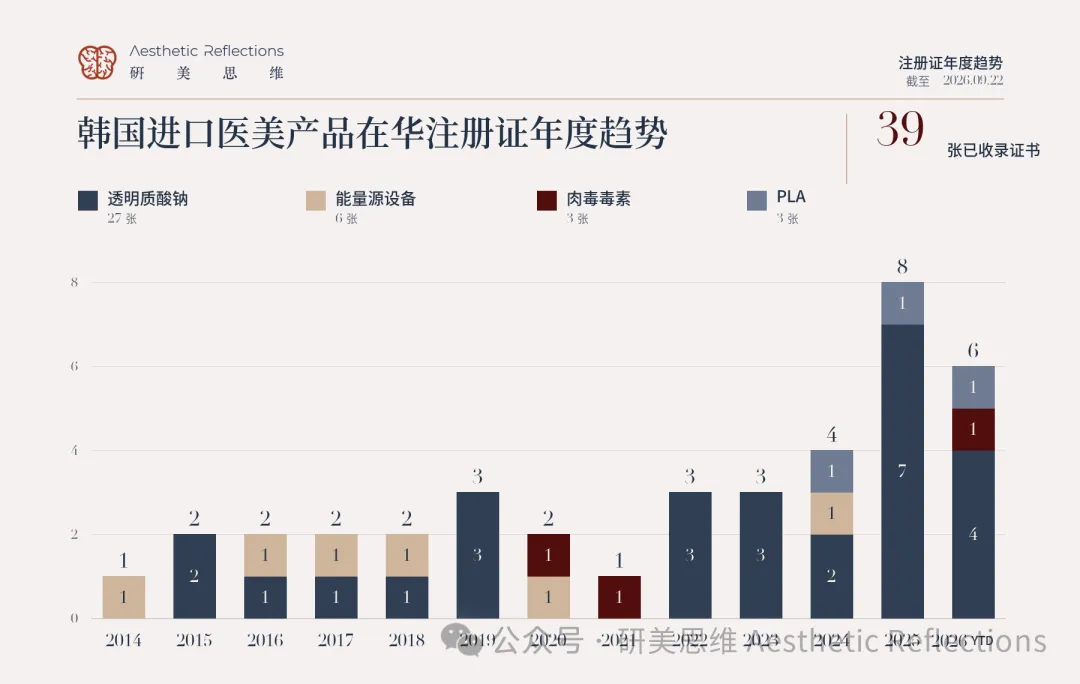
Chinese sales then support Korean companies’ valuations, drawing in capital and making subsequent exits and transfers easier.
Hugel, a leading Korean botulinum toxin maker, illustrates the pattern. Its main shareholder is an international private equity consortium, and the company is expanding in the US, China and Brazil. Growth in its core business and the valuation it achieves will shape the consortium’s eventual exit.
Each step leads to the next. In a sense, Korean companies have used the fierce competition in China to lift their valuations.
Capital flows follow their own logic. But Chinese practitioners who play a major part in this story should ask what value remains with them.
Three Calculations Beneath the Hype
First calculation: cost.
An old Chinese saying observes that a citrus fruit changes character when grown on the other side of a river. A product’s cost structure changes too when it crosses a border.
These products can be inexpensive in Korea. VAIM’s operating margin of more than 60% suggests manufacturing cost is not the chief constraint. In China, Class III medical device registration, clinical work and the capital required for approval add to import duties and successive channel markups. The price at the clinic looks very different.
Second calculation: the price anchor.
I remember the trajectory of Korean cosmetics in China.
More than a decade ago, Korean cosmetics were hugely popular in China. Following the THAAD dispute in 2017, visits by Chinese tourists to Korea fell sharply; Amorepacific reported a 10% decline in revenue and a 32.4% fall in operating profit that year. Domestic Chinese beauty brands then rose. In the first three quarters of 2024, Amorepacific’s Greater China sales fell year on year for three consecutive quarters. Laneige adjusted its offline presence, while Sulwhasoo and Innisfree also faced pressure. North America’s share of its overseas business rose from 5.5% in 2021 to 20.5% in 2023.
Chinese consumers have often seen Korean cosmetics as effective, fashionable and good value, but rarely as true luxury or premium products. As China cooled, Korean brands turned westward.
That perception may carry over to Korean aesthetics products. They can sell in volume, but may struggle to command prices on a par with European and US brands. Those brands’ premiums rest on decades of clinical evidence and physician education, which a new entrant cannot reproduce through rapid distribution alone.
Third calculation: distance.
Travel between China and Korea can be short enough for an aesthetics procedure and a same-day return.
According to the Korea Health Industry Development Institute, South Korea received 2.01 million visits by foreign patients in 2025, up 71.9% year on year. Chinese patients accounted for 618,000 visits, or 30.8%, making China the largest source market; 459,000 Chinese patients visited dermatology departments.
That trend is still growing. Kim Kardashian’s visit to a Seoul dermatology clinic last month circulated widely on social media. Providers are organising aesthetic services specifically for foreign visitors.
If a Korean product is priced too high in China, consumers have another option: fly to Seoul for treatment over a weekend and shop in Myeongdong while they are there.
That is awkward for a Chinese distributor that has paid for registration and market education. The pricing ceiling is visible: it may build the brand in China, only for customers to buy the treatment in Korea.
Scarcity Is Never a Moat
The recent experience of China’s aesthetics materials market illustrates the point.
A category can move from one pioneering product to more than a dozen approvals, with more awaiting certificates. In China, prices at the point of treatment have fallen from five figures to promotions at around RMB 1,000 in some channels. The familiar price war follows.
Korean advisers see the risk too. Boram Lee, a partner at EY-Parthenon who has advised on financial due diligence for Korean aesthetics deals including VAIM and Viol, recently said her team is particularly wary of K-beauty companies that depend heavily on a single fashionable ingredient or product. Trends change quickly, and today’s strong performance may not last.
Even Korean investment advisers are wary of relying on a single blockbuster. We have every reason to be careful.
Looking ahead: if ten Korean regenerative injectables and twenty Korean hyaluronic acid products enter China at once, how much scarcity will the “imported” label still confer?
The price war will not disappear; Korean products will join domestic ones in it.
Who Really Wins?
Korean products give Chinese consumers more choice and push domestic companies to improve quality and design, engage with fashion, and explore new products and materials. That is a positive development.
But where, ultimately, does the value created by this boom end up?
Brands and intellectual property remain in Korea. Valuation gains and exit proceeds accrue to Korean companies and the global investors behind them. Much of the registration cost, market education and channel risk stays in China.
Many Korean producers are already private equity acquisitions and may change hands again within a few years, even from one fund to another. The distributor agreement signed today could soon be with a company under new ownership. Who benefits from the brand recognition built in China?
I do not believe Chinese product technology is inferior to Korea’s. In some new materials and regenerative medicine, Chinese companies may already be ahead.
Why, then, should we settle for being a distribution channel and the Korean aesthetics factory’s largest overseas market?
A Note to Industry Partners
If you are considering distributing a Korean product, do not confer an automatic halo on its country of origin. Calculate the registration period, the length of exclusivity, ownership of brand assets, what happens to the contract if ownership changes, and whether exit terms are balanced. Above all, ask who the shareholders are and how long they intend to stay.
As the Book of Changes puts it: when circumstances reach their limit, change follows; change opens a path; what can adapt endures.
Competition in Chinese medical aesthetics has reached a breaking point. Change should mean more than bringing in another batch of imports to compete on the same terms. Within this global division of labour, we must decide whether to let capital cast us as supporting players, or to tell our own story.