Every medical-aesthetics company has its own hand to play.
Some enter the market with a single product, perhaps in an emerging category, but increasingly face competition from similar offerings.
Four companies now have a portfolio spanning hyaluronic acid fillers, regenerative materials and botulinum toxin. That looks like a strong hand. Can you name them?
A position in several mainstream categories is a product portfolio many companies work hard to build. Yet more cards do not necessarily make a business easier to run. At budget time, that advantage can become a welcome dilemma.
Mature products face intensifying competition but still need visibility. Newly launched products need market education, often within restrictions on promoting controlled medicines. The fastest growing line may be the core business, where further gains are still possible. Each has a claim on resources.
Every product line needs investment, but the total budget is finite. Saying “they all matter” does little to help decide.
Some companies have leading products in several major categories and marketing budgets of tens of millions of yuan. They have changed management teams repeatedly, yet performance remains unremarkable.
Others have only one materials line. Through competition, setbacks and careful spending, they have remained leaders; some now rival major multinational companies in their vision and teams.
These cases raise three questions: with a small budget, how do you concentrate spending where it matters? With many products, how do you avoid duplicating investment? With ample funds, how do you avoid spending in place of thinking?
Whether you hold a single card or a winning hand, a marketing budget should begin with one question: which short, medium and long term problems must it solve, and to what end?
First, Define the Marketing Budget
I have found that companies define “marketing budget” very differently.
In financial statements, selling expenses broadly include costs incurred in the sales process, including marketing staff pay and bonuses and routine business expenses. Those costs may sit across Marketing, Medical Affairs, Brand, Regional Marketing and Sales.
In practice, however, many upstream aesthetics companies use ‘annual marketing budget’ to mean the funds for marketing department events, media placements and materials.
Whichever definition a company uses, it needs to think through the budget before assigning numbers.
Does the boss set a figure for departments to divide among themselves? Or does someone first forecast sales, allocate targets, then build a plan around the objectives, problems and reasonable spending range, bringing departmental action plans together?
Which tasks belong to Marketing, and which require help from other teams? The marketing lead may not control every resource, but these dependencies should be explicit.
Otherwise, teams may spend the whole budget in the first half and run over it in the second. Departments may define marketing expenses differently and reserve funds or headcount without being able to explain what they will do with them.
Ask about a cost and it is called a ‘business expense’. Ask for details and you may be told it is outside your remit.
Who prevents duplicate spending on the same customer? Who brings together ROI for a shared objective, manages synergies across product lines, and owns the short, medium and long term business goals?
Tens of Millions or RMB 3 Million: What Should Come First?
I have encountered several companies whose entire annual spending plans amount to RMB 3–5 million.
By the standards of the market’s boom years, this would not even cover a lavish launch event. In today’s difficult conditions, however, it may be the most many companies can commit before reaching profitability.
A new product needs market entry and industry credibility. Doctors must understand and accept it, clinics must be willing to buy it, and sales teams need tools and customer support. Consumer awareness and objections may need attention too. Each need feels urgent.
A tight budget makes the choice of spending more exacting. Judge each expense against a specific task, rather than copying what other companies do.
In an established category, a company might try to match leading brands, cover regions nationwide, win use in many clinics and build consumer awareness at once. A small budget would quickly be spread thin. After a year of trade shows and scattered local events, it may have secured no market at all. A broad plan can consume the budget without solving the underlying problem.
A better question is whether the company can first establish a full path from initial adoption to repeat purchasing within one type of clinic or in a region its team can serve well.
Which customers respond well to the product, and what do they share? Why do they buy and use it? Do they reorder? Which conditions can be replicated, and which depend on a particular channel, doctor or clinic?
Those answers give the company a basis for deciding where to concentrate. Scaling down a national plan by a fixed percentage does not identify the right market.
The calculation may show that even a narrower plan costs more than RMB 3 million. If so, make the gap visible and discuss more resources, a lower target or more time. Showing that a target is unattainable under current conditions is part of budgeting; a team should not have to deliver the results first to earn the investment needed to produce them.
A company with hyaluronic acid fillers, botulinum toxin and regenerative injectables must define an annual objective for each line.
If an older hyaluronic acid line is underperforming while competitors keep launching products, should this year’s task be to defend its position, grow volume or improve customer quality and returns? For a newly launched botulinum toxin, are positioning and pricing clear? Which competitors and markets should it address: public or private clinics, broad rollout or a first test in one clinic segment? For a strong regenerative line facing closer competition, should the company ignore the threat, rely on organic demand to maintain sales, or use its brand strength to expand effective reach?

The company’s focus on current profits, cash recovery, or future business fundamentals will affect these choices. The time to market and strategic position of the product can help to judge, but it cannot directly be the reason for the distribution ratio.
‘Selling well’ needs a benchmark. Exceeding headquarters’ targets or ranking highly within the group is different from capturing the opportunity in China. A product can meet its internal goal and still have room to win customers from competitors.
Work Back from Sales to Stakeholders, Objectives and Actions
“I want to sell more” is an attractive wish. The hard part is explaining where growth will come from.
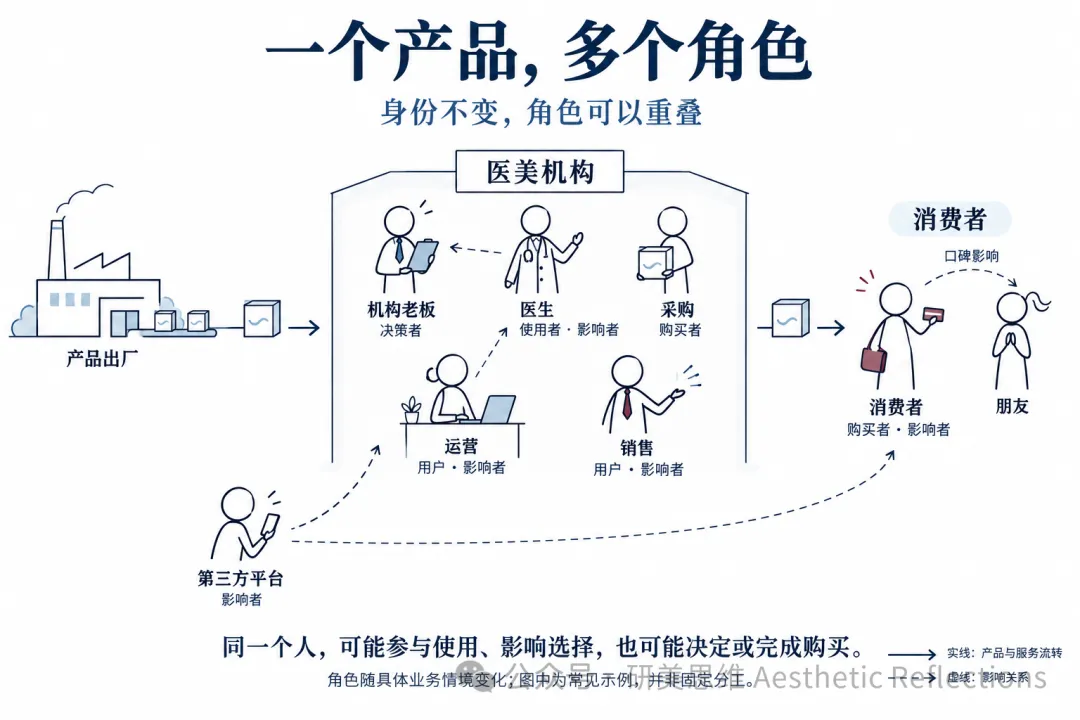
Sales figures are outcomes. A budget must identify where the business is getting stuck and what action could change that.
That is why business objectives need to be broken down by stakeholder: identify who affects each step and why they have not taken the next action.
A specific budget request should, at a minimum, state what kind of customer barriers are being addressed, who is being targeted for what actions, and what changes are being observed in what timeframe.
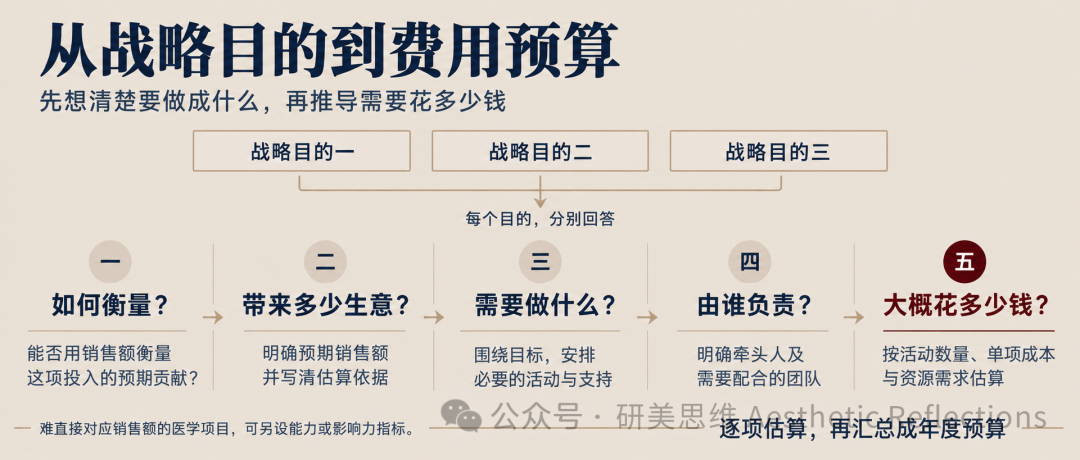
When There Is More Money, Ask Why More Often
At the other end of the industry are well funded new entrants on whom high expectations rest.
A company new to medical aesthetics may build an elaborate training centre and a premium CBD office, hire people from leading companies at top market salaries, then stage a lavish launch. Yet its target clinics and consumers, product positioning, treatment offering, pricing and stepwise market entry may remain undefined.
Training, experienced people and launch activities can each be valuable. The question is whether they suit the company’s stage, whether the scale of spending has a sound basis and whether it can be sustained.
How many doctors will the training centre serve? Who will design its courses, and will the current portfolio generate enough demand? How much of a highly paid sales leader’s past performance depended on the former employer’s brand, products and support? How will that experience translate here? After the launch, who will handle clinic trials, purchasing and follow up service?
Can the company carry those operating costs until it reaches a sustainable margin?
Even with ample resources, managers should reject spending without a business case. These choices create lasting costs that are hard to reverse. A company cannot simply hire with fanfare and dismiss people when plans change; stability in this industry requires respect from employers and employees alike. Work through the commitments and costs before making them.
An Annual Budget Need Not Be Fixed Entirely in January
Not every investment should be reduced to a short term ROI. Customer service, medical capability and brand building work on different timescales, but each needs an objective, a rationale and a way to observe progress. Difficulty with immediate attribution does not remove the need to explain the investment.
An annual budget also needs a release schedule. Necessary operating costs can be relatively stable; expansion supported by evidence should reflect the organisation’s capacity to deliver; exploratory spending should increase or stop as results emerge, with regular review.
A marketing lead who controls only department spending should name the other teams and owners needed in the plan. If those conditions are not in place after approval, or the work is not carried out on schedule, the expected results must change too.
A useful budget therefore records more than amounts: each line’s annual task, current obstacles and evidence, stakeholders, actions, owners, supporting resources, expected changes, and the conditions for adding or stopping investment. That connects spending to business judgement.
Limited resources can still leave room for ingenuity, but sales targets also require a realistic level of market investment. Marketing leaders and executives must distinguish which constraint they face and how much room remains to adjust. Lavish spending deserves scrutiny too: can the company sustain it, and will it stand up to later review?
The value of marketing should be visible in these choices.