As everyone knows, plenty of upstream medical-aesthetics companies require daily, weekly and monthly reports from every employee, on top of sell-through, sales performance and marketing spend. Every day seems to be about product, cost, channel, clinics and hitting the number. Add a simple chart deck at intervals and a summary, and on the surface it looks like data analysis. In practice, much of the time it is just looking at whether a number went up or down.
Introduction
There are a lot of start-ups in this industry. From a standing start, experienced salespeople and distributors can often open things up quickly, and a marketing team can generate content and heat with a few lively events. But once the business reaches a certain scale, the team structure gets complicated and the channel network extends, a great deal of uncertainty starts to surface.
In the run-up to a product launch in particular — even with no internal history to draw on — you still need analysis built on industry trends, the economic environment and competitor sales, to give commercial strategy something to stand on.
A lot of the time we merely have data. We never actually use it.
Data is another way of speaking the language of the business — a beacon that shows a company where to go. Leaving it as empty cells in a spreadsheet is a genuine waste.
Multinational medical companies: building competitive advantage with data
Anyone who has worked in a multinational’s marketing or SFE (sales force effectiveness) team will recognise the pattern: to make business reviews and commercial decisions more accurate, the company builds a multi-dimensional dashboard that can generate tailored reports for sales and marketing. Today some of the leading players even use AI agents to support alerting and decision-making.
Adequate budget is a major advantage in itself. It buys continuous market research, competitor monitoring, customer behaviour analysis and price-sensitivity testing. There is no such thing as perfect data, but a data-driven culture and logic keeps strategy consistent and gives it direction.
▍ Before launch: data in service of strategic decisions
- Market size and potential assessment
- Competitor matrix: price, function, proposition, lifecycle, channel structure
- Key customer analysis: clinic, physician and consumer profiles, stakeholder influence
▍ After launch: data in service of operational optimisation
- Sales tracking: funnel conversion, volume mix, progress against target
- Customer base monitoring: share of new customers, repeat rate, average purchase cycle, churn alerts
- Product performance: SKU sell-through, bundle structure and combination preferences
- ROI on events and education: conversion analysis for activity
The company has only just started — what is there to analyse?
The reality of this industry is that most medical-aesthetics brands are still early. Systems are incomplete, data collection is rudimentary, and budgets do not stretch to research or expensive software. But that also forces attention back onto the fundamentals.
▍Step one: work the public information
- Medical-aesthetics industry research reports
- Competitor financial statements and disclosures
- Authoritative trade media and professional communities
- Consumption trend data from the National Bureau of Statistics and consulting firms
▍ Step two: build a simple but sound data structure
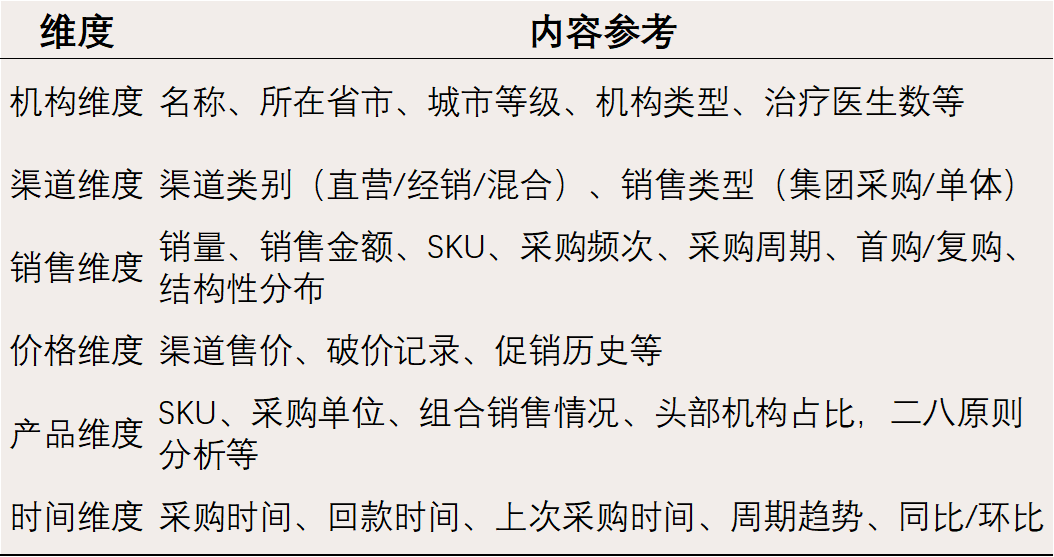
You do not need many dimensions of analysis, but they have to be real. Garbage in, garbage out is the founding principle of all data work.
“Plenty of news” vs “very little analysis” in medical aesthetics today
Compared with chronic-disease medicine, medical aesthetics is awash with information. More than ten research reports are published every year, covering market structure, consumer insight, technology trends and investment activity.
But it is worth understanding that:
- Many reports lack sample transparency, or lean too heavily on capital-markets logic in their extrapolations
- Metrics such as CAGR, new-material penetration and online conversion often chase whatever is fashionable rather than examining the underlying “ structure”
- Selective presentation and logical leaps are common problems in predictive conclusions
▍Example: the growth “discontinuity” in regenerative injectables
Published this June, the 2024 ISAPS survey puts PLLA and CaHA at 5.1% of global injectable procedures.
Yet a domestic regenerative anti-ageing injectables report published in July projects that by 2028 China’s regenerative injectables — the 3P1C group — will account for 16.43% of the injectables market.
Does that mean acceptance of regenerative materials in China will run far ahead of mature global markets? Or is it a structural bubble driven by capital and a marketing carnival?
As a brand you should listen to both the domestic and international readings, and stay objective and cautious in the face of a projection with that much spread:
- Look at the development path of mature overseas markets
- Accommodate competitors and grow the market healthily together
- Factor in your own product’s characteristics and treatment curve
- Understand deeply how the purchase decision is made and how market demand is shifting
Rational, comprehensive analysis helps you judge the market: whether it suits us, when to enter, and how to prepare.
Worked examples: the real questions behind the data
▍ A bubble chart exposes clinic-level sales risk
In one project I built a bubble chart across sales data from over a thousand clinics, plotting clinic volume × clinic potential × city tier. It immediately surfaced clinics whose purchase volumes were far out of line with their ability to sell. (Illustration is simulated and contains no company or product information.)

▍ Top-clinic distribution reveals differences in product strategy
Two regenerative injectables: one has a high concentration of top customers, clustered in leading channel clinics; the other has a broader customer distribution, a higher repeat rate and sits mainly with direct-account clinics. That difference reveals two distinct strategies for market selection and go-to-market. How their revenue distributes and how their growth curves behave gives different types of company something concrete to think about.
▍ National data as an aid to industry judgement
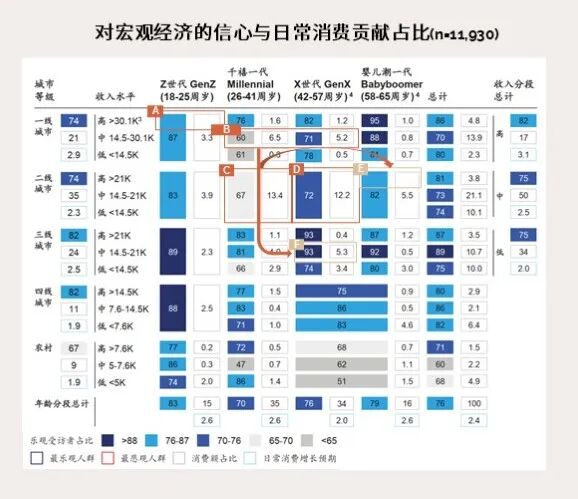
Working through the 2024 consumer-confidence data published jointly by the McKinsey Global Institute and the National Bureau of Statistics, a structured reading showed that tier-two cities have overtaken tier-one on both spending volume and willingness to spend, with a strong correlation to the age structure of household spending. It also let me identify the five population segments with the greatest spending power and appetite — a considerable steer for how our industry chooses its markets.
Where is the gap, and how do you build a feel for data?
Against a multinational we may lack systems, budget and tooling. The bigger gap is whether we believe data can help the business grow at all.
Not everyone needs to become a data analyst. A change as small as building one funnel chart or one scatter plot may turn up the clue to the next source of growth.
Data will not hand you the right answer, and it is not there to make you 100% certain. It is there so that inside the 80% that stays fuzzy, you make one fewer wrong move. It tells you: that direction may deserve a second look.
Suggested tools and reading:
- Visualisation: Excel pivot tables, think-cell
- Frameworks: Porter’s Five Forces, PEST, STP + 4P, customer value chain analysis
- Reading: Competitive Strategy